

Quick Inquiry
| Trip code | ABC0013 |
| Duration | 13 days |
| Max. elevation | 4130 m |
| Level | Easy |
| Transportation | Private car/ Tourist Bus |
| Accomodation |
|
| Starts at | KATHMANDU |
| Ends at | KATHMANDU |
| Trip route | Kathmandu-Pokhara-Ghorepani-Chhumrung-ABC-Pokhara-Kathmandu |
| Cost | USD 735 per person |
OVERVIEW
The Annapurna Base Camp Trek, most times just called ABC Trek, is a super famous trek in Nepal. It's not crazy hard, and it takes you right into the Annapurna Sanctuary. Imagine this huge bowl made of glaciers with giant mountains, some over 23,000 feet high, all around you.
Now, some people say the Manaslu Circuit is becoming the new Annapurna because it's way out there and not many people go there. But the Annapurna Base Camp trek? It gives you amazing views of the Annapurna mountains up close. You'll walk through cool villages where the Gurung people live, see forests full of bright rhododendron flowers, and when you get to the base camp at 13,550 feet, it feels so good. Plus, it's not as isolated or scary as some other high-up treks.
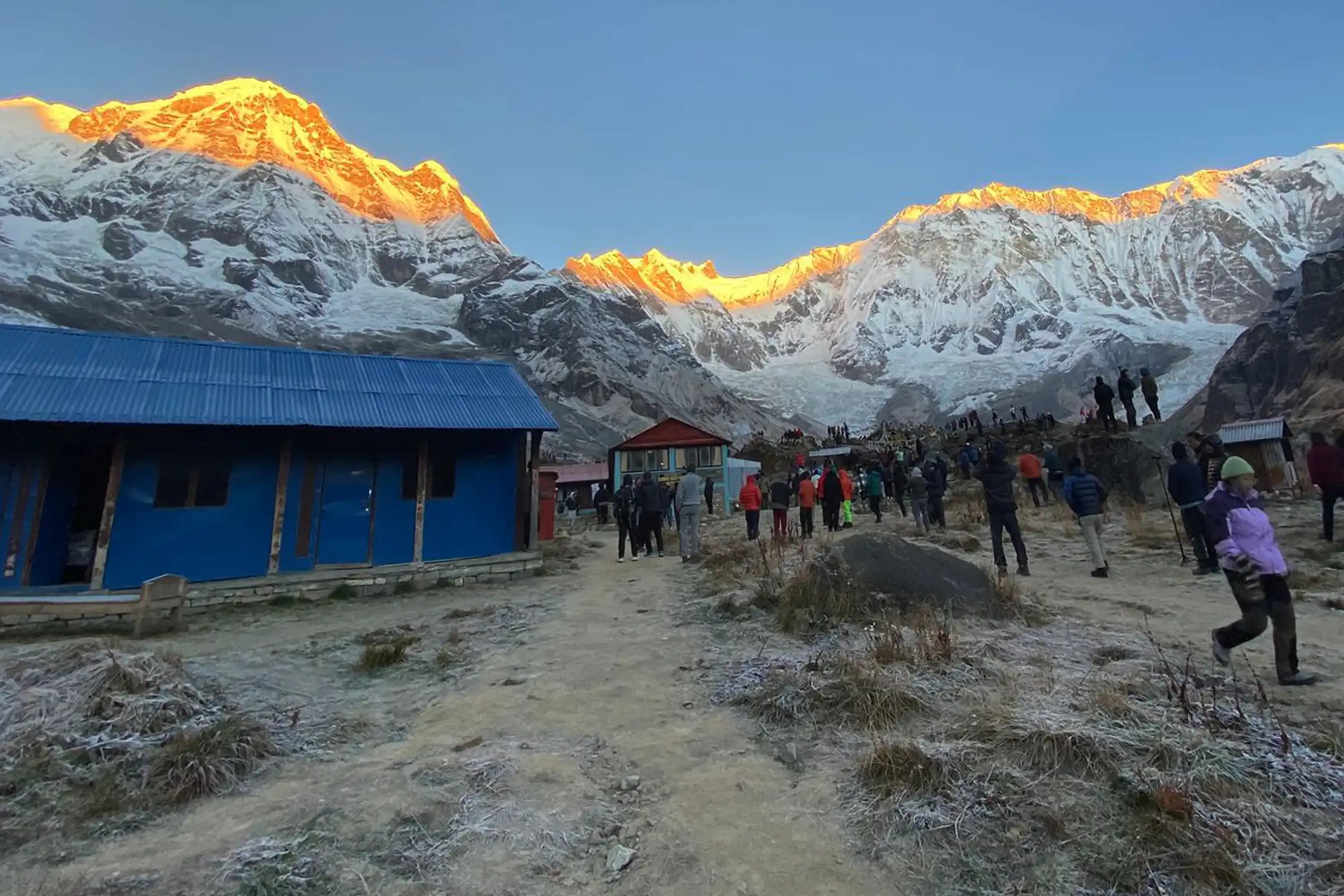
One thing everyone talks about is watching the sunrise over the Annapurna mountains from Poon Hill. It's a classic picture-perfect moment on the way to base camp.
The trail is awesome because it changes so much. You start in warm lowlands with rice fields and trails next to the river. Then you go up into thick forests with rhododendrons everywhere. Spring is the coolest time because they're all blooming. You pass houses made of stone, walk past villages, and then, boom, you're in this wild, snowy place where the huge Annapurna mountains are encircling you. You’ll see Annapurna I, which is super tall (over 26,000 feet), Annapurna South, the Fishtail mountain (Machhapuchhre), and Hiunchuli. There a lot of tea houses, which are like a mix of a hotel and cafe, where you can stay along the way. Lots of these places have hot showers and Wi-Fi, at least in the lower areas. This makes the trek easier than going way out into the wilderness, but you still feel like you're seeing something truly amazing.
This trek will make you work those legs with all the uphill walking and stone steps, but it's totally worth it. The Gurung and Magar people who live there are welcoming, there are hot springs to chill in after a long day and the feeling when you finally reach the base camp, surrounded by those massive mountains, is something you'll never forget. If you want to see the Himalayas, check out different scenery, and feel like you've achieved something great without having to be all alone in the middle of nowhere or deal with a ton of permits, this trek is perfect. For people who want beautiful views, easy access and iconic scenery, Annapurna Base Camp is one of the best treks you can do where you stay in tea houses the whole time.
The Annapurna Base Camp Trek usually takes about 7–12 days, but most people do it in 9–11. You'll walk around 68–71 miles total, depending on where you start and if you take some side trips. It starts pretty low, around 3,000–5,000 feet near Nayapul, and goes up to 13,550 feet at ABC. You don't have to cross any super high passes, but you still need to be careful because of the altitude. The trail is mostly the same way up and down, so it’s not a loop, especially when you get higher up. People say it's medium-hard to hard because you're going up and down hills every day and climbing lots of stone steps. However, if you're in decent shape and get ready for it, even beginners can complete this trek.
You don't need a special permit to go into a restricted area. You just need the Annapurna Conservation Area Permit (ACAP) and a TIMS card. It’s a good idea to hire guides, however it is not necessary. This is one of the most popular treks in Nepal, so you'll see other people on the trail, especially during the busy times of year.
Most people begin with a short drive from Pokhara to Nayapul. Then, you walk along rivers and through villages and rice fields to Tikhedhunga or Ulleri. The first few days are hot and humid. You'll cross bridges that swing in the air and climb thousands of stone steps. The Ulleri steps are notorious. There are more than 3,000 of them! You will see lots of local life: porters carrying heavy loads, mules, kids waving, and the Fishtail mountain popping up in the distance.
Ghorepani, at 9,383 feet, is a key stop. From here, you can hike up to Poon Hill early in the morning to see one of the most sought-after sunrises in Nepal. When the sun comes up, it lights up Dhaulagiri, Annapurna South, Fishtail, and all the other mountains. Then, you head down to Tadapani through forests of rhododendron and oak trees. The air is cooler here, the mornings are misty, and you get your first real views of the mountains.
Chomrong, which sits at 7,119 feet, is a Gurung village with stone houses and views of the valley. This is the beginning of the upper trail. The trail gets narrower and follows the Modi Khola river upstream through bamboo forests and past waterfalls. Sinuwa and Bamboo are small settlements where you can stay in tea houses surrounded by forests. Then, when you get to Himalaya and Deurali, it starts to feel more like the mountains. There are fewer trees, the nights are colder, and the snowy peaks are closer. The ground turns into rocky terrain that was deposited by glaciers, and you can sometimes hear avalanches rumbling.
Annapurna Base Camp stands at 13,550 feet. It’s like stepping into another world. You're in a flat, bowl-shaped area surrounded by tall walls of ice and rock. You'll see Annapurna I's south face, Hiunchuli, Gangapurna, and many more mountains. Usually, the skies are clear blue or filled with dramatic clouds. The tea houses here are simple, but comfy. Spend the night, or just have lunch, and take it all in before you head back down. Being surrounded by those mountains is a powerful experience.
The way back is usually the same trail you came up, but it feels easier because you're going downhill. A lot of people take a side trip to Jhinu Danda to relax in the natural hot springs. It's great for soothing sore muscles in hot pools next to the river. You can also go through Ghandruk, which is another scenic Gurung village with museums and places to stay. Then, keep going to Nayapul or go on to other trails. The lower parts of the trail are green and full of life again, and you end up back in Pokhara.
Cool Things About This Trek :
The Annapurna Base Camp (ABC) Trek takes you through a bunch of really different places, from warm, green lowlands to super high, snowy mountains. Each spot has its own vibe, its own height above sea level, and its own culture. They all play a part in This amazing adventure. Here's a rundown of the places you'll hit on the classic route, the one that goes via Ghorepani/Poon Hill (everyone wants that sunrise view!) and then down to Chomrong and up the Modi Khola river to ABC. Keep in mind that the elevations are rough guesses, based on maps and guides. The descriptions try to capture what makes each place special.
This is where most people kick off their trek. It's a hectic little village right by the Modi Khola river. You'll probably get dropped off here after a 1.5–2 hour drive from Pokhara. It's not usually a place to sleep, but it's the practical starting line. Jeeps unload people, porters wait for work, and you'll see fields stretching up the hills. It's a lively spot, with riverside paths, little tea shops, and your first peeks at the green hills that lead into the mountains.
After walking easy for 4–5 hours from Nayapul, you will get to this quiet village on the river. The paths are stone, winding past waterfalls and swinging bridges. It's a relaxing place to spend your first night, with comfy teahouses, banana trees, and views of the valley. It's a good place to chill before the tough climbs start.
Ulleri is known for its killer staircase – over 3,000 steps! – going up from Tikhedhunga. It's a big Gurung village on a hillside, with stone houses, small stores, and amazing views down the valley. It's full of life, with local families, kids playing, and porters taking a break. You can feel the change from the gentle riverside to the steeper hills here. The air starts to feel fresher too.
This is a bigger spot, tucked away in thick forests. It's home to Gurung and Magar people. The main path is lined with teahouses, often with fireplaces and sometimes even cultural dances in the evenings. It feels like a real mountain town – cool nights, foggy mornings, and the first great views of the mountains popping out through the trees.
Okay, this isn't a village, but it's the famous viewpoint you reach by climbing for a bit before dawn from Ghorepani (45–60 minutes). There's a platform on top with prayer flags, and it has one of the best sunrises in Nepal. You get a full view of Dhaulagiri, Annapurna South, Hiunchuli, Machhapuchhre (Fishtail), Nilgiri, and more, all glowing pink and gold. It gets crowded, but it's awesome. A lot of people say it's the best part of the trek.
After coming down from Ghorepani/Poon Hill through foggy forests (5–6 hours), you'll reach this village on a ridge. The views of Annapurna South and Hiunchuli are amazing and super close. It's quiet and pretty, with stone houses in the middle of the woods. It feels like a peaceful mountain getaway, with cooler air and fewer people than the places lower down.
Gateway Villages (Gurung Culture and Entering)
This is the biggest and most important Gurung village on the route. People call it the gateway to the Annapurna Sanctuary. It's built on a steep hillside with cool stone steps, fields (including bananas lower down), and stone houses. You get awesome views of Annapurna South, Hiunchuli, and Machhapuchhre. The teahouses have bakeries, stores, and places to check your permits. It's full of life, with women weaving and kids wearing school uniforms. It's a key spot to rest and get used to the altitude before the trail gets narrower.
This is a smaller, quieter place after you walk down steeply from Chomrong (tons of steps again) and then climb back up. It's surrounded by bamboo and forests, with fewer places to stay, but the ones they have are cozy. The air feels like you're in the mountains, and the views start opening up to the peaks. It’s less crowded here. It’s a peaceful spot where the trail starts following the Modi Khola river more closely.
These places get their names from the thick bamboo forests (you might see monkeys swinging around!). The path follows the loud Modi Khola river through foggy areas, waterfalls, and places where landslides happen. The teahouses are basic but welcoming, just simple wooden places surrounded by green. Dovan is a short walk past Bamboo. Both feel enclosed and have a cool vibe, with the constant sound of the water and the first hints of the cold that comes with higher altitude.
Upper Sanctuary Places (Mountains to Glaciers)
This is a small, rocky stop in a narrow valley. It's the last place that feels like a village before you get into serious mountain terrain. There's not much growing here, just rocky hills, and the teahouses are all bunched together. This is an important spot because you have views of Machhapuchhre and Gangapurna. The air is thin, and the nights are cold. People often feel the altitude here, so it’s a good idea to take it easy.
This is a tiny place between Deurali and the higher parts. Sometimes people skip it or combine it with other stops. There are basic places to stay among rocky paths. It's not as important, but it's part of the climb into the mountains.
This is the last village before ABC. It’s a group of teahouses in a flat, icy area below Machhapuchhre (Fishtail). You get awesome, close-up views of Machhapuchhre's south side, Annapurna South, and Hiunchuli. It's high up and exposed, and there might be snow or ice. A lot of people spend the night here to see the sunrise, or they keep going to ABC. It's a quiet and amazing place, and you can sometimes hear avalanches rumbling from the mountains.
This is it – the end of the line! It's a huge, flat, icy bowl completely surrounded by giant peaks. Annapurna I dominates everything, along with Annapurna South, Hiunchuli, Gangapurna, Annapurna III, and Machhapuchhre. There are basic teahouses (stone and wood with shared rooms) among the ice and snow. It's not really a village, more like a seasonal base camp. It's often windy and cold but the mountain views are incredible. A lot of people get here for lunch, look around, and then start heading back down. Others stay overnight to see the sunrise and sunset.
Descent/Return Places (Hot Springs here!)
This is a popular detour on the way down. There are natural hot springs next to the Modi Khola river, with steaming pools (some public, some private). You're surrounded by forests and the sound of the river. It's a great reward to soak your sore muscles in the warm water after days of hiking at high altitude. There are teahouses nearby, so it makes for a relaxing place to spend the night.
This is a pretty Gurung village on a lot of the routes back. It has stone houses, museums, and cultural homestays. You'll see fields, monasteries, and great views of Annapurna South and Machhapuchhre. It's one of the biggest traditional Gurung places, full of local crafts, friendly people, and a sense of community. It's often the last cool cultural thing you'll experience before heading back to Nayapul/Pokhara.
These places are the key parts of the trek. Each one builds on the last to create a change from normal life to high-mountain remoteness and back again. The beauty of the route is how the scenery changes so much but still feels linked by the Modi Khola river and the mountains around you.
1. When to Go: Picking the Perfect Season
When you go makes a HUGE difference. The best times are spring (March to May) and autumn (September to November).
2. Permits: What You Need to Get
You need two main permits to trek in the Annapurna area.
So, all in, you're looking at around USD 40–50 for permits. Unlike some other treks in Nepal, like Manaslu, there aren't any special restricted area rules for Annapurna.
3. Travel Insurance: Don't Leave Home Without It
Seriously, do not skip this. Travel insurance is a must, and a lot of trekking agencies will actually require it. It needs to cover a few key things:
Altitude sickness, falls on those never-ending stone steps, or bad weather can all mean you need to be evacuated. Insurance policies usually cost around USD 50–300 for 2–3 weeks, depending on how much coverage you get. Get your insurance from a company that specializes in adventure travel.
4. How Much Will it Cost? Trip Budget
A standard 9–12 day ABC trek will probably cost you somewhere between USD 600 and USD 1,500 per person. It depends on your trekking style:
Remember, those prices include permits, food, accommodation, and the services of guides and porters. They don't include your international flights or any personal spending money.
5. Daily Costs on the Trail:
Expect to spend around USD 25–50 a day for food and a place to sleep.
6. Guides and Porters: Should You Hire Them?
Guides are highly recommended. Yes, you can trek without one, but a guide makes the trek safer and more enjoyable. They help you:
Plus, you're supporting local Nepali people. Porters carry your heavy bag, so all you have to carry is a small daypack. Trekking agencies will make sure you get experienced and insured staff. Trekking on your own is an option, but it’s riskier if the weather turns bad or if you get altitude sickness. If you join a small group (2–6 people), you can share the cost of a guide and porter.
7. Altitude Sickness: Know the Risks
ABC is at 4,130 meters (13,550 feet), so altitude sickness is a real possibility. Symptoms include:
Symptoms start to show around 3,000 meters. The risk is lower than at Everest Base Camp, but you still need to be careful. Here's how:
Some people take Diamox (acetazolamide) to help prevent altitude sickness. If you start to feel really bad, go down immediately. Many agencies carry pulse oximeters to check your oxygen levels.
8. Get in Shape: How to Prepare Physically
The trek involves long days (5–8 hours) and lots of up and down, especially on stone steps. So, being in good shape helps a lot. Start training a few months before your trip:
Even if you're not a super experienced hiker, you can do this trek if you take it slow and give yourself extra days to get used to the altitude (like spending an extra night in Chomrong). You don't need any special climbing skills, but your knees might hurt from all the downhill walking, so use trekking poles.
9. What to Pack: The Essentials
Try to pack light (10–12 kg if you're using a porter). Here's what you need:
You can rent sleeping bags, down jackets, and trekking poles in Kathmandu or Pokhara if you don't want to bring your own. Teahouses provide blankets, but you might want to bring your own for comfort.
10. Health and Safety: Tips for a Smooth Trek
11. Staying Connected: Wi-Fi and Charging
You can find Wi-Fi and phone signal in the lower villages (like Ghorepani and Chomrong), but it's not very reliable higher up. Often, there's no signal at all at ABC. Charging your devices costs extra (USD 2–5 per hour). Hot showers (heated by solar power or gas) are common lower down, but they're rare above Deurali. Take a power bank with you, and bring Nepali rupees. There are ATMs in Pokhara and Nayapul, but cards aren't accepted on the trail.
| Day | Activity | Route / Elevation (Meters / Feet) | Duration |
|---|---|---|---|
| Day 1 | Arrival in Kathmandu and transfer to hotel | 1,350 m / 4,429 ft | — |
| Day 2 | Drive or fly to Pokhara and explore Lakeside | 860 m / 2,822 ft | 7–8 hrs drive OR 25–30 min flight |
| Day 3 | Drive to Nayapul and trek to Tikhedhunga | 1,540 m / 5,052 ft | 2 hrs drive + 3–4 hrs trek |
| Day 4 | Trek to Ghorepani | 2,860 m / 9,383 ft | 5–6 hrs trek |
| Day 5 | Early hike to Poon Hill (sunrise), then trek to Tadapani | 3,210 m / 10,531 ft (Poon Hill) → 2,610 m / 8,563 ft | 1 hr hike + 5–6 hrs trek |
| Day 6 | Trek to Chomrong | 2,170 m / 7,120 ft | 5–6 hrs trek |
| Day 7 | Trek to Himalaya / Deurali area | 2,900–3,230 m / 9,514–10,597 ft | 5–6 hrs trek |
| Day 8 | Trek to Machhapuchhre Base Camp (MBC) | 3,700 m / 12,139 ft | 4–5 hrs trek |
| Day 9 | Trek to Annapurna Base Camp (ABC), explore, then descend to Bamboo/Dovan | 4,130 m / 13,550 ft → 2,310–2,630 m / 7,580–8,630 ft | 3–4 hrs up + 4–5 hrs down |
| Day 10 | Trek to Jhinu Danda (hot springs) | 1,780–1,850 m / 5,840–6,070 ft | 4–5 hrs trek |
| Day 11 | Trek to Siwai/Modkyu or Nayapul and drive to Pokhara | 860 m / 2,822 ft | 3–4 hrs trek + 2–3 hrs drive |
| Day 12 | Drive back to Kathmandu (scenic route) | 1,350 m / 4,429 ft | 7–8 hrs drive |
| Day 13 | Departure from Tribhuvan International Airport | — | — |
Upon your arrival at Kathmandu International Airport, you will be welcomed by our representative. You will then be transferred to the hotel. Later, you can take a good rest or walk around the local market in your free time.
Activity:
After the early breakfast, you will be taking a scenic drive to Pokhara. The route to Pokhara includes some small to larger settlements, green hills, the Trishuli River, plus occasional views of the mountains. There will be several breaks for food/drinks and the toilet. After checking into the hotel, you can go for an evening walk around Phewa Lake. The sunset view from the lakeside looks stunning. For the food and drinks, you can find so many good options in Lakeside.
Activity
Good morning, your journey starts from Pokhara. Your guide will arrange a car from Pokhara to Nayapul, which is about an Hour's drive, depending on traffic. You will arrive at Nayapul, the starting point of your trek to Tikhedhunga. Here, you will need to register your permits at the check post before beginning your trek to enjoy Lunch at one of the local teahouses. After breakfast, your journey begins with a trek towards Tikhedhunga. The first day’s trek is relatively easy, passing through beautiful countryside, small villages, and terraced fields. After 3 to 4 hours of trekking, you will reach Tikhedhunga. Check in to Tea House for the night, and rest of the day, you can relax or walk around the river more fresh.
Day Activity:
While you get up in the morning, grab your delicious breakfast, and then tie your shoes for the day. The route to Ghorepani poon hill is mostly uphill and through the dense rhododendron forest via the beautiful village of Ullery. Rhododendron is a special flower as it is the national flower of Nepal. It would be a great walk if you were trekking in the spring months (March to May). Upon arriving in Ghorepani, you can enjoy the panoramic views of mountains, including Annapurna, Fishtail, Dhaulagiri, and more. Additionally, the sunset view of the Himalayas is an absolute stunner.
Activity:
You will be starting the hike early morning intending to reach Poon Hill before sunrise. The hiking route to Poon Hill from Ghorepani is uphill through the rhododendron forest. Upon arriving at Poon Hill (3210 meters); wait for the best sunrise view in the Himalayas. A moment later, once the golden rays of the sun come over near Fishtail Mountain, rest is the best moment of the trek.
Collect the best views of the mountains, capture the memory, and get back to Ghorepani. After breakfast, you will start the trek to Tadapani. Taking right from the teahouse, you will be heading to Deurali first. Deurali offers similar views to Poon Hill. From there onwards, the route is mostly downhill, Banthanti, then down to the River, and one hour up to Tadapani.
Day Activity:
Today, the most scenic view of Annapurna and Fishtail with a sunrise view and have breakfast, then begin your trek to Chhomrong. The trail initially descends through dense forests of Rhododendron and oak trees. While you are reaching Chuile, you will see seen open haven with mind-blowing views of mountain fields and rivers. After this beautiful place, walk down to the Kimrong River with a suspension bridge and walk up to Gurjung, then stop for Lunch. As you approach Chhomrong, you will encounter steep stone steps. Chhomrong is a beautiful Gurung village located on the lap of the Annapurna massif. The night, you will enjoy panoramic views of the surrounding mountains.
Day Activity:
Another beautiful and a bit long day starts after breakfast at your teahouse in Chhomrong. The trail descends to Chhomrong Khola and ascends steeply on the other side, going up to Lower Sinawa and Upper Sinawa. If you feel hungry, your guide will inform you to stop for Lunch either in Sinawa or Bamboo. After Lunch, continue trekking through Bamboo forests and alongside the Modi Khola. Pass through Dovan and reach Himalaya, a small settlement surrounded by towering cliffs. You will be arriving Himalayas in the late afternoon.
Activity:
Today, have an early breakfast at your teahouse in the Himalayas. Begin your trek towards Machhapuchhre Base Camp. The trail gradually ascends and offers stunning views of Machhapuchhre (Fishtail) mountain and many other peaks. If you feel hungry you can stop for lunch at Deurali, if not you can continue to Machhapuchhre base camp and there will be more time for acclimatization. Walk up to the glacier and enjoy the rest of the day. The landscape of MBC is more rugged as you ascend higher to the mountains.
Activity:
Wake up Early Morning to catch the sunrise over the mountains from Annapurna Base Camp. You have to walk for one and a half hours to reach the Base camp for 360-degree views of mountains, including Annapurna I, Annapurna South, and Fishtail. Similarly, walking up to Annapurna Base Camp is the moraine of the Annapurna glacier and its surroundings, with towering peaks on all sides. After spending a few hours in Base Camp, start your descent back to Machhapuchhre Base Camp, pack your baggage, and walk down to Bamboo.
Activity:
After reaching your final destination, you have another beautiful day to go down to Jhinu. Today, you can just relax and get up a bit late and have breakfast, then walk the trail heads up through the bamboo forest to reach Sinawa. The trail you will follow same one that you took up to base camp. The trial goes up and down. While you arrive in Chhomrong, you can stop for lunch and head straight down to Jhinu. If you feel so tired still you can relax here in a hot spring.
Activity:
On the final day of the trek, you will first be trekking back to Modkyu. The suspension bridge is the main highlight of the day. Then, in the final section, you will be driving back to Pokhara with a private jeep. In Pokhara, take a good rest or walk around Phewa Lake.
ACTIVITY:
Collecting the great memories of the Annapurna Base Camp, you will be driving back to Kathmandu on this day. In the evening, you can do some last-minute shopping around Thamel or explore. Then you can prepare your luggage and enjoy your last stay in Nepal.
ACTIVITY:
After an amazing week in Nepal, you will be transferred to Kathmandu airport to catch your return flight home. Our representative will be helping you to transfer to the airport, with the hope of seeing you again in Nepal, “FERI BHETAULA”.