All ground transportation as per itinerary
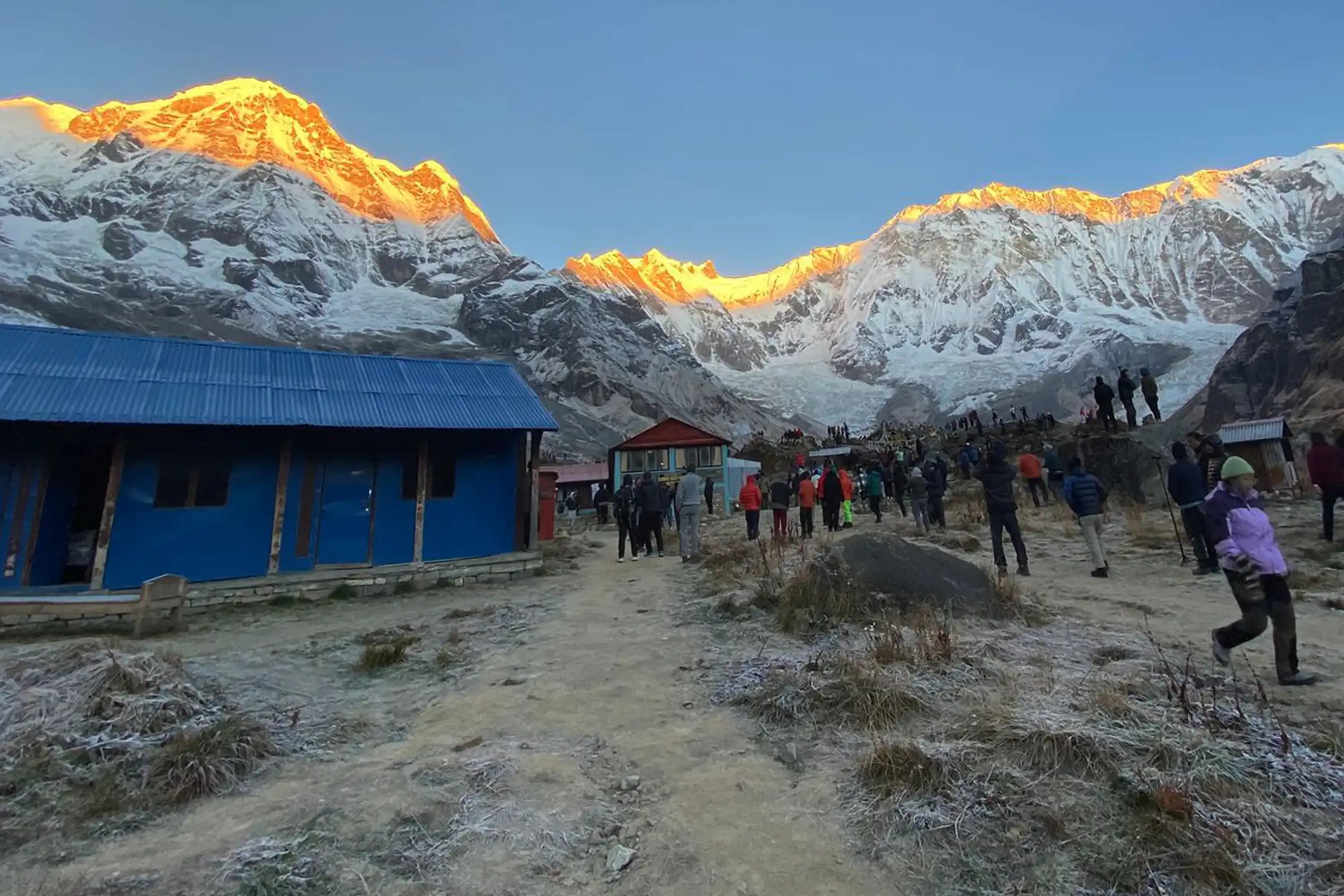
The sunrise from Poon Hill (3,210 m) has been drawing trekkers to Nepal for decades, not because it is the highest viewpoint in the Himalayas, but because from that single ridge you can see Dhaulagiri (8,167 m), Annapurna I (8,091 m), Machhapuchhre (6,993 m), and over a dozen other major peaks simultaneously in the early morning light.
No other viewpoint of comparable accessibility in Nepal delivers that scale of mountain panorama. And the Ghorepani Poon Hill Trek is the route that gets you there.
At Adventure A One Treks, the Ghorepani Poon Hill Trek is one of the most consistently requested packages from first-time Nepal visitors, and for a clear reason.
It combines three things that are genuinely hard to find together: a culturally rich trail through active Gurung communities, one of the most dramatic mountain panoramas in the Annapurna region, and a difficulty level that is honest enough for beginners without removing the sense of genuine trekking achievement.
Our team, led by Mr. Ajeeb Bhatta, handles every logistics detail from the moment you land in Kathmandu, so your only job is to walk and take it in.
The itinerary takes 8 days in total, including arrival and departure. Day 1 is your Kathmandu arrival and briefing. Day 2 is a drive or flight to Pokhara. Days 3 through 6 cover the trekking itself, starting from Nayapul. Day 7 is the return to Kathmandu from Pokhara. And Day 8 is your departure.
On the trek itself, Day 3 begins with a drive to Nayapul (1,070 m), where you cross the bridge over the Modi Khola and start the ascent through Birethanti, Tikhedhunga, and the famous stone staircase to Ulleri (1,960 m).
Day 4 continues through Banthanti and the rhododendron forest to Ghorepani (2,860 m). Day 5 is your pre-dawn Poon Hill sunrise, followed by the descent via Tadapani toward Ghandruk (1,960 m). Day 6 is a morning in Ghandruk, then a jeep drive back to Pokhara.
Note that jeeps now reach as far as Banthanti on the standard approach to Ghorepani, and some agencies use that shortcut to reduce trekking distance. We do not. The Nayapul start is the classical approach, and the two days of ascent from the valley floor through stone-paved Gurung villages is what makes the arrival at Poon Hill feel earned rather than convenient.
Read through the full package below, including the day-by-day itinerary and preparation sections, before you confirm your booking with us.
| Protected Area | Annapurna Conservation Area (7,629 sq km, Nepal's largest) |
| Total Trekking Distance | 36 km approx. (Nayapul to Ghandruk via Poon Hill) |
| Trek Duration | 8 days (arrival/departure included) |
| Highest Point | Poon Hill (3,210 m / 10,531 ft) |
| Overnight Villages | Ulleri (1,960 m), Ghorepani (2,860 m), Ghandruk (1,960 m) |
| Difficulty | Easy to Moderate |
| Best Season | Late March to May (spring), October to November (autumn) |
| Ethnic Communities | Gurung (Tamu) and Magar |
| Main Religion | Tibetan Buddhism and Hinduism (blended traditions) |
| Mountains Visible | Dhaulagiri I (8,167 m), Annapurna I (8,091 m), Annapurna South (7,219 m), Machhapuchhre (6,993 m), Hiunchuli (6,441 m), Nilgiri (7,061 m), and 10+ other peaks |
| Entry Permit | ACAP: NPR 3,000 (foreign nationals), NPR 1,000 (SAARC nationals) |
| Total Elevation Gain | 2,140 m (from Nayapul to Poon Hill) |
| Biodiversity | 105 mammal species, 518 bird species, 1,600+ plant species |
The Ghorepani Poon Hill trail is not just a mountain viewpoint trek. From the lower river valley at Birethanti to the open ridge at Poon Hill, the natural environment changes through at least five distinct ecological zones, each with its own character.
Here is what you will actually walk through:
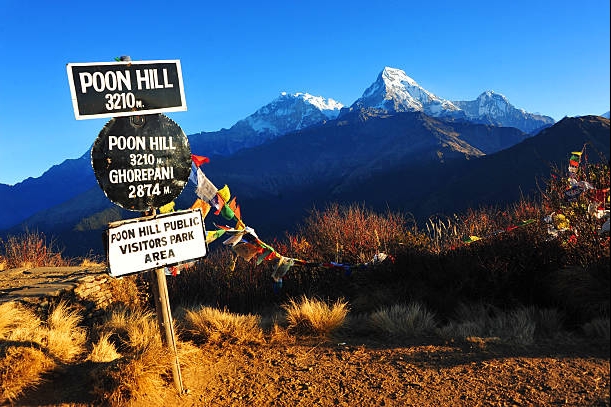
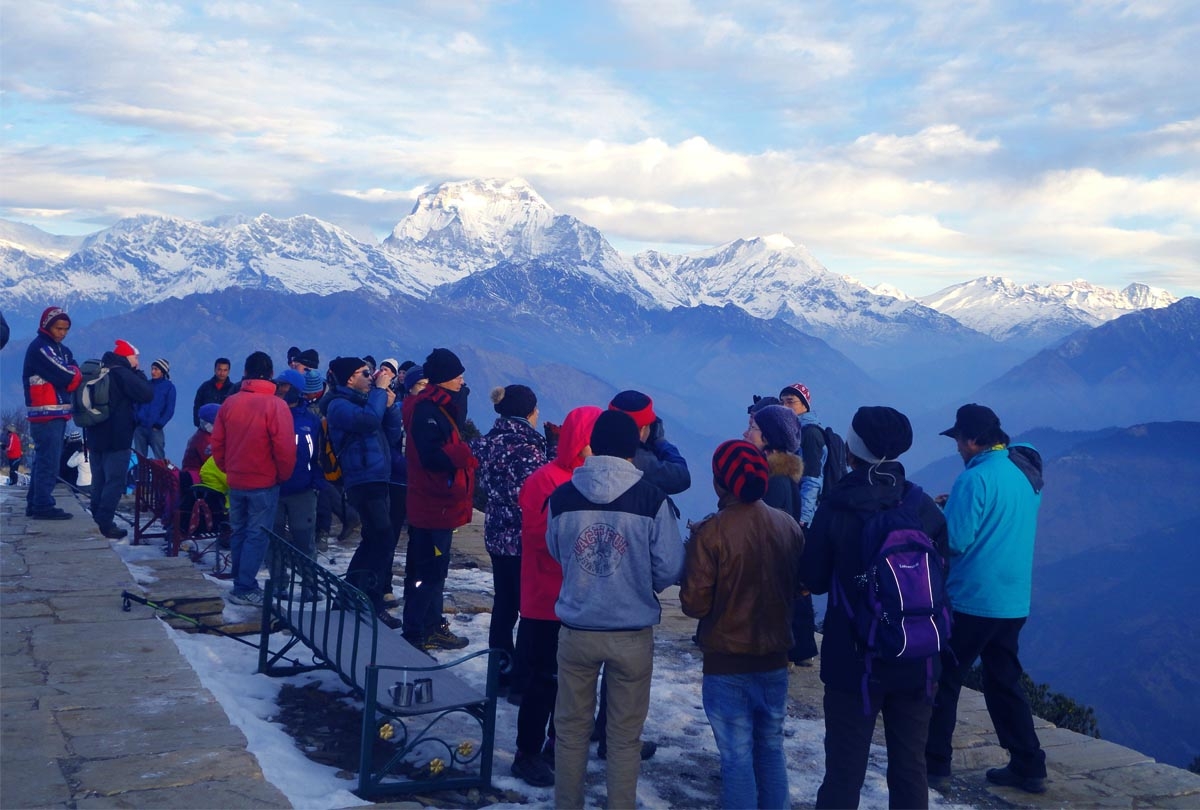
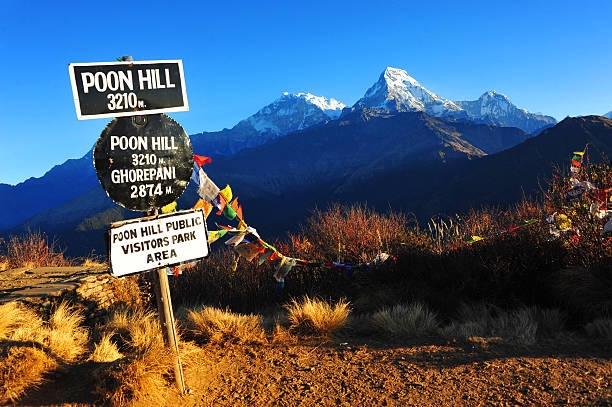
Poon Hill (3,210 m) is the reason most people start this trek, and the dawn panorama does not disappoint. From the viewing tower at the top, the entire Dhaulagiri-Annapurna range spreads across the northern horizon in a single continuous sweep.
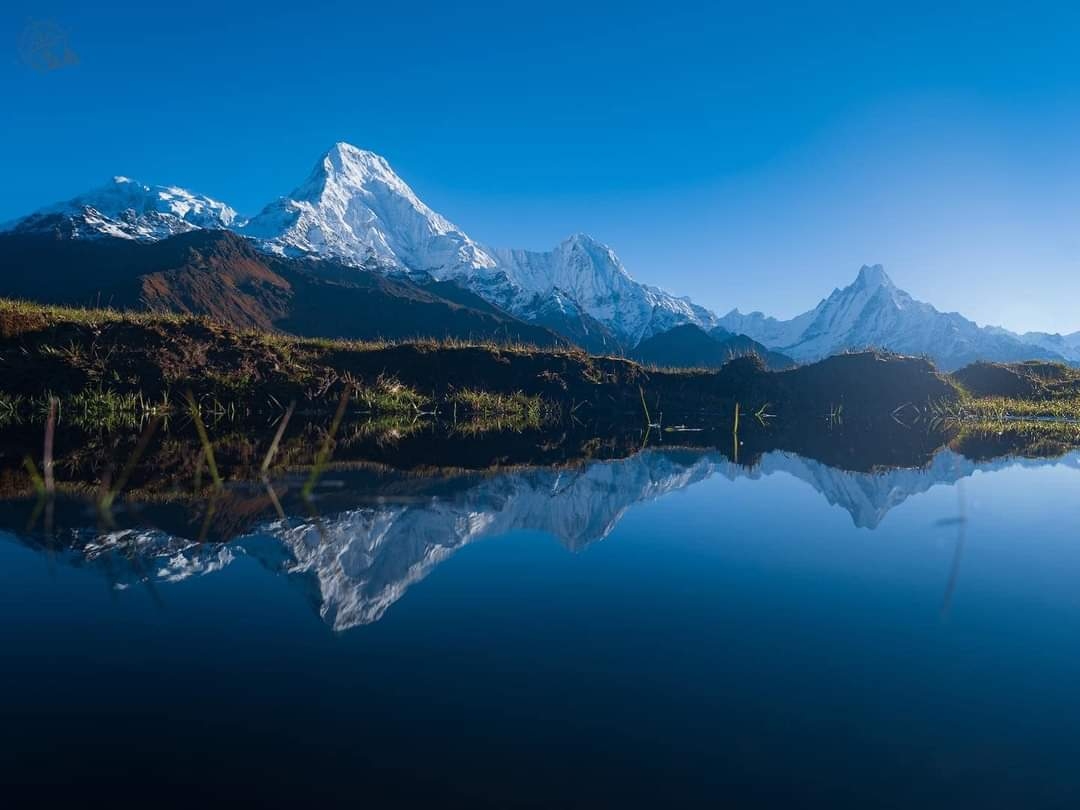
Dhaulagiri I (8,167 m) anchors the northwest, followed by the Annapurna massif moving east: Nilgiri (7,061 m), Annapurna I (8,091 m), Annapurna South (7,219 m), Hiunchuli (6,441 m), and Machhapuchhre (6,993 m) rising above everything to the northeast with its distinctive twin-peaked summit.
On a clear morning, the Gurja Himal (7,193 m) and Annapurna II (7,937 m) also come into view. Your guide will name them all, and the panorama is wide enough that a single photograph will not contain it.
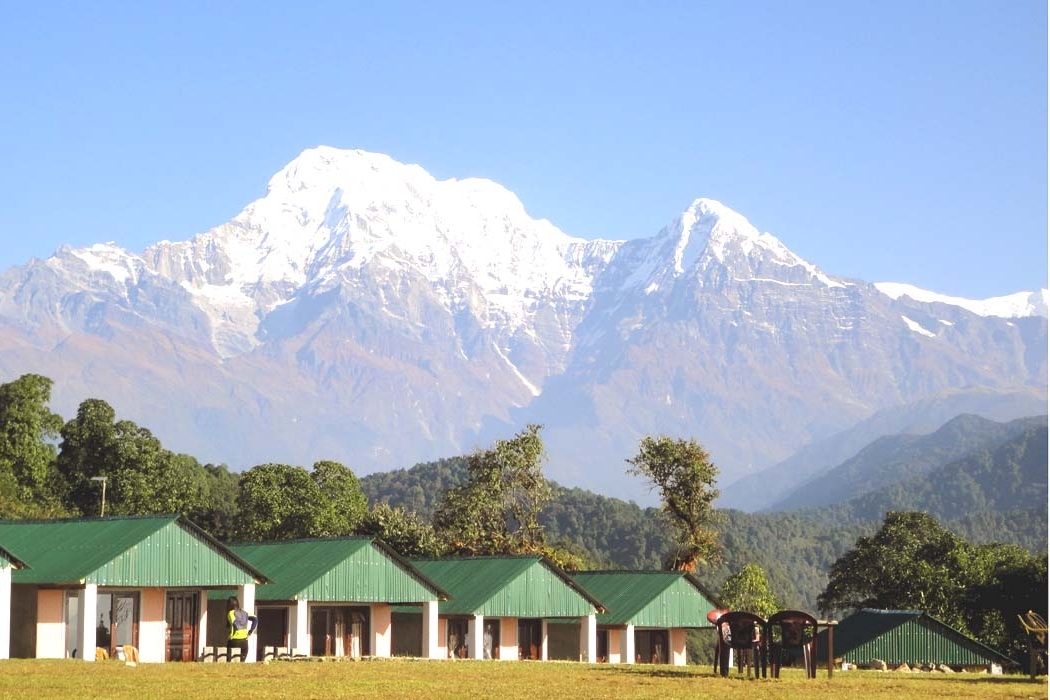
Ghandruk at 1,960 m offers a very different and in some ways more visually powerful perspective. Here, the mountain view is not panoramic but intimate. Annapurna South, Hiunchuli, and Machhapuchhre rise steeply above the village rooftops in a tight three-peak cluster, and the proximity makes the scale genuinely difficult to process from street level.
And on clear mornings, the reflection of these peaks appears on the surface of the Modi Khola far below. Photographers consistently rate the early morning view from Ghandruk's ridge as among the best close-range mountain views anywhere in the Annapurna region.
The forest between Ulleri and Ghorepani is the most botanically significant section of the entire Ghorepani Poon Hill trail. Researchers from the Annapurna Conservation Area Project have documented 16 species of rhododendron in the Ghorepani area alone, with Rhododendron arboreum being the dominant species at the altitude band between 1,800 m and 2,800 m.
These are not the low-growing rhododendron shrubs of temperate gardens. The R. arboreum trees in this forest grow to 80 feet (roughly 24 m) and individual specimens have been aged at over 250 years.
In full bloom from late March through mid-April, the forest turns into an almost unreal corridor of red, white, and pink flowers at a canopy height above the trail.
The rhododendron forest is intermixed with Himalayan oak (Quercus semecarpifolia) above 2,000 m, with birch, maple, and alder in the transitional zones, and dense bamboo groves appearing in the sheltered gullies.
Below Tikhedhunga, the lower subtropical forest includes sal (Shorea robusta), mixed broadleaf species, and riverine vegetation alongside the Modi Khola. You effectively walk from subtropical forest to high temperate forest in two days, and the change is visible with every hour of ascent.
The Annapurna Conservation Area records 105 mammal species and 518 bird species across its 7,629 sq km.
On the Ghorepani Poon Hill trail specifically, the most commonly sighted mammals are Himalayan tahr (often visible on rocky slopes above Ulleri), langur monkeys in the lower oak and broadleaf forest, barking deer, and occasionally musk deer above Ghorepani. Snow leopards inhabit the upper altitude zones of ACA but are rarely encountered on this route.
For birdwatchers, the trail between Tikhedhunga and Ghorepani is particularly productive. The Himalayan monal pheasant (danphe), Nepal's national bird, is found in the rhododendron forest between 2,500 and 3,000 m and is most visible in the early morning on undisturbed sections of trail.
Blood pheasant, Kalij pheasant, and various laughing thrush species are also commonly sighted in the oak-rhododendron zone. The rhododendron forest during bloom season draws sunbirds and flowerpeckers in numbers that make the trail feel actively alive even on quiet overcast mornings.
The adventure on this trek is distributed across the entire route rather than concentrated on a single summit day. Here is what the terrain actually demands of you.
The trail from Nayapul begins gently, following the Modi Khola river through Birethanti before the gradient picks up immediately past the checkpoint. The section from Birethanti through Tikhedhunga (1,540 m) and then to Ulleri (1,960 m) involves over 3,000 stone steps, most of them ascending continuously for 4 to 5 hours.
Total elevation gain from Nayapul to Ulleri alone is approximately 890 m. This is the steepest and most sustained uphill of the entire trek, and it happens on Day 3 when your legs are fresh but your lungs are still adjusting to the rhythm of walking at altitude.
Jeeps now reach as far as Banthanti in dry conditions, and it is technically possible to drive to Ulleri on rough road.
But we start from Nayapul because the stone staircase approach through Tikhedhunga and Ulleri is the actual trekking experience, and the cultural exposure through those lower villages is part of what makes the arrival at Ghorepani feel like something you have earned.
Day 4 then continues from Ulleri through Banthanti (2,250 m) and Nangethanti to Ghorepani, gaining another ~824 m through increasingly dense rhododendron forest over 5 hours. This day is long but the forest makes it visually rewarding throughout.
The morning hike from Ghorepani to Poon Hill covers approximately 1.7 km one way with 336 m of elevation gain, and takes roughly 45 minutes at a steady pace. It is steep, and in winter conditions icy sections can appear on the upper path.
The descent back to Ghorepani takes about 30 minutes. Start no later than 5:00 AM to reach the summit before the light changes
After the Poon Hill sunrise, the route continues from Ghorepani via Tadapani (2,630 m) to Ghandruk rather than returning down the same path to Nayapul.
This makes the full trek a loop rather than an out-and-back, and the descent from Tadapani to Ghandruk is a different kind of trail: narrower, with forest cover, and with the mountain panorama gradually revealing itself on the right as you descend.
Ghandruk itself is one of the largest Gurung villages in the Annapurna region and also one of the original sites where the Annapurna Conservation Area project was piloted in 1986.
It functions as a gateway to the Annapurna Sanctuary (ABC) trail, and many Annapurna Base Camp trekkers pass through here.
From Ghandruk, it is also possible to extend onward toward Jhinu Danda hot springs on the Modi Khola. But for this 8-day itinerary, Day 6 ends with a morning in Ghandruk and a jeep ride back to Pokhara via Kimche, which takes approximately 2 to 2.5 hours.
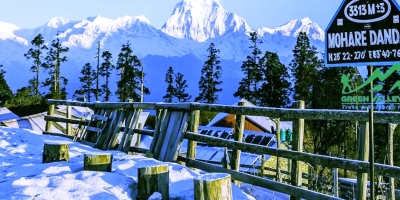
From Banthanti on Day 4, a route diverges toward Mohare Danda (3,313 m) and Kokhe Danda (3,308 m), offering a higher ridge line with different mountain perspectives than the standard Ghorepani approach.
This option adds one to two extra days to the itinerary and passes through a less-trafficked section of the conservation area, with rhododendron forest at higher elevation and views extending further into the Dhaulagiri and Mustang regions.
If you want to include this, let us know when contacting Adventure A One Treks so we can adjust the itinerary and teahouse arrangements before departure.
From Ghandruk, there is also an alternative descent via Chuile that adds roughly half a day and passes through forest sections not on the main Ghandruk-Nayapul trail. This is the quieter route and works well in shoulder seasons when the main trail is busiest.
If you plan to extend your time in Pokhara before or after the trek, the city offers a range of adventure activities at additional cost: ultralight aircraft flights over the Annapurna panorama, paragliding from Sarangkot, bungee jumping in Kusma or Hemja, ziplining at Hemja, and white-water rafting on the Seti River.
Well, our team at Adventure A One Treks can arrange any of these through reliable Pokhara operators.
The Ghorepani Poon Hill trek passes through villages that have been inhabited by Gurung communities for centuries, and the cultural engagement here is not arranged or packaged. It is simply the result of sleeping in teahouses run by Gurung families, walking through villages where the daily rhythm continues around you, and taking the time to stop and talk.
The Gurung people, who call themselves Tamu in their own language, are the primary community along the Ghorepani Poon Hill trail from Ulleri through Ghandruk.
As per Nepal's 2021 national census, we found out that almost 522,641 Gurungs live in Nepal, and the largest concentration? Well, it's in the Gandaki Province, specifically in Kaski, Lamjung, and Manang districts. And that's where Ghorepani and Poon Hihl are located.
They have historically provided a high proportion of Nepal's Gurkha soldiers, a tradition that continues today. Their religious practice is a genuine blend of Tibetan Buddhism and Hinduism, and you will see both traditions maintained in the same household without contradiction.
You will find a Buddhist shrine in one corner, Hindu puja materials in another, and merit-making prayer flags above the roof. The gompas in Ghandruk are worth visiting, and the Gurung Museum in the village documents community history, traditional dress (including the doura-suruwal for men and lunghi for women), and tools of highland pastoral life.
Gurung attire is also available to try on in Ghandruk for photographs, and the families offering this genuinely enjoy showing it to visitors.
The route passes through a progression of settlements that vary considerably in character and size.
The Ghorepani Poon Hill trek is a teahouse trek, meaning there is no camping and no need to carry food or shelter. You stay in family-run lodges every night, eat in shared dining rooms, and share the experience with whoever else is on the trail that day.
Teahouse culture in Nepal works simply: you order dinner the night before early-start mornings, you keep a filled water bottle beside you always, and you treat the dining room as a communal space rather than a restaurant.
The families running these lodges are also your cultural hosts, and the conversations around the wood stove at Ghorepani on a cold evening are often the most memorable part of the trek for guests who take the time to have them.
Dal bhat is the staple, and the standard response to "Dal bhat power 24 hour" from your guide when you complain your legs are tired at 2,800 m is one you will hear and eventually agree with.
After doing the trip oursevles and serving hundreds of guests already in the Ghorepani-Poonhill Route, we can confirm that the overall/total trekking distance starting from Nayapul to Ghandruk via Ulleri, Ghorepani, Poon Hill, and Tadapani is approx. 36 km.
The daily distances and elevation gain/loss are provided in the itinerary table given below:
| Route | Distance (Approx.) | Walking Time | Elevation Change (approx.) |
| Nayapul to Birethanti | 2km | 30mins | +80m |
| Birethanti to Matathanti | 2km | 1hour | +1050m |
| Matathanti to Tikhedhunga | 5.5km | 2hours | +410m |
| Tikhedhunga to Ulleri | 2km | 2hours | +550m |
| Ulleri to Banthanti | 1km | 45mins | +170m |
| Banthanti to Nangethanti | 4km | 2hours | +300m |
| Nangethanti to Ghorepani | 3km | 2hours | +350m |
| Ghorepani to Poon Hill (round-trip) | 6km | 3hours | +/-300m |
| Ghorepani to Tadapani | 8.5km | 5hours | -700m |
| Tadapani to Ghandruk | 6.5km | 2.5hours | -700m |
All four seasons are possible on the Ghorepani Poon Hill trek, though each has a different character and different trade-offs:
Winter (December to February) is the least crowded season and brings a completely different atmosphere.
Snowfall at Ghorepani and on the approach to Poon Hill is common, particularly in January and February, and the snow-covered rhododendron forest has its own visual character.
Morning temperatures on the Poon Hill hike can drop below -5°C, and the trail can be icy, so proper layering is essential. Teahouses remain open but with fewer guests. If a winter trip is your plan, contact us before booking to check current snow conditions on the route.
Monsoon (June to September) brings heavy rainfall, leeches on the lower trail sections, and limited mountain visibility above the cloud line. It is not recommended for first-time trekkers. The forests are lush and the waterfalls between Tikhedhunga and Ulleri are at their most dramatic, but Poon Hill in cloud is a very different proposition from Poon Hill in clear weather.
For any season, the most reliable approach is to check the weather window with our team at Adventure A One Treks before you finalize travel dates.
The Ghorepani Poon Hill trek is rated easy to moderate. It is the most accessible high-Himalayan viewpoint trek in Nepal for first-time trekkers and is genuinely suitable for people with no prior trekking experience, as long as they are reasonably fit and prepared for two days of sustained uphill walking.
The overall difficulty is easy for anyone who walks regularly or hikes occasionally. The moderate grade comes from two specific sections: the 3,000-plus stone step ascent from Nayapul to Ulleri on Day 3, which involves 890 m of elevation gain in 4 to 5 hours, and the descent from Tadapani to Ghandruk, which tests the knees on long downhill stone sections.
Neither of these is dangerous or technically demanding. They are simply tiring in the way that any sustained climb or descent is tiring.
Daily walking times stay at 4 to 8 hours, which is manageable for most healthy adults with basic preparation. The maximum sleeping altitude is 2,860 m at Ghorepani, and the Poon Hill hike adds another 336 m above that for a few hours.
At these altitudes, altitude sickness is possible but uncommon for most trekkers, and the standard precaution of drinking enough water and not rushing the ascent covers most of the risk.
This is also an excellent first Himalayan trekking experience because the infrastructure along the trail is well-developed, the path is well-marked, and teahouse accommodation is comfortable enough that a first-time trekker has nothing unfamiliar to manage outside of the physical effort.
Accommodation along the Ghorepani Poon Hill trail is in teahouses throughout. You will not need a sleeping bag or tent.
All overnight stops have proper beds with blankets, shared bathrooms (mostly squat-style toilets, with some western-style options in Ghandruk and the larger Ghorepani lodges), and hot showers available for a small extra charge (typically NPR 200 to 300).
Electricity is available at all stops via solar power or microhydro, and device charging is possible (again, sometimes at an extra charge). WiFi is available at Ghorepani and Ghandruk but is not reliable.
Food menus are broader on this route than on more remote treks because Pokhara supply lines keep the teahouses stocked reasonably well.
Dal bhat is the staple and the best energy source for the ascent days. The menus also include noodle soup, fried rice, chowmein, momo, thukpa, omelettes, Tibetan bread, and on the lower trail, some teahouses serve pasta and pizza of a reasonable standard.
Above Ulleri, the western menu items vary in quality, and dal bhat remains the most reliable and filling option for sustained walking. Three meals per day are included in your Adventure A One Treks package.
One important note: there are no ATMs beyond Nayapul. So, carry enough NPR cash from Pokhara for extra charges (hot showers, additional beverages, any personal shopping in Ghandruk) before you start the trek.
Only one trekking permit is required for the Ghorepani Poon Hill trail, and that is the Annapurna Conservation Area Permit (ACAP)!
The Ghorepani area is not a restricted zone (unlike Manaslu or Upper Mustang), so no special restricted area permit is needed and there is no requirement to book through a registered agency or travel with a licensed guide by law.
That said, trekking without a guide on this route is a genuinely different and less informative experience, and our team strongly recommends using one.
The cost details are as follows (at A1 Treks, we want to be as transparent as possible):
The ACAP permit is checked at the Birethanti checkpoint at the start of the trail and no other place in the route. Your guide carries and presents it at each checkpoint, so you will need to have your passport on you at Birethanti for the registration.
The TIMS (Trekkers' Information Management System) card was previously required for Annapurna region treks but has not been actively enforced on the Ghorepani Poon Hill route in recent seasons and is in the process of being phased out as a requirement.
At Adventure A One Treks, we handle all permit requirements before departure from Kathmandu so there are no surprises at checkpoints!
The Ghorepani Poon Hill trek does not require intensive preparation, but the two uphill days (Day 3 and Day 4) demand enough sustained effort that trekkers who arrive without any physical preparation feel the difference.
Here is what actually matters:
Start regular uphill walking or stair climbing at least 3 to 4 weeks before departure. You do not need to run marathons or hit the gym every day, but the specific muscles you need for sustained stone-step climbing (quads, calves, core stability) need some prior activation.
If you can walk uphill for 3 consecutive hours with a daypack before you arrive in Nepal, the Day 3 ascent will feel manageable. If the last time you walked uphill for more than an hour was years ago, it will be genuinely difficult.
Knee strength and stability matter as much as climbing fitness, because the descent from Tadapani to Ghandruk on Day 5 is long and steep on uneven stone. If you have any prior knee sensitivity, bring compression sleeves and use trekking poles from Ghorepani downward.
Mentally, the Poon Hill trek is not a demanding trip. The most common point of frustration is the stone staircase on Day 3, which feels relentless when you are tired and cannot see where it ends.
Knowing in advance that the staircase section lasts approximately 2 hours and ends in the Ulleri village is useful context when you are in the middle of it.
At 2,860 m (Ghorepani) and 3,210 m (Poon Hill), altitude sickness is uncommon but possible.
The primary prevention is hydration (3 to 4 litres of water per day from Day 3 onwards), a steady pace on the ascent, and not skipping overnight stops to push the itinerary faster.
Ascending too quickly from 1,070 m (Nayapul) to 2,860 m (Ghorepani) in 48 hours puts some people into mild AMS territory.
If you develop a persistent headache, loss of appetite, or disturbed sleep at Ghorepani, rest for an extra morning before attempting the Poon Hill hike.
Do not push to Poon Hill with active AMS symptoms. Your guide from Adventure A One Treks will assess your condition and make the right call with you. The most important thing is to tell your guide if you feel off, not to push through and hope for improvement.
The cost of this 8-day package at Adventure A One Treks covers everything from your Kathmandu airport pickup on Day 1 to your airport drop on Day 8.
Your ACAP permit, licensed guide, all teahouse accommodation and meals on the trek, land transportation between Kathmandu and Pokhara, and the Pokhara to Nayapul drive are all included.
What is not included: your international flights, your Nepal tourist visa (USD 30 for 15 days, USD 50 for 30 days), travel insurance, personal spending on the trail (extra beverages, hot showers, WiFi charges), and guide and porter tipping.
Note that tipping at approximately 10% of your total package cost, distributed between your guide and driver, is the standard across all trekking destinations in Nepal.
For groups of two or more, our standard package pricing applies. Solo trekkers are welcome and we arrange the package accordingly. Contact Mr. Ajeeb Bhatta at Adventure A One Treks for a full itemized quote based on your group size and preferred travel dates.
Our representative will be at Tribhuvan International Airport with an Adventure A One Treks paging board and will take you by private vehicle to your hotel in Thamel. The rest of the day is yours.
Depending on your arrival time and energy level, you can explore Thamel on your own in the evening, visiting the gear shops and restaurants around the tourist hub.
If you would like a guided Kathmandu sightseeing day before the trek, we can add this as an optional extra day to the package (at additional cost), covering the UNESCO heritage sites of Pashupatinath, Boudhanath, Swayambhunath, and Kathmandu Durbar Square. Let us know in advance and we will arrange a licensed city guide for you.
In the evening or early the next morning (depending on your arrival time), your lead guide will give you a pre-departure briefing: itinerary walkthrough, gear check, permit documents, and any last questions answered. Come to the briefing with your gear laid out and ready to discuss.


You have two options for the Kathmandu to Pokhara leg. The 7 to 8 hour drive by private vehicle follows the Prithvi Highway through the Trishuli River valley and into Gandaki Province, with a stop for lunch along the way. The 25-minute domestic flight is faster and gives you views of the Annapurna range on a clear morning.
Both are valid options and both cost differently. Let us know your preference when you book so we can arrange accordingly. If you choose the drive, your guide travels with you and uses the journey to brief you on the trail ahead.
Pokhara sightseeing is not included in this package but can be arranged as an add-on at extra cost. If you arrive early in the day, you will have enough afternoon time to visit Phewa Lake and the Barahi Temple on the island, the Gurkha Museum, or the viewpoints at Sarangkot on your own.
The lakeside area (Pokhara's main tourist hub) is walkable and pleasant. In the evening, meet your guide for a final pre-trek briefing and confirm all gear is ready. Carry cash from Pokhara's ATMs before departure the next morning, as there are no reliable ATMs beyond Nayapul.
The day starts with a 40 km drive from Pokhara to Nayapul (1,070 m), which takes approximately 1.5 hours by private vehicle along the Annapurna road.
The Modi Khola river runs alongside much of this road, and the mountains begin to appear on the northern horizon as you leave the valley.
Nayapul is a small bazaar settlement at the standard trek starting point. There is an ATM here but reliability is inconsistent, so make sure you have enough NPR from Pokhara.
Your guide will start the ACAP permit process at the Birethanti checkpoint (approximately 20 minutes walk from Nayapul, crossing the bridge over the Modi Khola). After the checkpoint, the trail begins climbing immediately.
The hike from Birethanti passes through Matathanti, Sudame, and Tikhedhunga (1,540 m), gaining altitude steadily through lower subtropical forest and terraced farmland.
The famous staircase begins properly at Tikhedhunga and continues to Ulleri through more than 3,000 stone steps built directly into the hillside. This section takes 2 to 2.5 hours of continuous uphill and is the steepest sustained climb of the entire trek. Go slowly, drink water consistently, and stop for tea at Tikhedhunga before the staircase if you need a break.
Ulleri (1,960 m) arrives in the early to mid-afternoon, a large Gurung village perched on the ridge with the first real views of the valley below. Check into your pre-arranged teahouse, explore the village in the evening, and order dinner early. Tomorrow continues the ascent.
This is a longer and higher day through the most botanically spectacular section of the trail. The rhododendron forest begins properly above Ulleri and thickens progressively as you gain altitude through Banthanti (2,250 m) and Nangethanti (2,430 m) toward Ghorepani.
In full bloom (late March to mid-April), the forest between Banthanti and Ghorepani is extraordinary. The canopy closes over the trail at points, and the flowers at 80-foot height catch the morning light in a way that is genuinely difficult to photograph accurately.
Even outside bloom season, the forest is dense and peaceful, and the variety of bird species audible in the upper rhododendron zone is notable throughout the year.
Note that at Banthanti, a route diverges toward Mohare Danda and Kokhe Danda if you want the optional ridge extension mentioned earlier. Your guide knows both options. The main route continues directly to Ghorepani.
Ghorepani (2,860 m) is a larger village than Ulleri, with multiple teahouses, a visible ACAP checkpoint, and strong mountain views from the upper sections of the village. Arrive by mid-afternoon, eat well, and sleep early.
Your guide will wake you at 4:00 AM. Have your headlamp, water, and warm layers ready the night before.
The hike from Ghorepani to Poon Hill covers approximately 1.7 km with 336 m of elevation gain and takes 40 to 50 minutes at a steady pace on the stone staircase heading northeast from the village.
The summit viewpoint (3,210 m) has a viewing tower and an open ridge, and the panorama on a clear morning covers Dhaulagiri I, Nilgiri, Annapurna I, Annapurna South, Hiunchuli, Machhapuchhre, and the full extent of the Annapurna massif from west to east.
In peak season, there will be other trekkers on Poon Hill at the same time. If you plan professional photography or videography and need clear shots, ask your guide about the best positioning and timing. Secure your spot on the ridge before the light fully arrives.
After the sunrise, descend back to Ghorepani for breakfast, then continue the day's walk toward Ghandruk. The route heads southeast from Ghorepani via Deurali and drops into the rhododendron forest toward Tadapani (2,630 m), where lunch is taken at approximately midday.
From Tadapani, the trail continues descending through the forest to Ghandruk, and the views of Annapurna South, Hiunchuli, and Machhapuchhre grow progressively larger as you lose altitude toward the village.
Note: There is an alternative route from Ghorepani toward Ghandruk via Chuile that is slightly longer and quieter. If you want that variation, let your guide know after the Poon Hill morning.
The morning view from Ghandruk is worth waking up early for even without the formal Poon Hill hike. Annapurna South and Hiunchuli rise directly above the village in a way that closer mountain views like this do not often allow.
Walk the village lanes before breakfast, visit the Gurung Museum (small entry fee payable at the museum), and if Gurung attire is something you want to photograph, the families who offer this are generally near the main square and the price is very reasonable.
After breakfast and final exploration, a 2 km walk up from the village center reaches the Ghandruk jeep station.
The drive from Ghandruk to Pokhara follows a different route from the one you came in on, heading through Kimche and rejoining the main road after approximately 2 to 2.5 hours. The road is paved for most of the route and considerably smoother than the approach.
Back in Pokhara, rest and use the afternoon to explore the lakeside, try restaurants, or simply recover. There are no scheduled activities on this evening unless you have arranged optional Pokhara adventures with our team.
The same choice as Day 2 applies: private vehicle drive or domestic flight. The morning in Pokhara is free before departure, and the lakeside walk along Phewa Lake at dawn is pleasant if you are an early riser. If you are driving, plan for a morning departure to arrive in Kathmandu in the early evening.
Back in Kathmandu, your driver will drop you at your hotel in Thamel. The evening is free. Thamel and the surrounding Asan Bazaar area are good for souvenir shopping, and the restaurant options range from traditional Nepali (Newari set meals in Asan or near Indra Chowk) to a wide variety of other cuisines in Thamel's main lanes.
If you would like a traditional Nepali cultural dinner with folk music and dance, let our A1 Treks team know in advance and we can arrange this at an additional cost. It is worth doing, particularly if you have not experienced Newar or hill cultural performances before.
Do take a moment to come and see our team at the Adventure A One Treks office, too. We would genuinely enjoy hearing how the trek went.
Our representative will collect you from your hotel approximately 3 hours before your scheduled international flight time. If you have an early departure, we coordinate the pickup accordingly the evening before.
At the airport, you receive the traditional Nepali farewell with a khada scarf. We hope the mountains were worth the stone steps, and that somewhere between Ulleri and Poon Hill, Nepal started to feel like somewhere you will come back to. If you want to plan the next trip, Mr. Ajeeb Bhatta and the team will be ready to help.
I traveled first time to Nepal and was worried about a new place visit. At the same time, I met one excellent guide for going trekking and touring Dhruba Bhatta through some company. lately, he organized his own company, Adventure A One Trek Private limited. Dhruba Bhatta is much knowledgeable person about everything like history, culture, flora and fauna, villagers, trekkers, guides and porters. he is always a smiley person. he is much caring person for his Client, always wondering how the client feels, and what the client prefers to eat, and always giving the best suggestion for achieving the destination. if you are investing money to reach some destination in Nepal, you should book the trip with Mr. Dhruba Bhatta, it will be really worth it and you never feel you were wasted

Great trek to Poonhill. Professional guide, good service and we had very nice trek, Warmly recommend.
Our Ghorepani Poon Hill Trek with Adventure A One Treks was a fantastic short trek in the Annapurna region. The sunrise view from Poon Hill was absolutely breathtaking, with panoramic views of the snow-covered mountains. The trail passed through beautiful rhododendron forests and charming villages, making the journey peaceful and enjoyable. Everything was well organized, and the team provided excellent service throughout the trek. Highly recommended for anyone looking for a short and scenic Himalayan adventure!
We had a wonderful experience on the Ghorepani Poon Hill Trek with Adventure A One Treks . The trek was perfect for enjoying nature, local culture, and stunning mountain scenery without long trekking days. Watching the early morning sunrise over the Annapurna and Dhaulagiri ranges was truly unforgettable. Special thanks to Ajeeb Bhatta for the smooth organization and warm hospitality. It was a memorable trip from start to finish!
The Poon Hill Trek with Adventure A One Treks was an amazing short adventure in the Annapurna region. The trek offered beautiful rhododendron forests, traditional mountain villages, and stunning Himalayan scenery throughout the journey. Watching the sunrise from Poon Hill with panoramic views of Annapurna and Dhaulagiri was truly unforgettable. Everything was perfectly organized, making the trek smooth, comfortable, and enjoyable. The staff was friendly, professional, and always helpful during the trip. This trek is perfect for anyone looking to experience the beauty of the Himalayas in a shorter amount of time, and I highly recommend Adventure A One Treks for a memorable trekking experience in Nepal.
The Poon Hill Trek with Adventure A One Treks was an amazing short adventure in the Annapurna region. The trek offered beautiful rhododendron forests, traditional mountain villages, and stunning Himalayan scenery throughout the journey. Watching the sunrise from Poon Hill with panoramic views of Annapurna and Dhaulagiri was truly unforgettable. Everything was perfectly organized, making the trek smooth, comfortable, and enjoyable. The staff was friendly, professional, and always helpful during the trip. This trek is perfect for anyone looking to experience the beauty of the Himalayas in a shorter amount of time, and I highly recommend Adventure A One Treks for a memorable trekking experience in Nepal.
My Ghorepani Poon Hill Trek with Adventure A One Treks exceeded all expectations. The trails passed through peaceful villages, green forests, and beautiful mountain landscapes that made every day enjoyable. The highlight of the trek was reaching Poon Hill early in the morning and witnessing the breathtaking sunrise over the snow-covered Himalayan peaks. The entire journey was very well managed, from accommodation and meals to transportation and trekking arrangements. The team was supportive, experienced, and always ensured we had a safe and enjoyable experience. I would definitely recommend this trek to anyone visiting Nepal who wants a perfect mix of culture, nature, and mountain views.
The Ghorepani Poon Hill Trek with Adventure A One Treks was a beautiful short trek in the Annapurna region. The trail passed through rhododendron forests, charming villages, and scenic hills. The sunrise from Poon Hill was absolutely breathtaking, offering panoramic views of Annapurna and Dhaulagiri ranges. The trek was well organized, comfortable, and perfect for beginners and nature lovers.
I had a wonderful experience on the Ghorepani Poon Hill Trek with Adventure A One Treks. The journey was peaceful, colorful, and full of stunning mountain views along the way. The hospitality in local teahouses made the experience even more enjoyable. Everything was smoothly arranged, making it a perfect short and rewarding trekking adventure in Nepal.
Footwear
Bags
Walking from Ulleri to Ghorepani villages encountered the Poon from Magar people, the main hill tribes of Western Nepal. Due to the mass population of Poon Magar around Ghorepani and named the hill Poon Hill.
The Poon Magar follows Hindu and Buddhism religions, and the Poon Magar menfolk are famous as Gorkha soldiers. Like in Indian and British Gorkha Regiments or Battalions.
The area around Ghorepani and Poon Hill is regarded as the world’s largest natural rhododendron garden. The village is surrounded by rhododendron trees and bushes, from the springtime March to May. The whole hill and valleys are alive with wildflowers in blooming seasons, especially the rhododendron of various species. Which is also a national flower the red Rhododendron species.
Depending upon the starting and ending point of trekking. On average minimum of 3-4 hours and a maximum of 5-6 hours of walks. The longest walk is from Tikhedhunga to Ghorepani due steep climb to Ulleri. As well as on return trek from Ghorepani to Tadapani or Ghandruk villages. On the last day walks from Ghandruk to Kimche for a drive back to Pokhara or walk the long way to Nayapul for the drive to Pokhara.
The Ghorepani Poon Hill Trek is a 3 to 8 day trekking route in Nepal's Annapurna region that leads to Poon Hill (3,210 m), a viewpoint with panoramic sunrise views of Dhaulagiri, Annapurna I, Machhapuchhre, and more than 16 other Himalayan peaks. It is Nepal's most popular short trek because it delivers a genuinely dramatic mountain panorama at an altitude and difficulty level accessible to first-time trekkers.
Unlike restricted area trekking, this trek does not legally require a licensed guide or agency booking. However, trekking with a knowledgeable local guide significantly improves the cultural and ecological experience, and at Adventure A One Treks, our guides are licensed, experienced, and specifically familiar with the Annapurna region trail conditions.
Yes, the Ghorepani Poon Hill Trek is one of the best introductory Himalayan trekking experiences available in Nepal. The only genuinely demanding section is the 3,000-plus stone step ascent on Day 3. Beyond basic fitness for sustained uphill walking, no prior trekking experience is required.
Yes, children who can definitely do this trek too but they should be trained prior to walking for 4 to 5 hours per day. The maximum sleeping altitude of 2,860 m is low enough that altitude sickness is rarely a concern for children, and the trail is well-developed with teahouse accommodation throughout. For children under 10, the Day 3 staircase may need to be broken into shorter stages. Contact our team for advice specific to your family's age group.
The Annapurna region collectively receives over 244,000 annual visitors, with the Ghorepani Poon Hill route being the most popular short circuit in the area. Poon Hill can be crowded on the viewpoint platform in peak season (October and April), but the trail itself, particularly the sections above Ulleri, becomes quieter as you gain altitude.
Yes. From Ghandruk, trekkers can continue to Chhomrong and on to Annapurna Base Camp (4,130 m). This adds 4 to 7 days depending on your pace and is a separate, longer itinerary. Adventure A One Treks offers Annapurna Base Camp treks and can combine the two routes if you have sufficient time. You can also extend via Jhinu Danda for the natural hot springs on the Modi Khola before returning to Nayapul.
On peak season mornings (October and April), 50 to 100 or more trekkers can gather on the Poon Hill viewpoint at sunrise. Arriving 10 to 15 minutes before the main crowd reaches the summit (which means leaving Ghorepani by 4:00 AM) gives you more space and better light for photographs. Off-season (December to February, May to September), the viewpoint is considerably quieter.
No, this is a teahouse trek and no technical equipment is required. In winter, microspikes or basic traction devices can be useful on the Poon Hill path if there is ice, but these are optional and can be improvised with careful steps on most winter days. Your guide will advise on conditions.
Yes, Lakeside in Pokhara has multiple trekking gear rental shops, These places provide you with renting facility for necessary items for your Ghorepani Poonhill Trek and beyond. These include down jackets, trekking poles, and other items as mentioned by your assigned guide. And the rent cost is also at reasonable daily rates (NPR 200 to 500 per item per day, approximately). Do note that the quality varies between shops, so inspect items before renting.
Carry extra NPR 3,000 to 5,000 per person for personal expenses above what the package covers: hot showers (NPR 200 to 300 each), extra beverages, WiFi cards, and any purchases in Ghandruk. Prices increase as you gain altitude. There are no ATMs beyond Nayapul, so exchange and withdraw in Pokhara before departure on Day 3.
At Ghorepani (2,860 m), nighttime temperatures drop to approximately 2 to 8°C in spring and autumn, and below -5°C in winter. On the Poon Hill summit (3,210 m) at 5 AM in the dark, add wind chill on top of that ambient temperature. A good down jacket, wool hat, and gloves are non-negotiable for the summit morning in any season.
The most common early signs of Acute Mountain Sickness (AMS) at 2,860 m are persistent headache, loss of appetite, nausea, and disturbed sleep. These symptoms at this altitude usually respond to rest, hydration (3 to 4 litres of water per day), and not ascending further until improved. If headache persists unresponsive to ibuprofen or is combined with vomiting, descend 300 to 500 m and inform your guide.
Yes, the Ghorepani Poon Hill trek is considered to be one of the safest trekking routes in Nepal, including for solo female trekkers. That is because the trail is well-trafficked, the teahouse owners are experienced with international guests, and the Gurung communities along the route are very very welcoming! On top of that, trekking with an Adventure A One Treks guide adds an additional layer of support and local knowledge.
Leeches are present in the lower forest sections between Birethanti and Ulleri during and immediately after the monsoon season (June to September). In spring and autumn they are generally not a problem above 1,500 m. Leech-proof socks (available in Pokhara) and tucking trouser legs into socks are the standard preventive measures during monsoon season.
Cloud cover or mist at dawn on Poon Hill happens in any season, most commonly during the monsoon and post-monsoon transition periods. If Day 5 has poor visibility, your guide has two options: attempt the hike anyway in hope of a brief clear window, or adjust the schedule to attempt a second morning if the itinerary allows. This is a judgment call made by your guide on the day based on conditions and forecast.
NTC SIM cards provide the most reliable coverage, with signal generally available at Ulleri, Ghorepani, and Ghandruk. Network drops in the forested sections between stops. Do not rely on data connectivity for time-sensitive communication during the trekking days. WiFi is available at most teahouses for a fee (NPR 200 to 500 per session) and is more reliable than mobile data at altitude.