
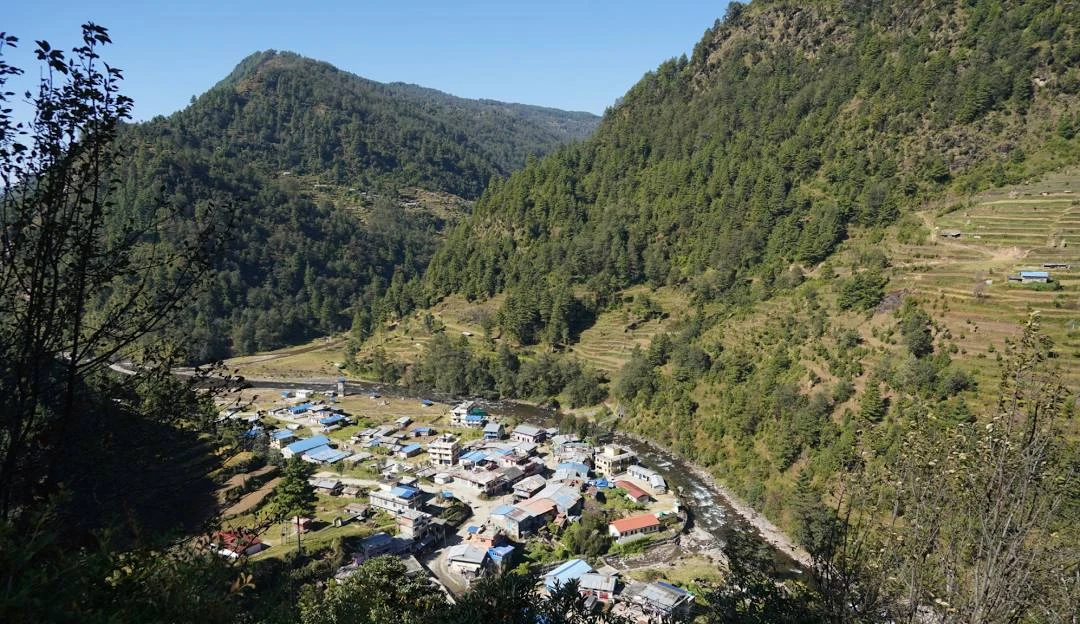
The Jiri route is famous for its historical significance as it was Mount Everest's first access point back then. Prior to the building of the airport in Lukla in 1964, expeditions that were heading to Everest started their journey from this area. Sir Edmund Hillary and Tenzing Norgay took this route in 1953 at the time of their historic first Everest climb. For many years, this was the main route to Everest Base Camp with mountaineers following the trails through the middle hills of Nepal, getting used to the higher altitude step by step, and exploring the local culture of the Solu neighborhood.
With the introduction of roads and flights to Lukla, the Everest region is now accessible to a far greater number of people and in much less time. Yet, there is a flipside to this convenience: the traditional route from Jiri to Everest Base Camp is hardly used now, as only a handful of trekkers are choosing this way. What seems like a loss in some sense here is actually a preservation of Jiri Trek's authenticity and the life of the locals as it is less commercialized and more connected to traditional Nepali life than the northern routes which are very crowded.
The experience of the landscapes, culture, and architecture gradually changing that you observe while going from Jiri at 1,900 meters to the main Everest Base Camp trail at Namche Bazaar cannot be replaced even by a direct Lukla flight. The ascent is just one of the means for the journey to the destination-place, besides it is a source of different impressions, including how geography determines human communities and their culture in various elevational zones.
The Jiri Trek usually lasts for 7-9 days before you get to join the standard Everest Base Camp trail. The distance is roughly 110-120 km, depending on how you choose the exact path. The route begins in the Dolakha district, and heads north and up through parts of the Solukhumbu district into the Sherpa heartland. While numerous Himalayan treks follow river valleys and jerseys with pretty gradual ascents, the Jiri route presents a never-ending sequence of steep climbs, each one followed by a steep descent into a river valley only to start a climb again onto the next ridge.
The back-and-forth nature of the Jiri Trek topography is the main reason why it is known as a demanding trekking route that makes use of your physical energy just as much as a high-altitude trek with gentler gradients. You are forced to go up and down through elevation changes that in total are a lot more than the net altitude gain, hence it is a good cardio workout and still gives you excellent acclimatization. A typical southern slope in the villages serves as a sunny spot during winter which is desirable for people and therefore where you will find them settled.
You pass through 4 major climate zones during your walking. Starting in terraced rice paddies and banana plants area where warm microclimate can be found, the next stage is oak and rhododendron forests with different types of pine. Further up, you enter a subalpine zone where junipers and dwarf rhododendrons dominate, and continuing after Jiri towards Khumbu you reach the alpine zone where only hardy grasses and lichens grow.
To start this journey, you generally first take a bus for seven to nine hours from Kathmandu to Jiri, depending on the road conditions. The road itself provides different experiences as it winds through river gorges and hills of the middle region, passing by several rural villages where Nepalis lead a life far away from the tourist centers. Thanks to road construction funded by China, the bus route has been improved considerably in recent years, but some sections are still rough and vulnerable to damage caused by the monsoon, which requires frequent repairs.
Starting the first day of trekking from Jiri to Bhandar, you will probably spend six to seven hours on the trail, getting to know immediately the characteristic of the Jiri trek that is alternating climbs and descents. From Jiri, which sits at an altitude of about 1,905 m, the path first goes down through the terraced fields into the valley of the Khimti Khola river. The lowering offers you a beautiful view of the farmland where farmers raise millet, potatoes, and other crops suitable for mid-elevation zones. Traditional houses in the Nepali style with their unique stone construction and slate roofs are scattered in small communities along the way.
...
After crossing the hanging bridge over the Khimti Khola, the trail starts a steep struggle toward the village of Mali which rests on the ridge at about 1,890 m. This rhododendron and oak forest climb becomes your first real challenge with portions of stone stairs leading you to the steepest ones. Mali is a great friendly local place where along with the few tea houses offering refreshments such as milk tea, one can also be tempted by local snacks. The community here is mainly Tamang, and you may have a chance to see traditional practices and architecture that is different from the other ethnic groups you will meet later on.
From Mali on, the trail doesn't let you go easily as the steep climb toward the Deurali Pass at around 2,700 m, which is signaled by a bunch of prayer flags waving in the mountain wind, continues. The prayer flags here,increasingly colored and inscribed with mantras and prayers signify the growing influence of Buddhism as you get nearer to the Sherpa areas. Besides the spectacular mountain peaks surrounding you and the opportunity to catch your first distant look at the greater Himalayas which are ahead on clear days, the pass is also a good place to rest. The following steep climb to Bhandar at about 2,190 m goes through forests that are alive with the birds that are singing in spring and autumn.
Trekking from Bhandar to Sete on your second day is approximately a 6-7 hours walk. You descend in the morning for a while through the Bhandar-terraced fields where the villagers have been continuously growing crops in accordance with the normal seasonal cycle for thousands of years. The steep trail drop you to the Likhu Khola river at an altitude of 1,580 m which is one of the lowest points on the entire trek. The suspension bridge over the river provides a fantastic view of the depth of the Himalayan valleys as well as the remarkable feat of engineering which is the connecting of isolated communities.
The climb from the Likhu Khola river to the Lamjura Pass is the most arduous part of the whole Jiri Trek. This is a long and hardworking series of ascents covering a height difference on the order of 1,700 m which you will do over several hours. During this time you will go through the changing of vegetation zones that feature a progressively displacing of the flora as the altitude increases. In the echelons closer to the ground, you will be seeing species of the subtropics which will eventually give way to the flourishing of the temperate oak and rhododendron forests as you continue to ascend. During the spring months particularly April and May the oaks and the rhododendron forests become the most beautiful spectacle with the bloom of rhododendrons in red, pink, and white colors, forming one of Nepal's most amazing displays of nature.
On the way up to the keyboard patch on the slopes, the small village of Kenja valley, provides a welcome break where one may find refreshment at the tea houses and get an opportunity for a short rest. The local families run these places and while the food is basic it it is nutritious and well-prepared giving those on the trail the standard Nepalese dal bhat meal that consists of rice lentils and vegetable curry and that keeps the energy going for hours of trekking. Gradually adapting to the local food is one of the highlight experiences that come with the cultural immersion of the Jiri Trek, which is a stark contrast to the mainstream routes with an overwhelmed commercial presence.
As you get closer to Sete (elevation about 2,575 m), you feel the forest thickening and the temperature dropping quite noticeably. Sete is a good place to rest before the next morning's assault on Lamjura Pass at which point, the highest point on this stage of the trek is reached and preparations for it are made.
...
...
...
...
The last main part of the Jiri Trek takes you from Surkhe to Namche Bazaar. You usually tackle this section in two days, staying overnight in Phakding. This is the spot where you merge into the classic Everest Base Camp route and very soon you will notice the difference in the nature of the trails - the longer you stay in the Jiri trail, the more natural it feels, more rough and challenging. From Surkhe, you will see the trail leading to Lukla at 2,860 meters first and then the famous Lukla Airport with the precariously short runway ending at a sheer cliff edge. Watching planes landing and taking off here gives you entertainment and some degree of nervous excitement particularly for those who will eventually fly out from that spot.
Leaving Lukla behind, you will notice that the trail is now busier, wider and more developed than what you have been used to for the past several days. There is a sudden influx of trekkers, the number of lodges multiplies and the whole atmosphere becomes that of a commercial tourist destination. Having walked all the way from Jiri, this transition can be quite shocking and stressing as it really brings out the contrast in the experiences of the historical route and the modern trekking corridor. On the upside, it is a nice feeling to know that you have gone a path less traveled and the journey of a lifetime which most Everest trekkers will never get to do - walking from Jiri.
...
Among the most blissful things of the Jiri Trek is the changing of your home area along the way to those of different members of the ethnic groups with the distinct cultures, languages, and traditions. The Tamangs principally occupy the lower elevations. They are a Tibeto-Burman ethnic group with their language closely related to Tibetan. Tamang villages exhibit specific features in both architecture and cultural practices, including shamanic traditions which coexist with Buddhist beliefs. Traveling through Tamang villages, one gets an opportunity to observe the agricultural practices adapted to middle hill environments as well as the social structures that have developed over centuries.
After that, going higher, you will come to the Chhetri and Bahun communities particularly in the Solu area. These groups are Hindus, and along the trail you will have a chance to see small temples and shrines dedicated to different gods. The cultural meeting points created by the two religions are quite wonderful in their own right and they form a fascinating cultural landscape where the two traditions intermingle and coexist peacefully.
The beginning of the Sherpa territory is around Junbesi and here it is mostly about the Sherpa community from this point until Lukla. The Sherpas, quite well known globally for their mountaineering skills, trace their lineage back to Tibet where they had lived before they migrated to the Khumbu several hundred years ago bringing with them the Buddhist tradition that has grown in the Khumbu region now. The major emphasis in the Sherpa culture is on Buddhist practice with monasteries serving not only as religious sites but also community centers. The religious festivals are the various markers of the time in the annual calendar. If you learn the Sherpa way of hospitality, religious practices and culture, the trekking becomes even more enjoyable.
Any cultural encounter situation should be handled with respect and humility, as you are guests after all, in cultures that have hosted foreign people but still managed successfully, to keep their identity and traditions. It takes very little to show that you appreciate the culture and this means that simply taking off your shoes before entering a house or a monastery, walking around a Buddhist monument clockwise, asking a person before taking a photograph and showing genuine interest in local life rather than treating the people as just the background of your adventure are all acts of kindness that go a long way to sustain the culture without diminishing it thereby promoting sustainable tourism which benefits the local people who become the custodians of their culture and environment.
Finishing the Jiri Trek in a successful way depends on whether one has done enough physical training because it takes a lot of continuous effort along the route with a great total of elevation gain and loss. The pattern of repetitive steep uphill and downhill motion which is different from simple uphill trekking affects more muscle groups, so preparation for the work requires building both cardiovascular fitness and muscular endurance. Starting training 2-3 months prior to your departure will be enough time to reach a good level of fitness.
The basis of training for a trek is an excellent cardiovascular condition. Running, cycling, swimming, and cardio machines are some of the activities that you can use to develop the required level of aerobic capacity. During the training you should gradually increase the duration and intensity of the workouts by aiming to be able to continuously sustain moderate effort for several hours. Interval training such as alternating between high and moderate intensity, is very beneficial at altitude by enabling the body to utilize oxygen more efficiently.
...
Having the right gear makes a significant difference in terms of comfort and safety on the Jiri Trek. You change from one climatic zone to the next as per the altitude and so your clothes must be versatile to be able to take care of anything from warm summer days in the subtropics to cold winters in the alpine areas. Therefore you should dress in layers- that is, have several thin garments instead of one thick one and change your outfit to suit the different conditions during the day and as you climb to different elevation zones.
If you could include both light and medium-weight thermal base layers in your wardrobe, then you will be suitably equipped for your Jiri Trek. Merino wool or a top-quality synthetic material are great for the base layers in that they provide moisture management and temperature regulation functions. A fleece jacket or insulated synthetic middle-layer garment is good enough for the shelter during the morning, evening and night time or at higher elevations. Your main layer for keeping warm during cold periods at camp or when sleeping is a good quality down or synthetic jacket. Your waterproof shell layer should comprise not only a rain jacket but also waterproof pants designed to be worn over your trekking trousers in wet conditions. You never know when it will decide to rain even when it is supposed to be dry season.
...
Theoretically, one can go for the Jiri Trek any time of the year and survive but the trek changes drastically depending on the seasons and the best time to go is either of the two main trekking seasons. Autumn from late September through November is generally a time when the weather is stable, the mountains are very clear and the temperature is comfortable. After the monsoon, the air is fresh and visibility is great which is why trekking becomes very popular throughout Nepal. On the one hand, the landscape is still green as a result of the monsoon rainfall on the other hand, the weather becomes nicely patterned with clear mornings and clouds in the afternoon.
In autumn temperature varies depending on the altitude; thus, the temperature can reach the point that it feels very warm outside when the sun is the strongest in the middle of the day but at night and at high altitude it can be quite cool. One of the characteristics of this season is crystal-clear sky enabling stunning views of the mountains and great photography. Women's and folk festivals also occur in the autumn: Dasain and Tihar. If you are lucky, you may see them through the cultural excursions. Autumn is so popular that the trails are most crowded and lodges fullest particularly on the main Everest Base Camp route after joining it at Namche.
...
Winter (December to February) walking along paths is difficult but possible for people who have proper clothes and know how to protect themselves from the cold. Even at low altitude there is a limit to how long the day can be warming, whereas the higher passes can be very cold and snow may fall. Nighttime temperatures fall sharply and high-altitude retreats such as lodges may shut down for the season. Apart from the latter, winter has the perk of seeing very few other hikers and getting excellent experience of visibility. However, as there are issues and risks, this season is only for experienced trekkers that can take care of themselves properly.
The monsoon season lies between June and early September. There is torrential rain, the trail is a mess and the clouds are always hanging; therefore the mountains are not properly visible. Leeches become a problem at the foothills and the danger of land slides is greatly increased. Most trekker avoid this season and only the brave few who have proper gear venture out when the weather allows. If you choose to trek at this time, prepare yourself for very muddy paths, wet conditions, and being virtually blind as far as mountain views are concerned.
A major plus of the Jiri Trek is that it is a slow ascent allowing you better acclimatization. In this way, you not only avoid the shock of rapid altitude change when you fly to Lukla, but you also gradually get used to the decreased oxygen level at various altitudes. Because you climb over passes and then descend to valleys before climbing again, you get exposed to the higher altitudes during the day, while sleeping at the lower elevations at night. This pattern follows the mountaineering principle of "climb high, sleep low" which is known to aid in faster adaptation.
Axe is a result of a too speedy ascent and a lack of sufficient time for the body to adapt to the decreased availability and concentration of oxygen at altitude. The symptoms appear mildly at first but if no attention is paid and the individual continues to rise in altitude, the condition can become very serious or even fatal. By the Jiri route, the risk of altitude sickness is much reduced as you physiologically adapt progressively through an increase in red blood cell production, more efficient oxygen utilization, and cardiovascular changes. After the same day flying to Lukla, your body would have already had significantly more time for adaptation if you came to Namche Bazaar by the Jiri route.
...
...
Lodging along the way is mostly tea house style so do not expect sophisticated comfort and facilities at each stop. A tea house is a place where you can get a bed, a meal, and have a hot shower although you may have to pay extra for the hot shower. Most often you will find double rooms with thin mattresses and pillows, blankets, usually it is preferable to bring your sleeping bag for both warmth and hygiene reasons. Toilets can be of the squat type or western-type depending on the place. It is standard to have shared bathrooms although western-style ones are becoming more prevalent. You can also pay for hot water solar panels or gas systems heat the showers.
...
...
Even so, the role of guides and porters for hire has considerable advantages that have to be taken into account. In particular, a knowledgeable guide not only shares with tourists his knowledge of the area, territorial habits, and language skills but also enhances the safety of those that he is leading through his acquaintance with the conditions, risks, and solutions to emergencies. Besides, a guide is a bridge to the community that would otherwise remain closed to you, he or she will tell you about the religious ceremonies, historical sites, and natural features that you encounter along your walk. The company of a guide is an extra pleasure for solo trekkers and groups. An experienced and friendly guide can, among other things, provide a lot of information about the culture, the way of life and the environment of the area you are visiting.
...
Choosing to employ the services of a good agency with a solid reputation ensures that the staff will be treated fairly, provided with adequate clothing and be insured as well as that the agency will work in line with the principles of responsible tourism. It is possible to book directly but then the person doing that faces the obligation to give the worker/worker's a fair wage, to treat them reasonably, and to equip them properly for the conditions they will come across.
The rapid increase in the number of trekkers visiting Nepal's mountain regions has become a source of problems for the environment to such an extent that the very beauty that is the reason for the visits is threatened. Adherence to responsible trekking principles is the most basic step for any visitor if they wish to help in minimizing the impact as well as preserving these fantastic natural areas for the future. The Leave No Trace guidelines, which have been modified to fit Himalayan trekking, are something that visitors should learn, understand and apply as they represent the first-step responsibility of all.
...
Living near a river, a spring, or just a faucet, people need to realize that soap and detergent use has to be limited. The water that forms the base of our livelihoods is being polluted by the chemicals and soaps that trekkers use in the river. Other little things such as taking shorter showers and switching off taps when you don't need water are easy ways of showing respect to the limited and valuable water resources that are available at high altitudes.
...
Symptoms of blisters start with the skin becoming red and tender; if the situation is not treated properly, it could develop into open sores. Prevention of blisters is far better than cure, especially in a situation when trekkers have to endure rough terrain for many hours. Prevention measures include having the right shoes, wearing good quality socks and immediately taking care of overhot spots with protective removal of areas. Carrying blister treatment supplies such as special patches, tape, and possibly second skin products allows you to promptly address any problems that arise.
Nowadays, when convenience and haste dominate travel-related decisions, the Jiri Trek can argue that it is the antithesis as it gives you so much that you cannot get by rushing. The extra time walking from Jiri rather than flying to Lukla is definitely not wasted, and rather, the trip removing places just to get to another becomes one of the many things that make the trip memorable. It is not the case that one day you find yourself at Namche Bazaar and next day you are thrown into a strange and wonderful environment; instead, you are a person who owns that place by virtue of having struggled, of having witnessed changing landscapes and cultures and of having participated in the journey rather than just using it as a means of consumption.
The physical demands of the trail help you build stamina and confidence which you will most certainly find a great support once you get to higher altitudes beyond. The cultural experiences expose you to the vastness of Nepal's human diversity and traditions in a way that a packed schedule cannot. The smaller crowds leave you with a feeling of an adventure, and you discover something which is increasingly becoming quite rare in popular trekking routes. The acclimatization here is of a better quality and this ensures you get both health benefits and higher success rates for those going further to Everest Base Camp.
By the way, Jiri Trek provides today's travelers with a great opportunity to connect with the historical roots of mountaineering in the Himalayas. You will have a special connection with that history when you literally step in the footsteps of Edmund Hillary and Tenzing Norgay. It is your privilege to experience what those early explorers lived through, that is, understanding their achievements in a time when mountains were far from being a subject of mass tourism, support infrastructures had yet to be devised, and simply getting to the Himalayas tested one's commitment to climbing before the technical aspects of it even started.
Choosing the Jiri Trek means letting experience have a first say, then efficiency and then convenience. Not every trekker will be able to find the trade-off they need in these words given time constraints and only that which is essential is of most import to them. Nevertheless, those who choose this traditional route do so to report the investment as paying the highest dividends. Besides, what makes the memories you create, the skills you develop, and the deepening of your insights through walking from Jiri so tremendous is that they far exceed the length of the days and thus, not only is your walk through the Himalayas enriched; it is your entire relationship with mountains, Nepal, and the true essence of adventure that gets uplifted.
Eventually, when you are at Everest Base Camp or have stood over the summit of Kala Patthar, having walked all the way from Jiri, you will be acutely aware of the fact that no one period or piece of information could have been enough. Every part of the elevation you achieved was through your patience, which provided supplementary physical adaptation and allowed cultural changes to be absorbed gradually such that you did no less than living normally. You have not really been to the Himalayas as a tourist but your journey through them has been real and thus, your understanding is second to none.