Private Car, Flight, and Bus
The Upper Mustang Trek is often called the "Forbidden Kingdom" or "Tibet in Nepal" among the trekking community, but it is really much more than a mere side trip. It leads you into a stark, arid, high-desert land hidden in the rain shadow of the Annapurna and Dhaulagiri ranges, where the hand of modernity has barely touched the ancient way of life. The barren plateaus and red cliffs are bathed in relentless sunlight, while only the narrow riverbeds and tiny irrigated fields of barley offer patches of green. So, the trek into Upper Mustang—a once-closed kingdom sharing culture, language, and religion with Tibet—offers a rare glimpse of traditional Tibetan Buddhist life that is increasingly difficult to find even in Tibet itself. Among trekking circles, it is nicknamed “the last secret of the Himalayas.”
Trekkers pause to admire the dramatic red cliffs and ancient chortens along the Upper Mustang trail, one of Nepal’s most culturally rich and otherworldly routes.
The path is a masterclass in geological drama and cultural continuity. It takes you from the deep, dramatic Kali Gandaki gorge—one of the deepest on earth—through narrow canyons and wind-carved rock formations, up onto vast, dry plateaus dotted with whitewashed villages and cave monasteries. The lodges here are modest family homes or simple guesthouses, far from the bustling teahouses of Annapurna or Everest. The trail is shared with mule caravans carrying supplies, local women in traditional dress spinning prayer wheels, and occasional pilgrims heading to Muktinath. It is a journey measured not just in kilometers but in the gradual immersion into a centuries-old Tibetan-Buddhist culture that has changed little since the days of the old kingdom of Lo.
Majestic barren plateaus under an endless blue sky, with trekkers walking past ancient cave dwellings.
Undertaking this trek is demanding on the body—long days on dusty, rocky paths, strong winds, and thin dry air—but deeply nourishing for the mind. It is a true journey that reaches its heart in the ancient walled city of Lo Manthang. Beyond good legs, you need curiosity, openness to a very different way of life, and the willingness to disconnect from the modern world and tune into the rhythm of prayer flags, chanting monks, and the silence of high desert. If someone seeks an adventure that combines cultural depth, historical wonder, and the feeling of stepping into another time and place, then Upper Mustang stands as one of the most unique and rewarding teahouse treks in the Himalayas nowadays.
A Snapshot of the Adventure
The Upper Mustang Trek is typically a 13 to 17-day journey covering about 100–150 kilometers (62–93 miles) round trip. It starts at around 2,720 m in Jomsom and reaches its highest point in Lo Manthang at approximately 3,840 m (12,598 ft). Because it is an out-and-back or loop route, you experience the dramatic change from deep valley to high desert without retracing every step. The trek is rated “moderate” due to steady daily distances, some short passes, dry air, and wind exposure, but it is achievable with good fitness and prior hiking experience.
It remains a “Restricted Area”—you cannot trek alone. You must travel with a licensed guide and at least one other trekker (minimum group of 2 + guide), and obtain the expensive Restricted Area Permit. This regulation helps protect the fragile environment and unique culture of the region.
The Lower Trails: Jomsom to Chele (Entry into the Forbidden Land)
Starting point – Kagbeni village with its red monastery and apple orchards.
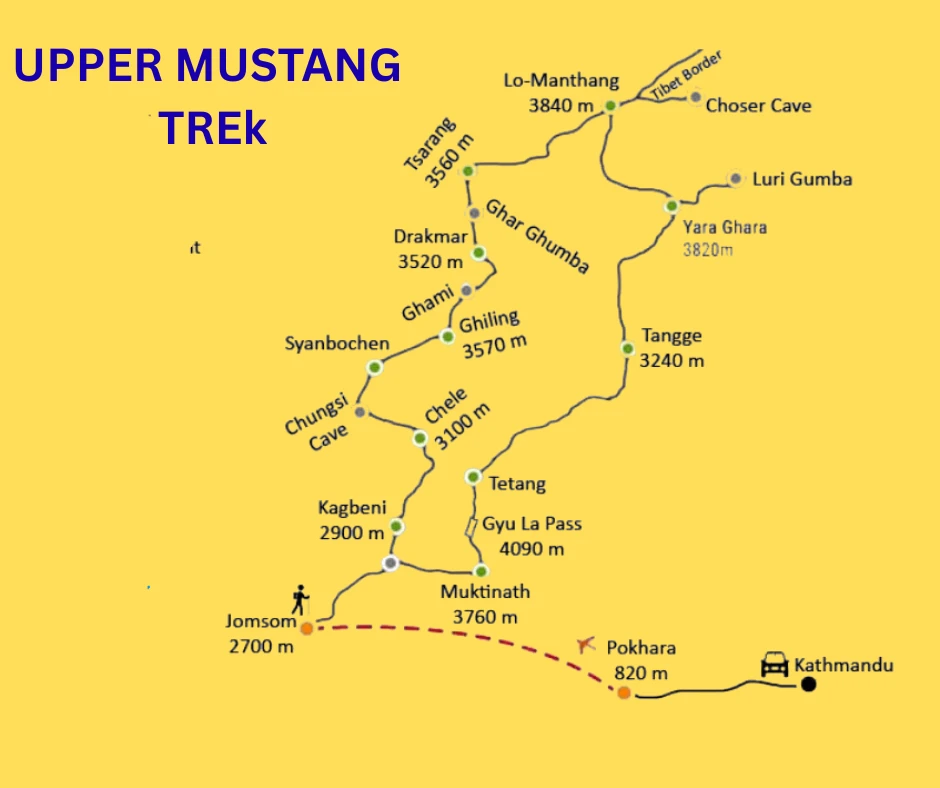
Most trekkers fly into Jomsom and walk the short stage to Kagbeni—the official gateway to Upper Mustang. The first day or two follow the wide, stony riverbed of the Kali Gandaki, passing through the interesting village of Chhusang with its ancient cave dwellings. The landscape is already dry and dramatic, with towering cliffs and the sound of wind constant. After crossing the restricted-area checkpost at Kagbeni, the trail climbs more steeply to Chele (Chaile). Here you begin to feel the transition: greener fields disappear, replaced by barren slopes and the first whitewashed houses.
Entering Upper Mustang: Chele to Ghiling / Dhakmar (Into the Desert World)
After Chele the path climbs through narrow canyons and over small passes (such as Yamdo La ~3,600 m). You reach Samar, then descend and climb again to Syangboche/Geling and onward to Dhakmar. The terrain opens into high, arid plateaus. Villages consist of flat-roofed, whitewashed stone houses, mani walls, and small gompas. The air is dry and crisp, the sunlight intense, and snow peaks of Annapurna and Dhaulagiri appear distant on the horizon. The silence is profound—broken only by wind, occasional birds, and the tinkling of yak bells.
Ghami to Tsarang: The Cultural Heartland
Ancient mani wall near Ghami—one of the longest in Nepal.
Beyond Ghiling you pass the impressive mani wall of Ghami and reach the village of Dhakmar with its striking red and white rock formations. The trail continues to Tsarang (Charang), an important historic settlement with a large gompa, an old royal palace, and a maze of lanes. The landscape is classic Mustang: eroded cliffs painted in red and ochre, barley fields fed by narrow irrigation channels, and the constant presence of Buddhist symbols—chortens, prayer flags, and carved mani stones.
Lo Manthang: The Walled City of the Kingdom
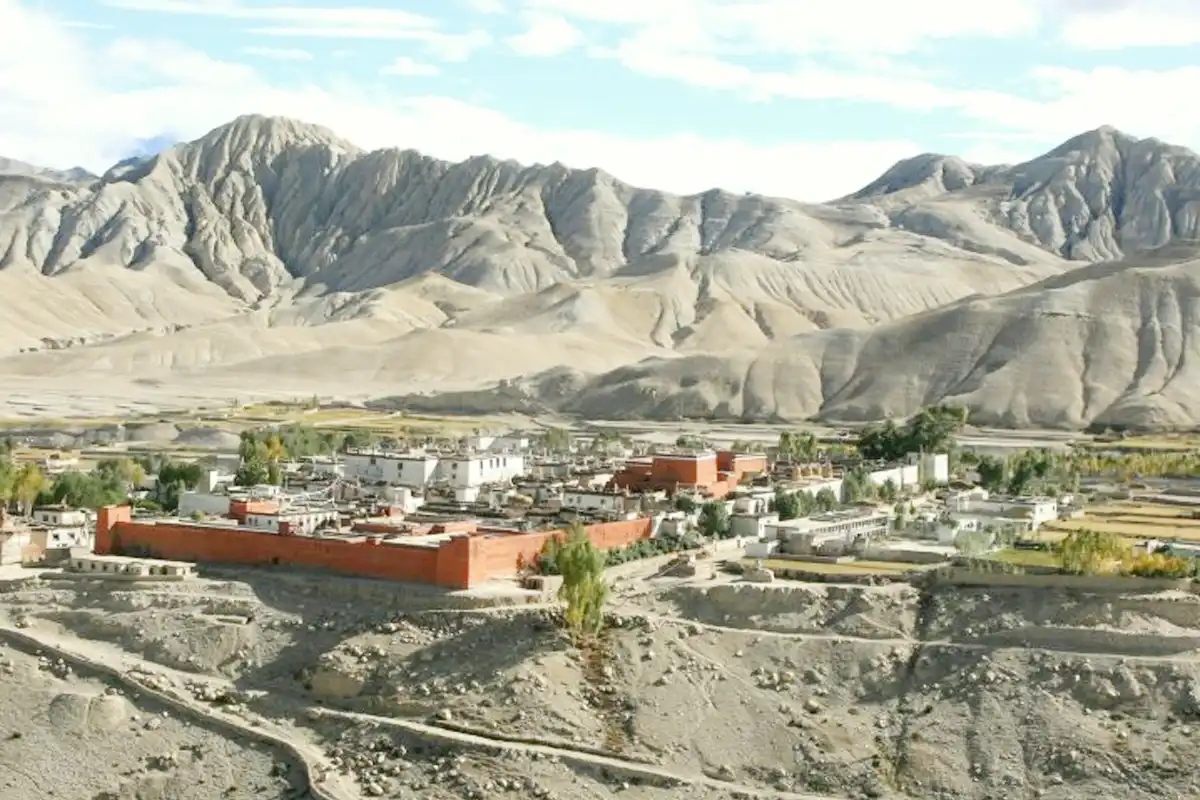
The ancient walled capital of Lo Manthang (3,840 m)—heart of the old kingdom.
After a steady climb the trail arrives at Lo Manthang—the walled city that was once the capital of the Kingdom of Lo. Inside the ancient walls you find the royal palace, three major gompas (Thubchen, Jampa, and Chode), old chortens, and traditional flat-roofed houses. This is the cultural and spiritual highlight of the trek. Spend at least one full day (or two) exploring the city, visiting monasteries, and taking short side trips to nearby caves or Namgyal Gompa. The atmosphere is timeless and peaceful—a living museum of Tibetan Buddhist culture.
The Descent into Green: Lo Manthang to Muktinath / Jomsom
The return journey usually follows a different path, descending through Yara and Tangge or via Tetang and the high Ghyu La pass to Muktinath. Muktinath is a famous pilgrimage site with Hindu and Buddhist temples and 108 water spouts. From there the trail drops quickly to Jomsom, bringing you back to greener vegetation, apple orchards, and the familiar roar of the Kali Gandaki. Suddenly you are again among jeeps, more trekkers, and the conveniences of the main Annapurna trail.
Unforgettable Highlights of the Circuit
The Upper Mustang Trek is defined by recalling the very specific instances that have been left in the memory.
Permit Navigation
Due to the area being a restricted zone (on the border with Tibet) and stricter policies enforced here than usual, Upper Mustang no longer allows you to obtain permits yourself. A registered agency must handle the paperwork. You will need three special permissions:
There is a "minimum number of trekkers" rule: solo trekking is prohibited, but agencies can pair you with another trekker if needed (you still require a guide).
Seasons of the Mountain: When to Go
Timing is everything on the Upper Mustang Trek. The best windows are spring (March to May) and autumn (September to November).
Autumn: This is often the peak season. With post-monsoon clarity, the air is crisp and clean, giving the sharpest views of distant peaks. Days are mild, nights cool, and fewer clouds mean stunning sunsets over the red cliffs.
Spring: Pleasant temperatures, blooming wildflowers in lower areas, and the chance to witness the colorful Tiji Festival (usually May). It's slightly warmer than autumn but can be windier in afternoons.
Winter and Monsoon: Generally possible due to the rain shadow (minimal rain even in summer), but winter brings cold nights and possible snow on high passes, while summer can be dusty/hot with strong winds. Many prefer to avoid extremes.
Why Choose Upper Mustang Trek?
If you're looking for a journey that feels ancient and untouched, this is it.
The Upper Mustang Trek offers travelers a rare chance to escape the "trekking highways" of Nepal and step into a hidden world where time stretches into eternity. It’s quiet here. You don’t fight crowds on trails or queues at viewpoints. Instead, you wander remote villages near the Tibetan border, where life follows the rhythm of seasons, prayer, and wind. Every step reveals discoveries—whether colorful prayer flags against deep blue skies, eroded canyons like painted sculptures, or the profound silence of ancient gompas. It’s for those who want the real cultural Himalayas, without the commercial gloss.
The Upper Mustang Trekking Schedule
| Day | Activity / Route | Elevation (Meters / Feet) | Duration |
| Day 1 | Arrival in Kathmandu (1,350 m / 4,430 ft) and transfer to Hotel | 1,350 m / 4,430 ft | — |
| Day 2 | Drive to Pokhara (6/7 hours’ drive) | 820 m / 2,690 ft | 6–7 hours drive |
| Day 3 | Fly to Jomsom (2,715 m / 8,907 ft) / 22 minutes flight, trek to Kagbeni | 2,807 m / 9,209 ft | 22 min flight + 4–5 hours trek |
| Day 4 | Trek from Kagbeni to Chaile | 3,080 m / 10,102 ft | 5–6 hours trek |
| Day 5 | Trek from Chaile to Geling | 3,510 m / 11,513 ft | 5–6 hours trek |
| Day 6 | Trek from Geling to Dhakmar | 3,820 m / 12,529 ft | 5–6 hours trek |
| Day 7 | Trek to Lo Manthang (3,780 m / 12,402 ft) via Ghar Gompa | 3,780 m / 12,402 ft | 5–6 hours trek |
| Day 8 | Lo Manthang Exploration (rest/acclimatization + city/gompas) | 3,780 m / 12,402 ft | — |
| Day 9 | Lo Manthang Exploration (side trips to caves/Namgyal Gompa) | 3,780 m / 12,402 ft | — (optional walks) |
| Day 10 | Trek from Lo Manthang to Yara Gaon via Lo La Pass | 3,530 m / 11,578 ft | 5–6 hours trek |
| Day 11 | Excursion hike to Luri Gompa and back to Yara | 3,850 m / 12,628 ft (Luri) | 3–4 hours trek |
| Day 12 | Trek from Yara to Tanggye | 3,240 m / 10,627 ft | 5–6 hours trek |
| Day 13 | Trek to Chuksang | 3,050 m / 10,004 ft | 5–6 hours trek |
| Day 14 | Trek to Jomsom | 2,715 m / 8,907 ft | 4–5 hours trek |
| Day 15 | Fly to Pokhara | 820 m / 2,690 ft | 20–25 min flight |
| Day 16 | Drive back to Kathmandu (6/7 hours’ drive) | 1,350 m / 4,430 ft | 6–7 hours drive |
| Day 17 | Final departure | — | — |
Upon your arrival at Kathmandu International Airport, you will be welcomed by our representative. You will be then transferred to the hotel. Later, you can take a good rest or walk around the local market in your free time.


After the early breakfast, you will be taking a scenic drive to Pokhara. The route to Pokhara includes some small to larger settlements, green hills, the Trishuli River plus occasional views of the mountains. There will be several breaks for the food/drinks and the toilet. After checking into the hotel; you can go for an evening walk around Phewa Lake. The sunset view from the lakeside looks stunning. For the food and drinks, you can find so many good options in Lakeside.
With an early morning flight, you will be arriving at Jomsom airport. You enjoy the greater views of the mountains during the flight. Upon arriving at Jomsom, you will be starting the journey to Kagbeni. The journey to Kagbeni from Jomsom is through a windy and rough terrain. Kagbeni is one of the most beautiful villages in Annapurna with a unique culture and traditions. The gateway to Upper Mustang, you can enjoy exploring the wonderful village in your free time. You will be staying overnight at a local teahouse.
Passing through the beautiful village of Tangbe, you will be heading towards Chaile for the night. Along the way, you will get the chance to go through the barley fields, apple farms, and other farmland. Upon crossing the Chhuksang village, you will pass a stream to reach the destination of the day. You will be staying overnight at a local lodge.
Like other days, the trek starts after breakfast. The morning walk leads towards a beautiful village of Samar, then to a gorge. Upon crossing the gorge, you will be reaching a wonderful chorten. The route then follows and passes the stream to reach Syangmochen top. You will be then taking a downhill route to get to Gelling for the night. You will be staying overnight at a local teahouse.
Following the wonderful path of viewing the stunning landscapes and some mountain views, you will be trekking to Dhakmar today. In Dhakmar you will get the chance to visit one of the oldest monasteries of Lo Gekar Monastery. It was built by the great Guru Rinpoche back in the 8th century. You can go around and explore the wonderful monastery. You will be staying overnight at a local teahouse.
The walk starts with a short downhill towards the Charangchu river then it diverted into an uphill climb to reach a ridge passing the wonderful village of Tholung. The trail then progresses towards a large chorten which is in between Tsarang and Lo. The final section of the walk towards Lo Manthang includes a high pass of 3850 meters, you will then further be climbing towards Lo Manthang village. Lo Manthang is one of the most beautiful places to be during the whole trip. You will be staying overnight at a local teahouse.
This is our ultimate destination for this trip that's why we went to a take one-day rest. day Tenth will be exploring around the exciting Lo-Manthang village and hiking to Chhuser cave. The Lo-Mangthang village with more the one hundred and fifty households is one of the kingdoms. The village has several monasteries, and Chhortens and has a beautiful palace inside it. The exploration of the village also offers to witness the traditions and cultures followed by the people and the religion they are practicing. Also, the exploration of the city allows getting closer ideas of the connection between Mustang and Tibet in the past and the present. You will be staying overnight at a local lodge.
One of the exciting days, today, you will be trekking to Yara Gaon via Lo La pass. Elevated at 3950 meters above sea level, the Lo La Pass is an easy yet interesting pass. Upon passing the wonderful pass you will be getting to Yara Gaon for the night. You will be staying overnight at a local teahouse.
The day is dedicated to exploring the village. You will be doing a short hike to Luri Gompa from Yara. Yara is a beautiful 12th cave monastery. You can visit the fantastic places before getting back to Yara for the night. You will be staying overnight at a local lodge.
After the early morning breakfast, you will be trekking to Tanggye this day. Following an easy trekking trail with good views of landscapes and mountains, you will be getting to Tanggye, which is a beautiful village in the hills with good views of mountains. You will be staying overnight at a local lodge.
Following the wonderful views of mountains and the landscapes, you will be trekking to Chuksang today. The trek through the Kali Gandaki Valley is a fabulous journey. Upon reaching Chuksang, you will be staying overnight at a local lodge.
You will be taking a downhill route to get back to Jomsom. Jomsom is the headquarters of the Mustang region. You can explore the local village in your free time. You will be spending the night at a local lodge.
With an early morning flight, you will be getting to Pokhara. In Pokhara, you can do a half-day sightseeing to explore Phewa Lake, Devis Falls, and Gupteshwor Cave. In the evening, you can collect a good sunset view from Phewa Lakeside.
Collecting the great memories of the Upper Mustang Trek, you will be driving back to Kathmandu today. In the evening, you can walk around the local bazaar. Then you can prepare your luggage. You will then be staying overnight at a hotel.
After an amazing week in Nepal, you will be transferred to Kathmandu airport to catch your return flight home. Our representative will assist you in transferring to the airport, with the hope of seeing you again in Nepal.
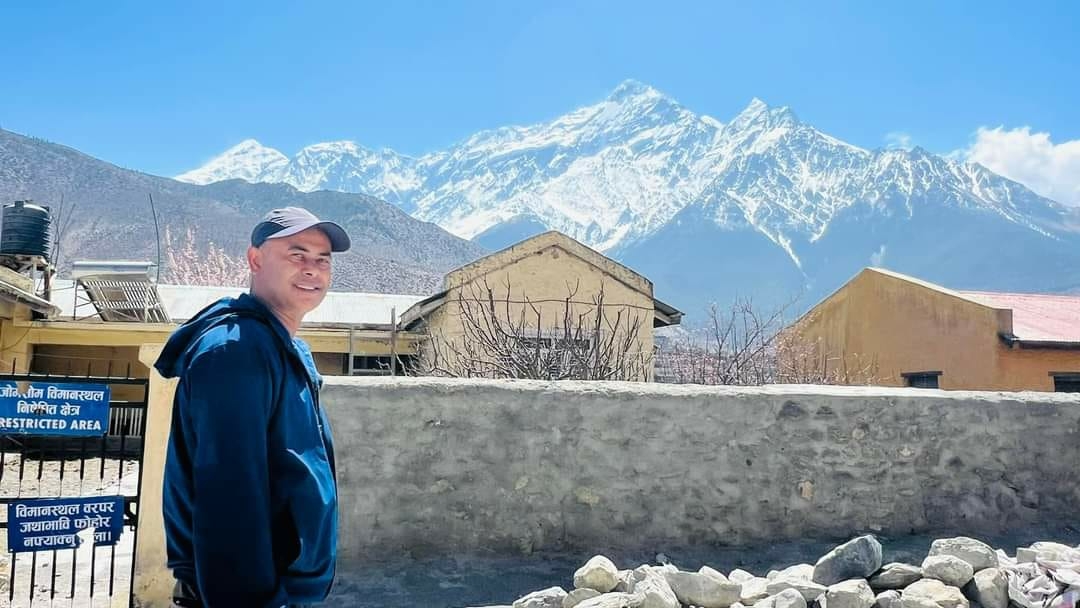
Upper Mustang Trek – Trip Info (2026 Overview)
Trip Name: Upper Mustang Trek (Forbidden Kingdom Trek / Lo Manthang Trek) Region: Mustang District, Annapurna Conservation Area, Nepal (restricted zone bordering Tibet/China) Duration: 16–17 days total (including arrival/departure; 12–14 days actual trekking) Difficulty Level: Moderate
Why This Trek? Upper Mustang offers one of Nepal’s most unique cultural experiences: a journey into a hidden, timeless Tibetan-Buddhist kingdom with surreal desert landscapes, ancient gompas, and profound isolation—far removed from the greener, busier trails of the main Annapurna region.
I recently went on the Upper Mustang Trek with Adventure A One Treks, and I couldn't be more pleased with the experience. The cost was very reasonable and the service was top-notch. The guides were knowledgeable, friendly, and helpful. The views were stunning, and the trek was an adventure of a lifetime. I highly recommend Adventure A One Treks for anyone looking for an amazing trekking experience at an affordable price. 5 stars!

Ajeeb Gave us the most tremendous experience. Nothing was too much trouble for him. He was an expert host, guide and companion. Our group had the experience of a lifetime in an area of incredible beauty. Thank you Ajeeb - it was wonderful
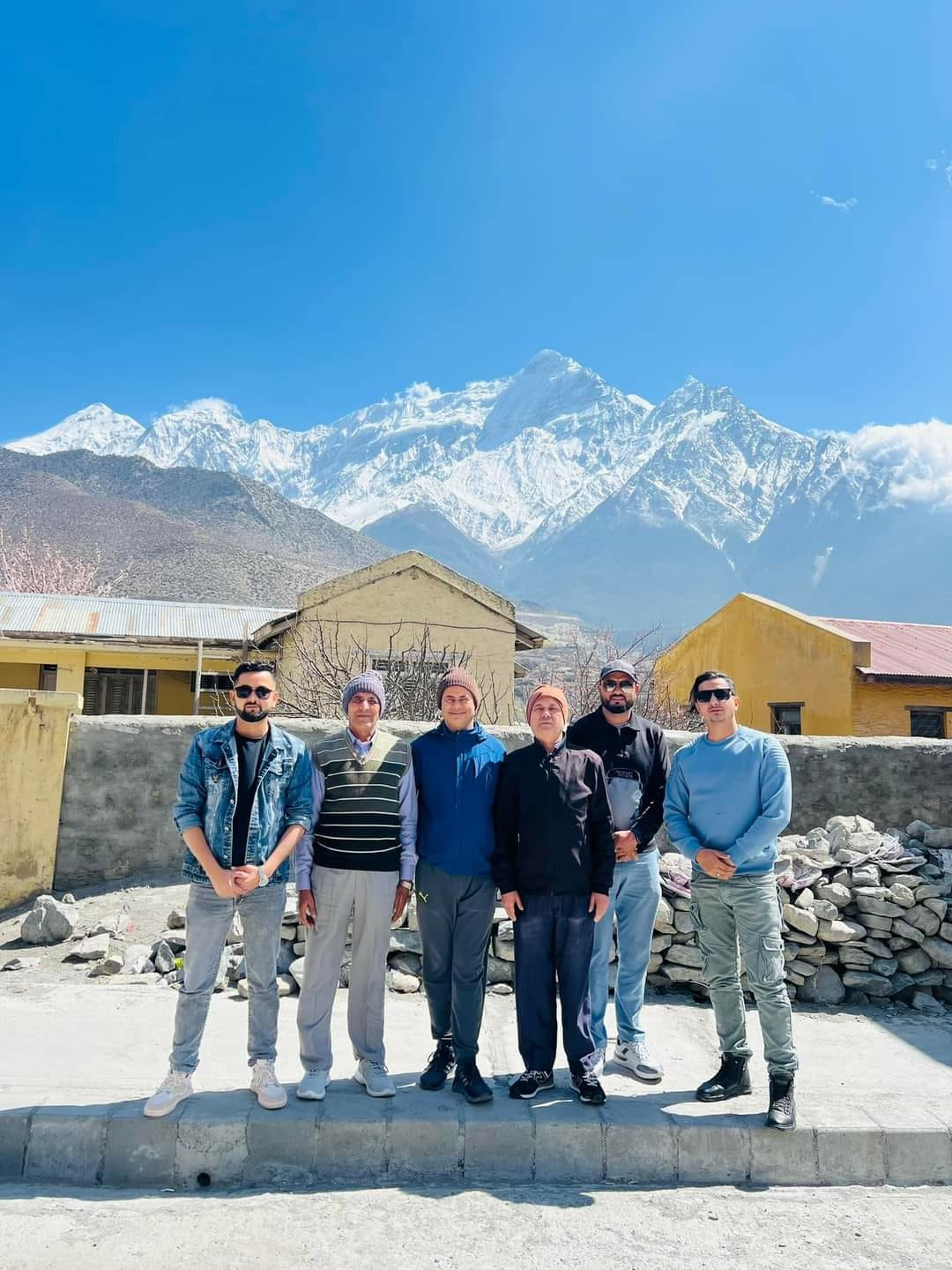
Six of us booked with A1trek as this was a return visit to Nepal for two of us following the previously successful trip booked and managed by Ajib. We chose to go to Upper Mustang this time and as our average age was in the mid sixties and of mixed experience, we soon realised that we had collectively been a little overly ambitious attempting to fully appreciate the wonderful sights and trekking with our agreed route. One measure of a good operator is that they can change things quickly, efficiently and without any fuss. Ajib did all of that. We ended up with a fantastic trip, thanks to his experience and professionalism. This is a company that we are all very grateful to for turning a challenge of our own making into a huge success. Highly recommended.
Ajeeb organised everything for us, from meeting us at the airport to hiring out equipment we needed and being the most fantastic, flexible guide. We wanted to visit the ancient capital of Lo Mantang in Upper Mustang, all our permits , jeeps & accommodation were organised for us in advance. We ended up having to change some of our itinerary & Ajeeb managed to re organise everything as we went along, he never made us feel as if anything was a problem, he quietly got on with any changes, nothing was too much bother. We had some great porters who accompanied us, again nothing was too much trouble, they taught us a Nepalese card game and were lovely company. The trek itself was out of this world, everything we were hoping it would be. The scenery was spectacular, really dramatic, wonderful to see Buddhist culture, many things haven't changed in centuries. A thoroughly amazing experience, thank you.
This was the most fantastic experience we have ever had. We walked through the most remote and majestic landscape - it was gruelling but so rewarding. Ajeeb was a wonderful guide and could not do enough for us. Lomanthang was a magical place to visit. Definitely a trip for any one who wants an adventure. Thank you Ajeeb; we will never forget our Upper Mustang Trek.
The Upper Mustang Trek is a remarkable journey into Nepal’s hidden Himalayan kingdom, once closed to outsiders. Trek through a dramatic high-altitude desert landscape, ancient caves, colorful cliffs, and traditional Tibetan-influenced villages that feel untouched by time. With Adventure A One Treks, you’ll explore the walled city of Lo Manthang, visit centuries-old monasteries, and experience the unique culture of the former Kingdom of Mustang. This trek offers stunning views of Nilgiri, Dhaulagiri, and Annapurna ranges, combined with expert guidance, proper acclimatization, and seamless logistics. Perfect for travelers seeking a cultural adventure, breathtaking scenery, and an off-the-beaten-path Himalayan experience.
The Upper Mustang Trek with Adventure A One Treks was a truly unique journey into one of the most fascinating regions of Nepal. The landscapes of Upper Mustang are unlike anywhere else—dry desert mountains, deep canyons, ancient caves, and colorful Tibetan-influenced villages that feel timeless and mysterious. Exploring the walled city of Lo Manthang and surrounding areas was a cultural highlight of the trek. Everything was very well organized, and the journey felt smooth and comfortable from start to finish. The team was professional, supportive, and always attentive to our needs. I highly recommend this trek for anyone looking for a rare blend of culture, history, and dramatic Himalayan scenery.
My Upper Mustang Trek with Adventure A One Treks was an unforgettable experience filled with adventure and cultural discovery. The region of Upper Mustang felt like stepping into a preserved ancient kingdom, with its red cliffs, centuries-old monasteries, and traditional Tibetan-style villages. Every day of the trek offered something new and fascinating. The entire trip was managed very professionally, including accommodation, permits, meals, and logistics. The staff was experienced, friendly, and always made sure we were comfortable and safe throughout the journey. This trek is perfect for those who want something truly different from the usual Himalayan routes, and I would definitely recommend Adventure A One Treks.
Upper Mustang Trek – Equipment List (2026 Recommendations)
Pack light for the arid high-desert conditions: aim for 10–12 kg total main bag (porter carries 15–20 kg max) + 6–8 kg daypack. The trek is dusty, windy, sunny, and dry (low humidity, strong UV, cold nights at Lo Manthang ~3,840 m), with basic teahouses providing blankets, meals, and occasional charging (extra fee). Rent heavy items (sleeping bag, down jacket, duffel) in Thamel, Kathmandu—cheaper and saves flight weight.
Kathmandu Packing Tips (January 23, 2026)
Upper Mustang is one of the restricted areas of Nepal, at one time closed for outside visitors, opened in 1992. Interested travelers can enter Upper Mustang from Kagbeni village onwards to Lo Manthang, the former forbidden walled kingdom. Where all trekkers require to obtain a special permit, the fee is more than another normal trekking region. so, after taking a special permit you can enter the forbidden land.
The native of Upper Mustang is known as Lobas and the people of Lo as related to Upper Mustang and Lo-Manthang. Follows strong Buddhism religion and culture similar to their Tibetan predecessors across the border. Also practice Bon cult, a pre-Buddhism, an ancient religion, worship of nature and mountain spirits.
On treks to Upper Mustang, one can notice rows of prayer walls and spinning wheels. Probably the longest Mani walls in Nepal and in the whole Himalayas, as well as visiting monasteries and places of cultural interest.
For interested people with limited time in Nepal and who can take a four-wheel drive in a local jeep or similar vehicle. As the motorable road has reached as far to Nepal and Tibet / China border near high Karo-La pass. Can take a drive to Lo-Manthang taking less than a week, having overnight stops in a few interesting villages on the route. But the road is quite a dusty dirt road, leads over several passes and a narrow gorge. Driving between a high canyon and windblown towering eroded cliff, but a very scenic place to travel and to gain great experience.
Yes, Upper Mustang is an extension that looks like Tibet, one of the vast and highest South Western plateaus of Tibet. 90 % of the area is a mountainous desert with sparse vegetation and few trees around villages with green crops. Although barren and arid desert landscapes, but one of the most picturesque countries, a true heaven for photographers.
The whole Kaligandaki River from Tatopani, Ghasa to Jomsom and onwards to Upper Mustang till Karo-La Pass. It Falls within the Old Trans Himalaya Salt Trade Route of Nepal & Tibet, where trade still exists at present. But in smaller ways, than it used to be in the early days when Tibet was not annexed by mainland China.
Upper Mustang the restricted area starts and ends at Kagbeni village. Which is a few hour's walks from Jomsom the headquarters town of the whole Mustang district. one path leads to Muktinath Hindu religious place and one path leads to the Restircated area Lomang-thang.
A licensed guide is mandatory. Porters are not required by law but are highly recommended (and usually included in packages) to carry your main bag (15–20 kg max per porter). Most packages provide 1 porter for every 2 trekkers.
Not legally, but practically yes—almost all agencies require proof of insurance before issuing permits or starting the trek. It must cover high-altitude trekking (up to at least 4,500 m), full emergency helicopter evacuation, medical expenses, and trip cancellation/delay.
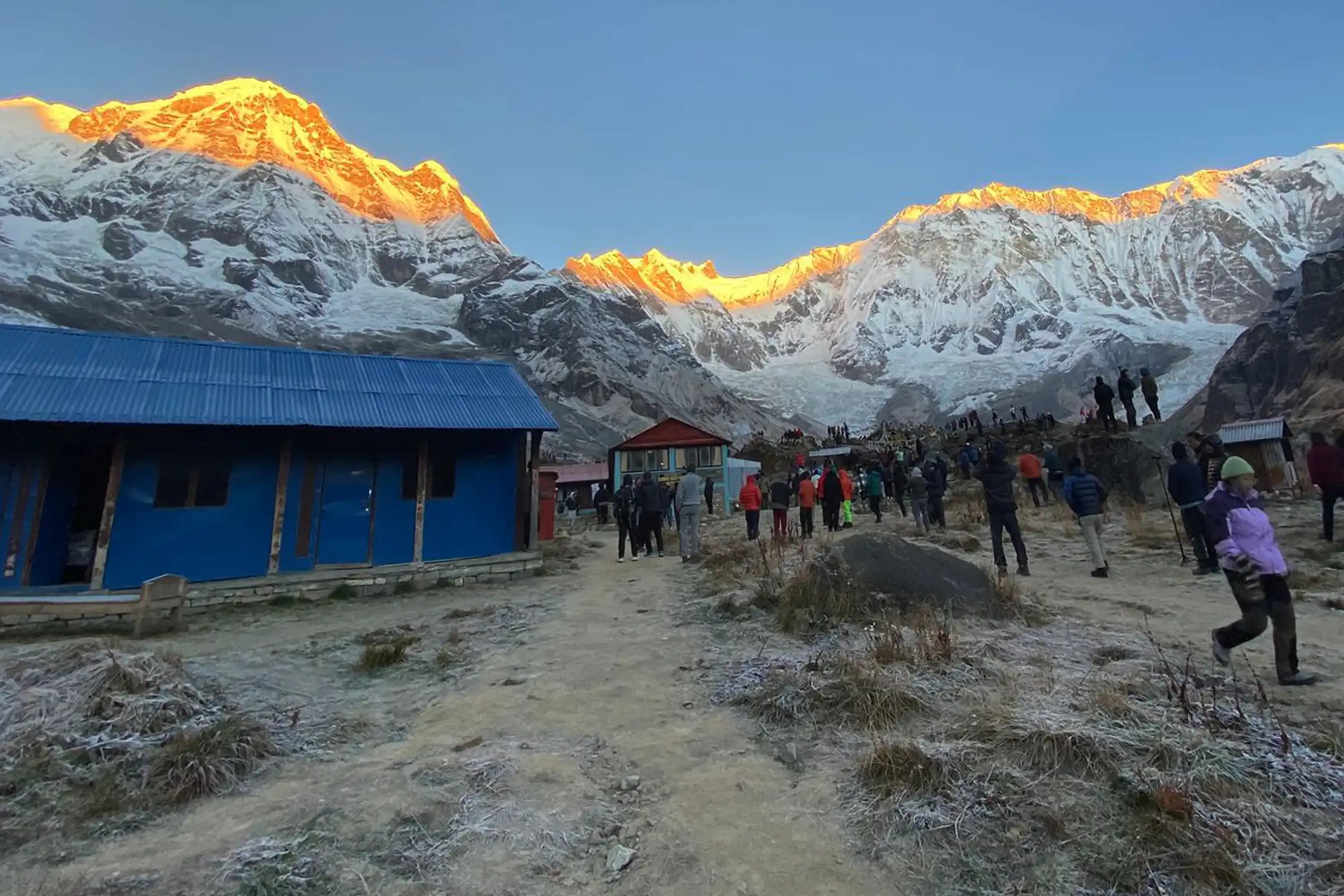

| No of people | Price per person |
|---|---|
| 1 - 1 | $1,085 |
| 2 - 4 | $990 |
| 5 - 10 | $910 |
| 11 - 20 | $850 |