Summit Gokyo Ri (5,357 m) for the sunrise panorama of Everest, Lhotse, Makalu and Cho Oyu: route, difficulty, start times and packing — from A One Treks.
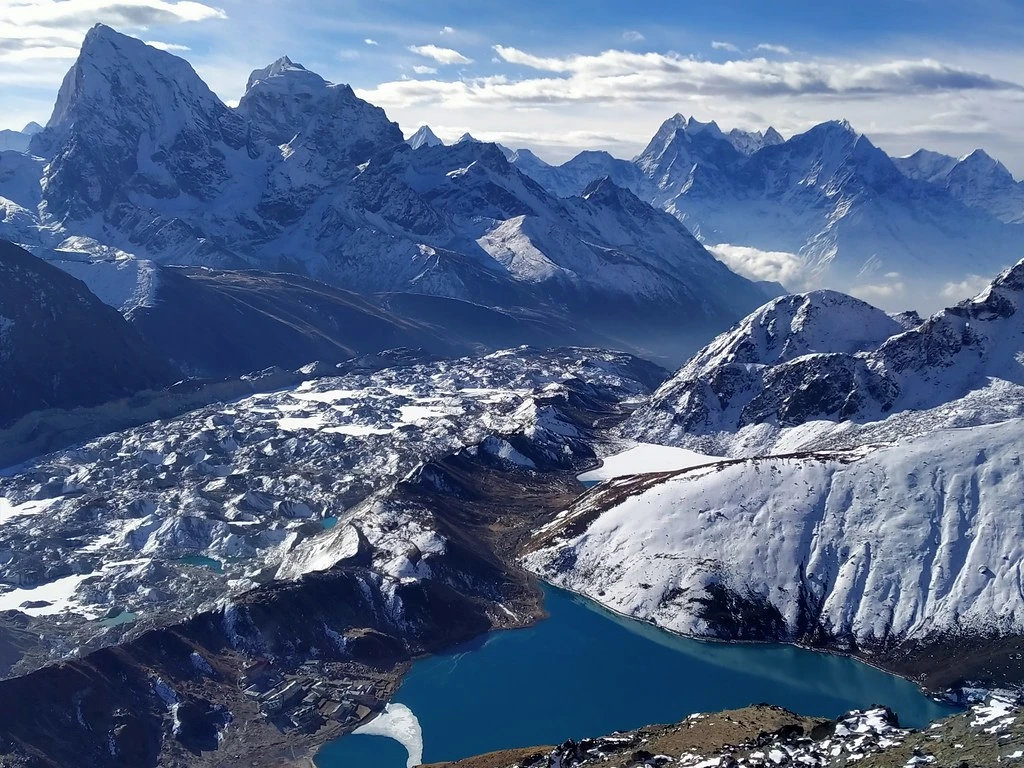
Gokyo Ri is a 5,357-metre (17,575 ft) viewpoint peak above Gokyo village in Sagarmatha National Park, and it delivers arguably the purest sunrise panorama in the Himalaya: Everest, Lhotse, Makalu and Cho Oyu — four of the six highest mountains on Earth — on one horizon, with six glacial lakes and the Ngozumpa Glacier stretched out below. It is a steep, non-technical pre-dawn climb of roughly 567 m over 3.5 km, taking 2h30–3h up and 1h30–2h down at a relaxed plodding pace. Most trekkers leave Gokyo at 4:00–4:30 AM to stand on the summit ridge as the first light hits the peaks between 6:00 and 6:45 AM, depending on the season.
This guide is the one we brief our own 13-day Gokyo Valley Trek clients with before their summit morning. It covers the exact altitude profile, how hard the climb really is, when to start each month, what to carry, how to read the mountains from the top, and how Gokyo Ri compares with Kala Patthar. If you follow the route timing and acclimatization plan below, you have the best honest chance of being on the ridge when the sky turns orange.
Key Takeaways - Gokyo Ri stands at 5,357 m (17,575 ft), climbed from Gokyo village (~4,790 m) for a gain of roughly 567 m over 3.5 km — the hardest sustained climb of the Gokyo Valley route, but no ropes or technical skills. - Plan a 4:00–4:30 AM start to hit the clear summit for sunrise between 6:00 AM (October) and 6:45 AM (March–April); arrive at least 45–60 minutes early in colder seasons. - The climb splits into three sections: village → first ridge (+210 m), first ridge → second ridge (+200 m), second ridge → summit (+157 m);
allow 2h30–3h up, 1h30–2h down. - From the top you see Everest, Lhotse, Makalu and Cho Oyu — four of the six highest mountains in the world — plus the ~36 km Ngozumpa Glacier and six Gokyo Lakes. - It's a moderate-to-challenging Himalayan viewpoint day: pre-dawn temperatures run −10 to −18°C, wind 20–40 km/h, and oxygen is roughly half of sea level at the summit. - Permits are the two standard Khumbu fees (Sagarmatha NP NPR 3,000 + Khumbu Pasang Lhamu NPR 3,000); there is no TIMS card in the Everest region.
Yes — for most Gokyo trekkers it is the single best day of the whole route. Gokyo Ri is lower (5,357 m) than Kala Patthar (5,545 m) but the view is more complete: where Kala Patthar frames Everest across the Khumbu Glacier, Gokyo Ri opens a 360° panorama with four 8,000-
metre peaks, the lake chain, and Ngozumpa Glacier all in one frame. It is also dramatically quieter — a fraction of the trekkers make the walk up from Gokyo compared with the EBC viewpoint trail.
The honest trade-off: the climb is steeper than Kala Patthar's (roughly 567 m of gain versus
~380 m) and the summit morning is physically demanding at altitude. Physically, most reasonably fit trekkers manage it; altitude, cold and pack weight are the real variables. If you arrive at Gokyo correctly acclimatized — which means two nights above 4,000 m and a full rest day before the summit morning — the sunrise hike is a demanding but squarely achievable day.
| Requirement | Detail |
| Fitness baseline | Walk 4–6 h/day for 8–10 days before summit day; comfortable ascending ~500 m/day at altitude |
| Acclimatization | At least one full rest day at Gokyo (4,790 m) after two nights above 4,000 m; see Step 1 |
| Headlamp | Mandatory — you start in darkness and return in full light |
| Warm layers | −20 °C capable: insulated jacket, gloves, buff, warm hat, windshell |
| Footwear | Trekking boots; microspikes or yak-trekker crampons in November–April |
| Time | ~5 hours round trip, plus 45–60 minutes on the summit |
| Difficulty | Moderate–challenging; strenuous above 5,000 m |
| Guide | Optional legally; recommended for pacing, weather reads and safety (included on all A One Treks trips) |
The Everest-region trek overview explains how Gokyo fits into the wider Khumbu network before you plan specifics. If you are still choosing between routes.
The Gokyo lake chain seen from the approach: the lakes and moraine are your visual companions for the days before the Gokyo Ri summit morning.
Micro-outcome: by summit day you have slept two nights above 4,000 m with the night before the hike spent at Gokyo, which is the single biggest factor in whether the sunrise morning succeeds.
Altitude sickness is the dominant risk on this climb — not the trail itself. A peer-reviewed study of 150 teahouse trekkers in the Solu-Khumbu region that includes this exact route measured acute mountain sickness (AMS) incidence climbing sharply with sleeping
altitude: ~0% between 2,500–3,000 m, 10% between 3,000–4,000 m, 15% between 4,000–4,500 m, and 51% between 4,500–5,000 m (Vardy et al., solukhumbu teahouse trekkers cohort, retrieved 2026-08-28). Gokyo village sits at ~4,790 m — inside the 51% band — which is exactly why a structured approach matters more than leg strength.
The acclimatization schedule we use on our Gokyo itinerary:
The study's underlying finding is worth taking personally: trekkers who developed AMS had ascended a significantly higher mean in the prior 72 hours (~846 m vs ~722 m for healthy trekkers), so the fix is bounded — keep daily net sleeping-altitude gains near 500–600 m and your risk stays comparatively modest.
Micro-outcome: you leave Gokyo at the hour that puts you on the summit ridge before first light, with a comfortable headroom buffer.
Sunrise at Gokyo Ri changes by about an hour across the trekking year. The region's October sunrise is roughly 6:00 AM at Gokyo Ri (civil sunrise from nearby Kala Patthar/Khumjung is
~5:51–6:08 AM through October), while in late winter and early spring light arrives later — around 6:30–6:45 AM in March–April (local 2026 sunrise tables, retrieved 2026-08-28). First light actually catches the very highest peaks before the sun clears the horizon, so plan to reach the summit 45–60 minutes before predicted sunrise in spring, when the gap between civil dawn and full sun on the faces is widest.
Recommended start times by season:
| Season | Summit morning start | Target arrival | Sunrise window |
| October (prime) | 4:00–4:30 AM | 6:00 AM | 5:50–6:00 AM |
| November | 4:30–5:00 AM | 6:15 AM | ~6:10 AM |
| March–April | 5:00–5:30 AM | 6:30 AM | 6:30–6:45 AM |
| May | 4:30–5:00 AM | 6:15 AM | ~6:10 AM |
Your headlamp has to last the full ascent — roughly 2h30–3h of darkness. Carry spare
batteries or a second light; lithium cells drain faster in −15 °C air, so keep the spare in your inner pocket rather than the pack lid.
Micro-outcome: you reach the summit ridge having broken the climb into three predictable stages, each one shorter than the last as the air gets thinner.
The route from Gokyo village follows a well-trodden moraine-and-slab path up a shoulder of the massif. Published 2026 operator route profile retrieved 2026-08-28):
| Section | Distance | Elevation gain | Time (up) |
| Gokyo village (4,790 m) → first ridge (~5,000 m) | 1.2 km | +210 m | 45–60 min |
| First ridge (~5,000 m) → second ridge (~5,200 m) | 1.5 km | +200 m | 40–55 min |
| Second ridge (~5,200 m) → summit (5,357 m) | 0.8 km | +157 m | 25–35 min |
| Total | ~3.5 km | +567 m | 2h30–3h |
How to pace the three sections:
Verification: if you can hold the pace of "slow, steady, no gasping" through all three sections, you are on plan. The summit ridge is unmistakable — a clear terraced crest lined with prayer flags and a stacked cairn.
Level headlamp, level pace. The margin on this climb is altitude and cold, not miles. Trekkers who start too fast typically hit section two (5,000–5,200 m) low on steam; the fix is a deliberately slower section one.
Micro-outcome: you can identify every major peak on the ridge and point out the lake chain and glacier below — the difference between "a big mountain view" and a Gokyo Ri summit.
From the 5,357 m crest the view orders itself west to east:
Verification: Aim your camera east-then-south across the skyline in that order and you will check off all four giants. A quick test for new summits: if a photograph shows a teal lake chain curving away to the west below the ridge line, you are looking from Gokyo Ri, not Kala Patthar.
Micro-outcome: you return to Gokyo for a proper breakfast, having protected your knees and avoided the temptation to linger at altitude.
The descent repeats the three sections in reverse but changes character fast:
1. The summit ridge is rubble — microspikes or your poles keep the loose slabs from turning the first 200 m into a slide.
Verification: you are in the teahouse with your summit photo before 9:00 AM if you left at 4:30 AM on a perfect-weather morning — the rhythm the itinerary is built around. If you booked a heli-probe day or buffer, your afternoon is free for the fourth and fifth lakes.
Micro-outcome: you can recognize the five clear turn-back signals before they become emergencies, and you know the mechanical facts about altitude and cold that force the call.
The five turn-back signals:
The science of the risk window:
The same cohort that produced these rates is honest context: the majority of trekkers who sleep at Gokyo do not develop severe AMS, and an ascent plan that keeps net sleeping-altitude gains at ~500–600 m per day materially improves the odds.
Trekkers choosing between the two big Everest-region viewpoints want a direct comparison, so here are the numbers that matter:
Kala Patthar frames Everest across the Khumbu Glacier at 5,545 m — the closest walkable view, but a narrower panorama than Gokyo Ri's four-8000er skyline.
Gokyo Ri | Kala Patthar | |
| Summit altitude | 5,357 m | 5,545 m (188 m higher) |
| Base village | Gokyo (~4,790 m) | Gorak Shep (~5,164 m) |
| Elevation gain | ~567 m | ~381 m |
| Typical climb time | 2h30–3h | 1h30–2h |
| Peaks in view | Everest, Lhotse, Makalu, Cho Oyu | Everest (closest walkable view), Lhotse, Nuptse/Pumori wall |
| Unique framing | 6 lakes + Ngozumpa Glacier | Khumbu Glacier + icefall below Everest |
| Crowds | Quiet by comparison | Busy EBC-corridor trail |
Figure 3 Kala Patthar is physically easier despite the higher summit: ~186 m less net gain from Gorak Shep.
Our guide's short answer: if you want the closest, most iconic Everest frame and fewer climb-metres, Kala Patthar is the efficient choice — which is why our Everest Base Camp Trek puts it on Day 10. If you want the fullest landscape — four 8,000ers, the lakes, the glacier — and you value quiet solitude over the EBC infrastructure corridor, Gokyo Ri is the better morning. The 17-day EBC + Gokyo Lakes combo intentionally stacks both viewpoints onto one trip, crossing the Cho La pass between them,
What to Pack for the Gokyo Ri Sunrise Hike
Packing for the sunrise is packing for a short, cold, altitude-exposed mission, not for the whole trek. Layer by layer:
| Layer / Item | Detail |
| Base layer | Merino or synthetic; avoid cotton against skin |
| Mid layer | Insulated jacket or heavy fleece |
| Shell | Windproof/waterproof outer, hooded |
| Hands/head | Warm gloves, liner gloves, buff, insulated hat |
| Footwear | Broken-in trekking boots; microspikes or loose crampons for snow/ice in Nov–Apr |
| Lighting | Headlamp + spare batteries (kept warm) |
| Hydration/energy | 1–1.5 L warm drink, snacks, high-energy bars |
| Electronics | Camera with charged battery, spare battery in inner pocket; phones lose 30–50% capacity in cold |
| Summits extras | Small dry bag for jacket layers not worn yet |
Full-gloss details for every leg of the trek live in our A One Treks equipment-list article and our guide to tea houses in Nepal for the lodging realities above Gokyo. Bring cash in NPR for the hot-shower and charging fees — the lodges' solar hot water is a real plank of summit-morning comfort.
Common Mistakes to Avoid
If everything is planned correctly, here is the shape of the day: you leave Gokyo at 4:15 AM under a clear sky, headlamp on, and climb in three controlled sections. At 5:45–6:00
AM you stand on the summit ridge, pick out Cho Oyu lightening to the west, then watch the sun catch Makalu's pyramid, Lhotse's wall and finally the crown of Everest as the lakes below turn from slate to teal. You photograph, you identify the fourth and fifth lakes over the Ngozumpa moraine, and by 7:45–8:15 AM you are back in the Gokyo kitchen with a full breakfast.
Measurable success markers: summit reached with no significant AMS symptoms · all four 8,000ers identified · back in the village within 5 hours round trip · breakfast eaten. The stretch goal is the fourth/fifth-lakes loop in the afternoon — the full "big view + big lakes" Gokyo day the itinerary is designed to deliver.
How long does the Gokyo Ri climb take?
Roughly 2h30–3h up and 1h30–2h down — about 5 hours round trip including summit time. Distance is ~3.5 km one way with ~567 m of elevation gain.
Is Gokyo Ri harder than Kala Patthar?
The Gokyo Ri climb itself is steeper — ~567 m of gain versus ~381 m at Kala Patthar — but it starts 374 m lower, so the physical peak altitude is lower. Trekkers generally rate Kala Patthar slightly easier on the legs and Gokyo Ri more rewarding visually; our comparison above lays out both.
Do I need a guide or a permit for Gokyo Ri?
The Khumbu technically allows this trail without a guide, but the two standard permits are not optional: Sagarmatha National Park NPR 3,000 and the Khumbu Pasang Lhamu local fee NPR 3,000 (foreign nationals), and no TIMS card applies in the region. A licensed guide (included on every A One Treks departure) manages the acclimatization timing, the pre-dawn start and the weather call.
Can you see Mount Everest from Gokyo Ri?
Yes — Everest's summit pyramid and Lhotse's face are clearly visible across the Khumbu, alongside Makalu and Cho Oyu. Gokyo Ri is one of the few viewpoints that puts four of the world's six highest mountains in a single panorama.
Ready to Plan Your Gokyo Ri?
You now have the altitude truth (5,357 m), the effort truth (3.5 km, +567 m, 2h30–3h), the timing truth (leave in the dark, reach the ridge before first light), and the honest risk picture (acclimatize first, turn back on symptoms, pack for −20 °C). That combination of verifiable facts is exactly what you need to make the summit morning a memory instead of a struggle.
The practical next step is locking the acclimatization schedule to a real itinerary. See the full day-by-day plan on our 13-day Everest Gokyo Valley Trek trip page — the summit morning is its Day 8 centerpiece — or combine it with EBC on the 17-day EBC + Gokyo combo. Have questions about the climb, the season, or your fitness baseline? Contact A One Treks and our Everest-region guides will talk you through the numbers.