
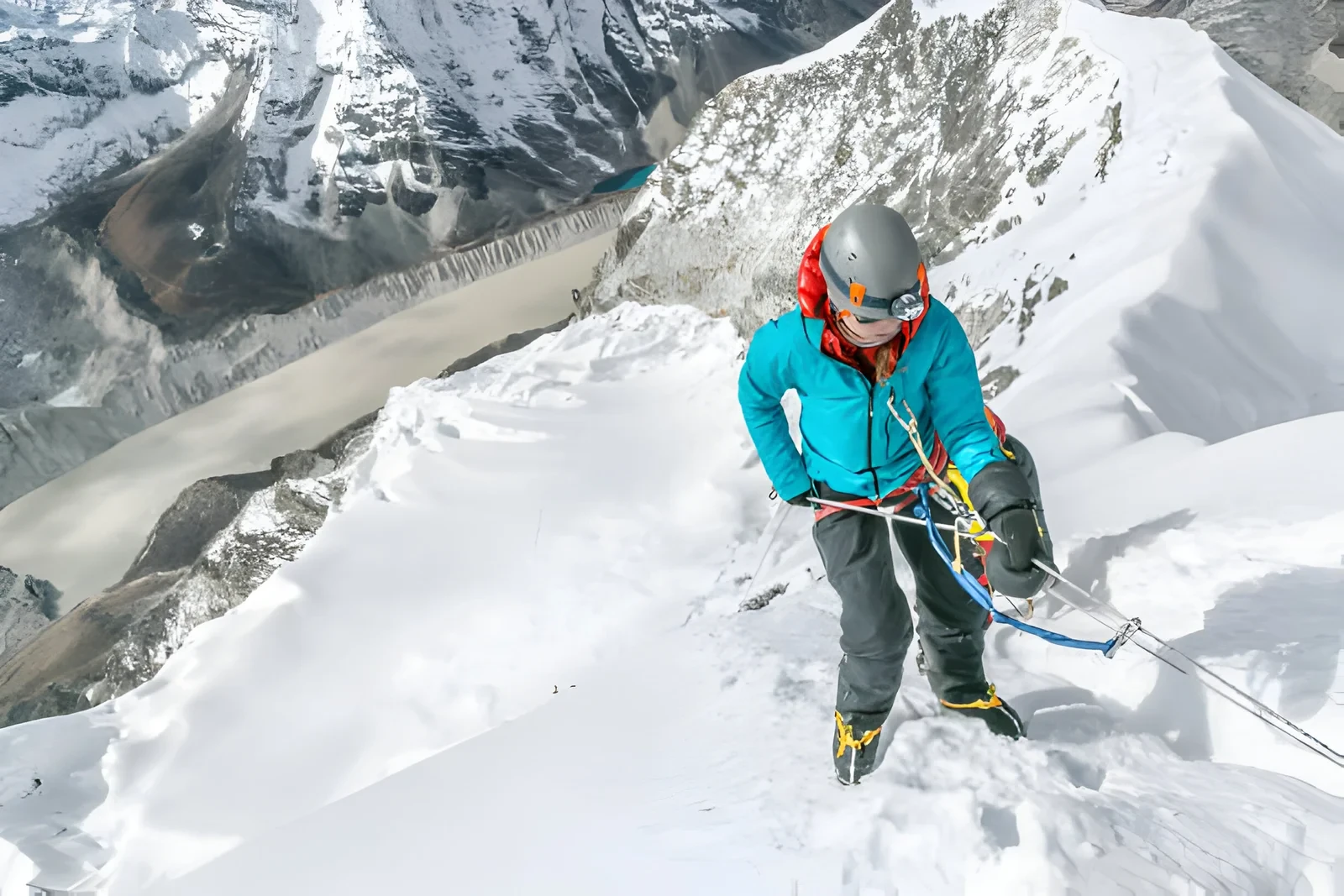
Every single year, hundreds of trekkers stand at Everest Base Camp (5,364 m) and look to the south, where there’s a triangular summit rising from the surrounding glaciers.
Quite a lot of our previous A1 trek guests have asked us this, “Can I climb that?” And the answer, more often than not, is yes!
However, that yes comes with conditions most people are not fully prepared for!
Island Peak, known locally as Imja Tse, sits at 6,189 m in the Khumbu region of Nepal. It is the most popular trekking peak in the country, and it is also one of the most misunderstood.
The word "trekking" in its classification has led countless climbers to underestimate what the mountain actually demands.
Don’t worry! I’ve brought this guide to set the record straight. I’ll be covering how difficult is Island peak climbing, what makes the climb hard, and how to prepare properly.
Island Peak is officially graded PD+ (Peu Difficile Plus) on the international alpine scale and classified as a Group B trekking peak by the Nepal Mountaineering Association (NMA).
On paper, that puts it in the "slightly difficult" category, above a basic snow walk but well below serious technical mountaineering.
In practice, the real-world difficulty is considerably higher than the official grade implies. The main reason is: altitude.
At 6,189 m, your body operates on roughly 50% of the oxygen available at sea level. Every section of the climb that would feel manageable at lower elevation becomes genuinely hard up there!
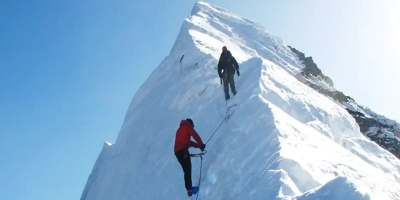
The steep ice headwall, the glacier crossing, the exposed summit ridge: none of these are extreme by alpine standards. But combine them with altitude-driven fatigue, thin cold air, and a summit day that routinely runs 10 to 14 hours, then you know why Island Peak is difficult.
Reportedly, success rates for Island Peak sit between 70% and 85% depending on the operator (ours at A1 Treks is a little high, up to 85%!).
Now, ask yourself: on a peak widely marketed as accessible for beginners, isn’t that a meaningful failure margin? Well, almost every failed attempt traces back to the same root cause: underestimating what the climb actually requires.
To understand the difficulty properly, let me help you understand the structure of the full expedition:
By now, you already know what I’m talking about. The difficulty of Island Peak does not come from one defining obstacle. It comes from several serious challenges stacking on top of each other over the course of a very long day.
Here is what our guides at A1 Treks consistently identify as the core factors, along with the specific sections where each one bites hardest:
This is the question most people are really asking us before booking our Island Peak Climbing package. And let me answer this to you here!
The honest answer is that prior mountaineering experience is not a requirement, but prior high-altitude trekking experience is strongly recommended!
This is the reason we also organize the Everest Base Camp Trek alongside Island Peak Climb for a multi-day high-altitude route before attempting the main summit. This is to give your body an understanding of how it responds above 5,000 m.
In terms of physical fitness, the benchmark our guides at A1 Treks have set is pretty straightforward:
A reputable operator (like Adventure A One Treks) will train everything before the real adventure begins. So, be ready for the training session at Base Camp or High Camp before the summit push.
Our guides will teach you the basics: crampon use, ice axe handling, jumar technique, and basic rope movement.
That said, what you need tot bring to that session should be at least some prior exposure to these tools. Even if only on a local hill or at a climbing gym is the experience you have, that should be more than enough!
But if you arrive at the Base Camp with zero experience of any of this gear, I’m sure that’s just going to bring anxiety at altitude. And like I mentioned earlier, anxiety at altitude is a performance problem!
Also, you may be wondering if there’s an age restriction for Island Peak Climbing. The answer is: as long as you have strong fitness and are acclimatizing properly, you shouldn’t stress on this at all!
What genuinely disqualifies someone from attempting Island Peak is an untreated cardiovascular or respiratory condition, a history of severe AMS on prior expeditions, or an itinerary too short to allow the body to adapt. So, still, consult your physician before attempting Island Peak.
The good news is that difficulty in Island Peak Climbing is manageable with the right preparation.
Based on guidance from our A1 Treks team across multiple seasons and feedback from past clients ranging from first-time climbers to experienced mountaineers, here are the best preparation tips for you:
Find Your Perfect Island Peak Climbing Option.
Island Peak rewards every bit of effort you put into preparing for it. The summit view of Lhotse, Makalu, and Ama Dablam at eye level is not something you forget quickly.
Standing on that narrow ridge at 6,189 m, with the entire Khumbu spread out below you and the south face of Lhotse filling the sky directly ahead, is an experience that stays with you in a way that most travel experiences simply do not!
But it also demands proper acclimatization, genuine cardiovascular fitness, and the mental readiness to face a long, cold, technically demanding summit day after nearly two weeks of hard trekking at altitude.
The PD+ grade is accurate by alpine standards. What it does not capture is the weight altitude adds to every single element of that difficulty.
You have to prepare for all of that, and this way, summit becomes well within reach!
Remember: the climbers who stand on top of Island Peak are not necessarily the most experienced or the most athletic. They are the ones who took the preparation seriously, chose the right itinerary, listened to their guides, and respected the mountain from the very first day out of Lukla.
Is Island Peak harder than Mera Peak?
Mera Peak (6,476 m) is higher, which makes altitude the primary challenge here, but its climb itself involves gradual snow slopes with minimal rope work. On the other hand, Island Peak (6,189 m) is lower but considerably more technical. Mera tests your altitude tolerance more while Island Peak tests your technical skills more. For first-time climbers who want genuine mountaineering experience, Island Peak would be better choice to taste the challenge.
Can beginners climb Island Peak?
Yes, with the right preparation and support in place, beginners can indeed climb Island Peak It’s a Group B trekking peak, which means guided beginner climbers can attempt it without formal mountaineering certification. But what is required is solid cardiovascular fitness, the capacity for long consecutive days of high-altitude trekking, and the mental readiness for exposed terrain at serious altitude.
Can you climb Island Peak without a guide?
No, the NMA regulations require all Group B trekking peak climbers to be accompanied by a licensed guide compulsorily! And far from just the legal requirement, the crevassed glacier, fixed rope headwall, and remote location is what makes Sherpa guidance absolutely essential for safety.
How long is summit day on Island Peak?
The round trip from High Camp (5,600 m) to the summit and back typically takes between 10 and 14 hours. But it also depends on your pace, conditions, and headwall queue time. Our guides at A1 Treks will leave camp between 1 AM and 2 AM so that we reach the summit before that afternoon winds build.
What is the best time to climb Island Peak?
The best times to climb Island Peak are Spring (late March to May) and autumn (late September to November):
We don’t recommend Island Peak climbing in Monsoon (June to August) and deep winter (December to February) due to heavy snow, avalanche risk, and extreme cold, respectively (all adding to extreme difficulty).