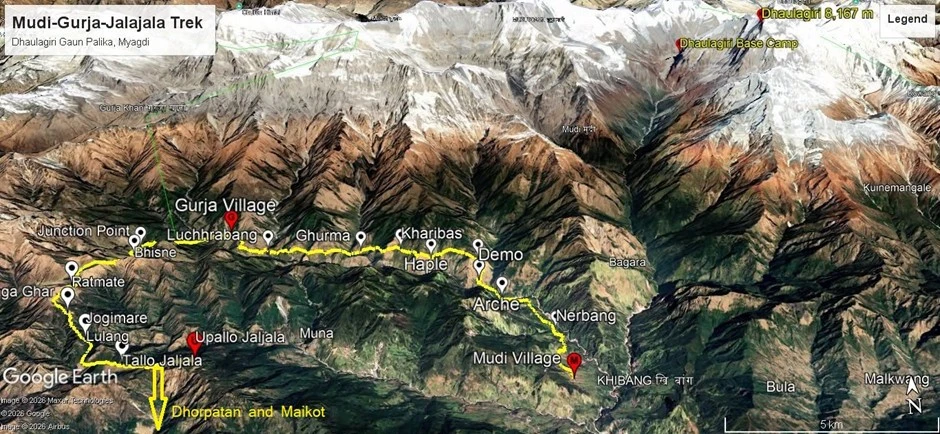
Nepal may soon welcome one of its most exciting trekking destinations—a completely new Virgin Trail in the heart of the Dhaulagiri region. The proposed Mudi–Gurja–Jaljala Trekking Route aims to connect remote mountain villages, pristine forests, alpine meadows, and spectacular Himalayan viewpoints while creating new economic opportunities for local communities.
The announcement was recently shared by renowned social innovator Mahabir Pun, who revealed that preparations are underway to make the route operational, possibly from the upcoming winter trekking season.
If completed as planned, this trail will become one of Nepal's newest off-the-beaten-path trekking experiences.
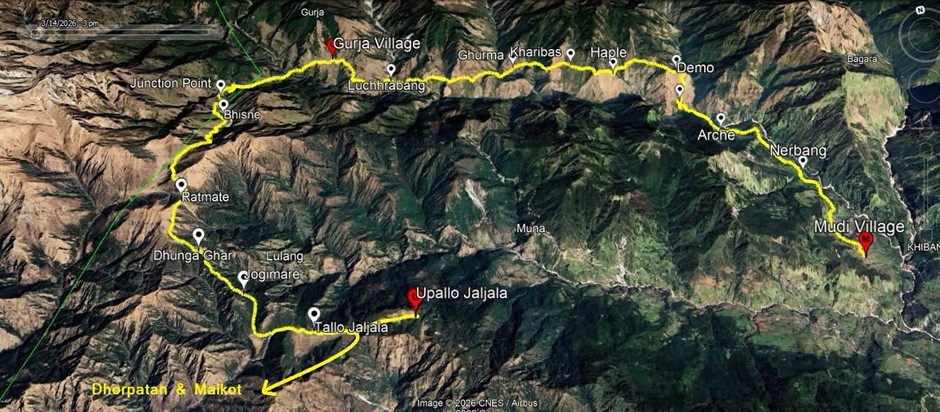
The proposed trekking route begins from Mudi Village in Dhaulagiri Rural Municipality, Myagdi District, passes through the historic Gurja Village, and reaches the high alpine grasslands of Jaljala over approximately five days.
Unlike Nepal's established trekking routes, this trail is expected to remain largely untouched, offering trekkers an authentic wilderness experience with very little commercial development.
Because the route has not previously been promoted as a trekking corridor, it is being described as a Virgin Trail—a destination where visitors can experience unspoiled landscapes and traditional mountain culture.
The development of this route represents more than just another trekking destination.
It has the potential to:
Nepal has long needed new trekking destinations that balance tourism growth while reducing overcrowding in popular regions.
| Day | Route | Highlights |
|---|---|---|
| Day 1 | Mudi Village | Traditional Magar settlement |
| Day 2 | Trek towards Gurja | Forests, waterfalls, mountain scenery |
| Day 3 | Gurja Village | Local culture and Himalayan views |
| Day 4 | High alpine trail | Meadows and ridges |
| Day 5 | Jaljala | Panoramic Himalayan viewpoint |
Note: The final itinerary may change once official trail development is completed.
Mudi lies in Myagdi District within Dhaulagiri Rural Municipality.
It serves as the gateway to several remote Himalayan valleys and is already known among experienced trekkers heading toward the Dhaulagiri region.
However, much of the surrounding landscape remains unexplored by mainstream tourism.
Gurja Village: A Hidden Himalayan Settlement
One of the biggest attractions of the route will undoubtedly be Gurja Village.
The village is famous for:
Unlike heavily commercialized trekking villages, Gurja has preserved much of its authentic character.
Jaljala: The High-Altitude Destination
The final destination of the proposed trek is Jaljala, a beautiful alpine region known for:
From Jaljala, trekkers are expected to enjoy spectacular views of the Dhaulagiri mountain range and surrounding Himalayan peaks.
Future Connections Beyond Jaljala
One exciting aspect of the project is its long-term connectivity.
According to the announcement, the trail could eventually link Jaljala with:
Such connections could create an extensive trekking network across western Nepal.
This would provide opportunities for longer expeditions and regional tourism development.
Community Participation Is the Foundation
Unlike many infrastructure projects that rely solely on contractors, this initiative emphasizes community ownership.
Local residents are expected to contribute through voluntary labor in activities such as:
This model encourages long-term maintenance while ensuring that local communities directly benefit from tourism.
Government Support
The proposed project has reportedly received support from Nepal's Ministry of Tourism.
The ministry is expected to assist in constructing essential infrastructure, including:
According to the announcement, project monitoring will involve both the Ministry and Mahabir Pun to help ensure transparency during implementation.
1. A Genuine Virgin Trail
Very few international trekkers have explored this area.
Visitors will likely experience landscapes untouched by mass tourism.
2. Authentic Local Culture
Remote villages continue to preserve their traditions, language, festivals, and architecture.
3. Fewer Crowds
Trekkers looking for solitude will appreciate a quieter alternative to Nepal's busiest trekking routes.
4. Untouched Nature
Dense forests, rivers, alpine meadows, and dramatic Himalayan scenery make this route especially appealing for nature lovers.
5. Opportunity for Sustainable Tourism
Because development is beginning now, planners have an opportunity to adopt responsible tourism practices from the outset.
Potential Challenges
As with any newly developed trekking route, visitors should expect:
These factors may actually appeal to experienced trekkers seeking a true wilderness experience.
If the trail officially opens, the recommended seasons are likely to be:
| Season | Conditions |
|---|---|
| Spring (March–May) | Rhododendron blooms, stable weather |
| Autumn (September–November) | Clear mountain views |
| Winter (December–February) | Possible opening season, colder temperatures |
| Monsoon (June–August) | Less recommended due to rain |
The route may be ideal for:
If successful, the trail could create opportunities for:
Tourism has the potential to become an important source of sustainable income in these remote communities.
Current Status
As of now, the trail is in the planning and development phase. Local community participation, infrastructure work, and government support will determine when it officially opens to trekkers. While the goal is to have the route ready for an upcoming winter season, the exact opening date and final trail details have not yet been formally confirmed.
Prospective trekkers should wait for official announcements before making travel plans.
Nepal has always been known for legendary treks like Everest Base Camp, Annapurna Circuit, and the Manaslu Circuit. The proposed Mudi–Gurja–Jaljala Virgin Trail represents a different kind of adventure—one centered on untouched landscapes, authentic villages, and community-led tourism.
If developed responsibly, this route could become one of western Nepal's most rewarding trekking experiences while bringing meaningful economic benefits to remote Himalayan communities. It is also a reminder that Nepal still holds many hidden corners waiting to be explored.
Is the Mudi–Gurja–Jaljala Trek open?
No. The route is currently under development, with plans to make it operational after construction and safety work are completed.
How long is the proposed trek?
The current proposal outlines a trek of approximately five days from Mudi to Jaljala via Gurja.
Where is the trek located?
The route is located in Myagdi District, beginning at Mudi Village in Dhaulagiri Rural Municipality and passing through Gurja to Jaljala.
Why is it called a Virgin Trail?
The route has not yet been established as a mainstream trekking corridor and remains largely unexplored by commercial trekking groups, offering a more pristine and authentic experience.
Can the route connect to other trekking regions?
Yes. Future plans indicate potential connections from Jaljala toward Dhorpatan in Baglung District and Maikot in Eastern Rukum, creating a broader trekking network across western Nepal.