
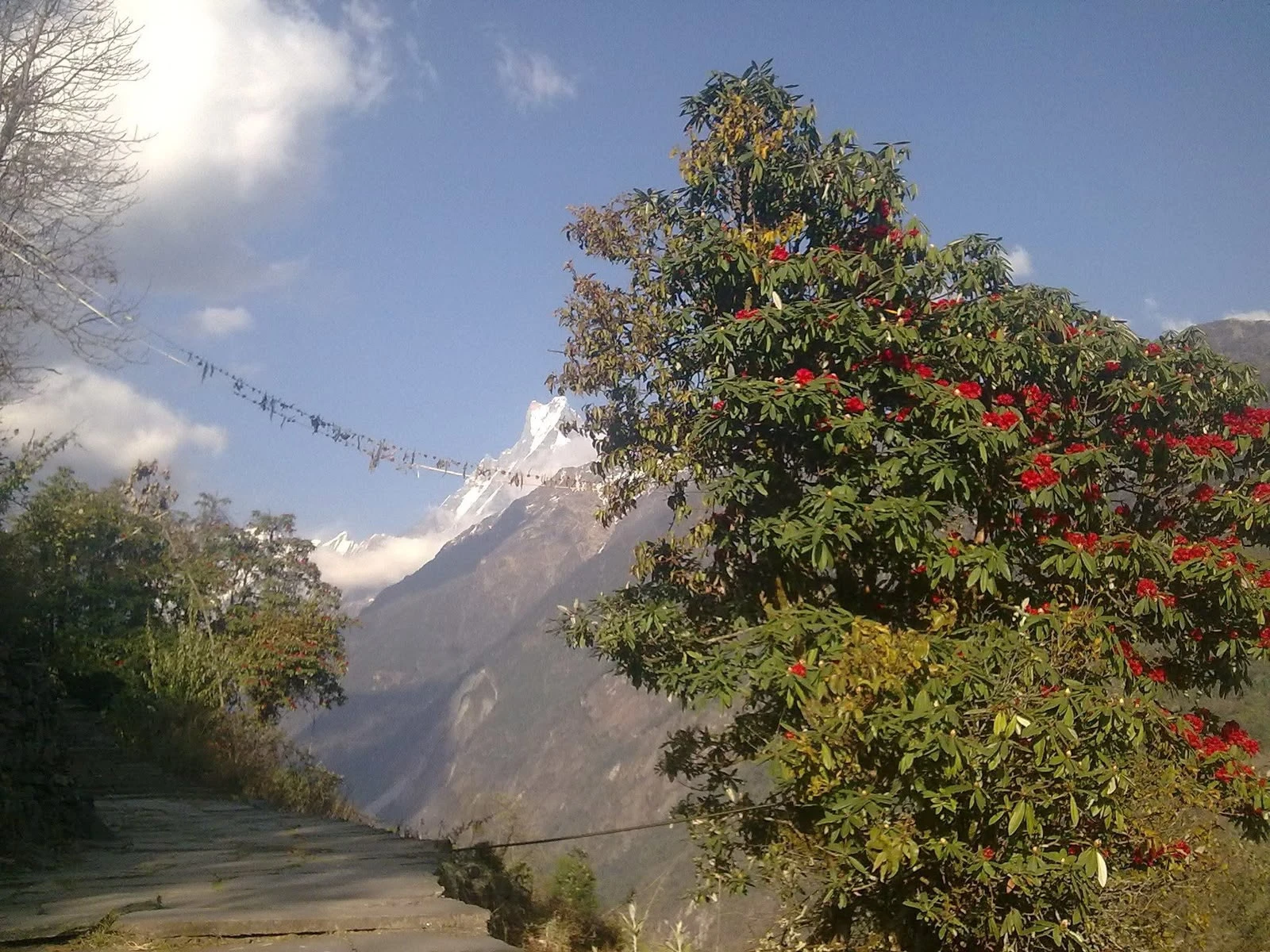
The word "rhododendron" is derived from the ancient Greek words "rhodon," meaning "rose," and "dendron," meaning "tree." Its translation is rose tree. It was borrowed into Latin as "rhododendron" and later entered as an English term.
Rhododendron forests in Nepal are vibrant mountain woodlands dominated by Nepal’s national flower. the Lali Gurans (Rhododendron arboretum). They bloom spectacularly between March and May, painting hillsides in red, pink, and white across regions like Ghorepani Poon Hill, Langtang, and the Tinjure, Mike, and Jaljale ridges.
Nepal is home to over 32 species of rhododendron, more per square kilometer than almost anywhere in the world. Lower forests around 2,000 meters have a deep red color in the spring season. Every spring something quietly extraordinary happens across Nepal’s hills. The forests have thousands of rhododendron blossoms. During the blooming season, trekkers can not only enjoy the floral beauty but also see the clear mountain views, as spring features stable weather.
Rhododendron forests in Nepal not only elevate the beauty, but they also paint the entire region with their beauty and fragrance. They have shades like crimson, blush pink, and snow white. It is called Laligurash, the national flower of Nepal. It is woven into Nepali songs, it is painted on Nepalese currency notes, and it is celebrated in mountain villages. These rhododendron forests serve as a home to exclusive wildlife.
Nepal’s rhododendron forests are some of the most enchanting trekking destinations in the Himalayas, especially between March and May when the hills burst into crimson, pink, and white blooms.
Ghorepani Poon Hill Trek
If there is one trek that feels like walking through a living painting, it is this. The Ghorepani – Poon Hill trail is home to the world’s largest Rhododendron forest, where ancient trees from tunnels of red blossoms. At dawn, the view from Poon Hill (3,210m) is unforgettable: the rising sunlight up the Annapurna and Dhaulagiri ranges while the Rhododendron glow beneath.
Langtang Valley Trek
North of Kathmandu lies the Valley of Glaciers, which transforms into a flowering paradise in spring. Here, you’ll find rare white rhododendrons alongside the classic red varieties. The trek blends alpine meadows, glacier views, and vibrant forests.
Annapurna Conservation Area
The Annapurna region is a paradise for rhododendron lovers. Treks like the Annapurna Circuit or shorter routes around Tadapani and Ghandruk take you through dense woodlands that explode with color in spring. The contrast of fiery blossoms against snow-capped peaks is breathtaking.
Dhorpatan Hunting Reserve
For those seeking solitude, Dhorpatan offers one of Nepal’s largest rhododendron forests in a remote setting. Spread across Rukum, Myagdi, and Baglung districts, this reserve is far from the usual tourist trails, making it ideal for nature enthusiasts craving tranquility.
Helambu Trek
Close to Kathmandu yet surprisingly serene, Helambu offers gentle trails through oak and rhododendron forests. It’s perfect for those who want a short trek with cultural immersion.
Kanchenjunga Trek
In Nepal’s Far East, the Kanchenjunga Trek passes through some of the country's most spectacular rhododendron forests. The diversity of species here is unmatched, creating a landscape that feels like a secret floral kingdom. During spring, the trails of the Kanchenjunga Trek come alive with vibrant shades of red, pink, white, and purple, offering trekkers an unforgettable journey through one of Nepal’s richest rhododendron habitats.
Makalu Base Camp Trek
Rugged and demanding, but immensely rewarding. The rhododendron forests here are dense and vibrant, leading you toward the towering Makalu peak.
Manaslu Circuit Trek
The Manaslu region combines cultural richness with natural beauty. Its rhododendron forests bloom in fiery shades, framing views of the eighth-highest mountain in the world.
Nature’s vibrant Himalayan tapestry comes alive with explosions of color like scarlet reds, soft pinks, delicate whites, and subtle purples. Rhododendrons are locally known as Gurans or Laliguras. Rhododendrons are resilient evergreen shrubs and trees. They are not only just pretty but they are also deeply woven into Nepal’s cultural fabric, ecology, and identity. Their blooms signal the arrival of the spring season.
Nepal is home to more than 30 species of rhododendrons (some sources cite around 32–33), out of over 1,000 species found worldwide. They thrive across a wide altitudinal range from the mid-hills around 1,400 meters up to alpine zones above 4,000 meters. They adapt beautifully to Nepal’s dramatic topography.
Their blooms support local biodiversity, provide nectar for pollinators, help prevent soil erosion, and even feature in traditional medicine, cuisine, and religious rituals. The most iconic is the Rhododendron arboretum, or Nepal’s national flower, often called Laliguras. This majestic species can grow into a substantial tree reaching up to 20 meters tall. Its bell-shaped flowers typically burst forth in vibrant red (though pink and white variants exist), carpeting lower to mid-elevation forests between 1,400 and 3,600 meters.
Seeing a hillside ablaze with these blooms is an unforgettable experience for trekkers on routes like Ghorepani-Poon Hill or in the Annapurna region. Culturally, the flowers are used in offerings, garlands, and even to make a refreshing drink or local wine. Another standout is Rhododendron campanulatum, commonly known as Chimal. This medium-sized shrub, which can reach about 8 meters, displays elegant purple, blue, or white bell-shaped flowers. It prefers higher altitudes (around 3,000–4,500 meters), where its dense growth creates striking contrasts against the rugged terrain—perfect for photographers chasing higher Himalayan trails.
A true dwarf variety grows only about 20 cm tall but produces large, bright red flowers. It clings to rocky slopes above 4,000 meters, offering a delightful surprise on high-altitude treks like those toward Makalu Base Camp.
Other notable species include:
These are just a few highlights; rarer species like Rhododendron falconeri or Rhododendron niveum add even more diversity, particularly in biodiversity hotspots such as the Tinjure-Milke-Jaljale (TMJ) ridge in eastern Nepal, often called the “Rhododendron Capital of the Himalayas,” where nearly 28 species can be found in one area
Here’s a summary table of some prominent types for easy reference:
| S.No | Scientific Name | Common/Local Name | Key Characteristics | Typical Elevation Range |
|---|---|---|---|---|
| 1 | Rhododendron arboretum | Laliguras (Rhododendron arboretum) | National flower of Nepal; tree up to 20 m tall; produces red, pink, or white blooms | 1,400–3,600 m |
| 2 | Rhododendron campanulatum | Chimal | Medium-sized shrub or small tree up to 8 m; purple, blue, or white bell-shaped flowers | 3,000–4,500 m |
| 3 | Rhododendron forrestii | Gurans | Dwarf shrub (around 20 cm); large, bright red flowers | Above 4,000 m |
| 4 | Rhododendron lepidotum | Bhale Sunpati | Low-growing shrub; pink or white flowers; valued for medicinal uses | 2,200–5,300 m |
| 5 | Rhododendron anthopogon | Sunpati | Small aromatic shrub; pale yellow or white flowers; traditionally used as incense | 3,900–4,800 m |
| 6 | Rhododendron barbatum | Kaalo Chimal | Deep red flowers; distinctive bristly stems and bark | 2,000–3,500 m |
| 7 | Rhododendron hodgsonii | — | Large leathery leaves; clusters of rose-purple flowers | 2,700–3,700 m |
| 8 | Rhododendron ciliatum | Seto Gurans | Small shrub; white to pinkish funnel-shaped flowers | 2,700–3,500 m |
Rhododendrons stand as a vivid symbol of the country’s extraordinary biodiversity, painting the landscapes with life and color. Whether you are setting out on a spring trek, capturing the magic of the Himalayas through your lens or simply embracing Nepal’s natural beauty and resilience, their presence is unforgettable. As you walk beneath their blooming canopy, pause for a moment to absorb their brilliance—they beautifully reflect the soul and spirit of the mountains.
Rhododendron, often referred to locally as Laliguras in Nepal, holds profound cultural significance across the Himalayan regions, particularly in Nepal where it is celebrated as the national flower. Its vibrant red blooms, which carpet the hillsides during spring, have come to symbolize love, passion, unity, and the renewal of life. For many communities, the flower is more than a natural spectacle; it represents a deep connection between people, nature, and spirituality, appearing in everyday life, folklore, and artistic expressions.
In religious and ritual contexts, rhododendrons play a central role. The bright flowers are commonly offered as sacred garlands and decorations in Hindu temples and Buddhist shrines, embodying purity, devotion, and respect for the divine. During major festivals such as Tihar (the festival of lights) and Buddha Jayanti, families use rhododendron blossoms to adorn homes, altars, and processions, infusing celebrations with color and spiritual meaning. In regions like Uttarakhand in India, the flower (known as Buransh) features prominently in weddings, Holi, and other community events, where garlands and decorations bless participants and signify prosperity. Festivals dedicated to the rhododendron further highlight its cultural importance.
Events like the Lali Gurans Festival in Helambu, Nepal, and similar celebrations in Rolpa or Bhutan’s rhododendron festivals transform the blooming season into vibrant community gatherings. These occasions typically feature traditional dances, music, local cuisine (including rhododendron-based delicacies believed to have health benefits), arts and crafts, and nature walks. Women often adorn their hair with the flowers, while lovers exchange them as tokens of affection, reinforcing themes of romance and seasonal joy.
Beyond ceremonies, rhododendrons weave into the broader social and economic fabric of Himalayan societies. They inspire folk songs, poetry, and literature, while also supporting local livelihoods through tourism and traditional remedies. This enduring presence underscores how the flower bridges the natural environment with human identity, reminding communities of the harmonious interplay between faith, culture, and the changing seasons. In essence, rhododendrons are living emblems of resilience, beauty, and cultural heritage in the Himalayas
Travelers venturing into the rhododendron forests of Nepal discover that comfort is not sacrificed in the wilderness. Local lodges and teahouses, often family-run, provide simple yet cozy accommodation wooden interiors warmed by a hearth, soft bedding after a long trek, and the welcoming smiles of hosts who treat guests like kin.
Alongside this, cuisine becomes a highlight of the journey. Traditional Nepali meals such as dal bhat, freshly steamed momos, and hearty noodle soups are served steaming hot, offering nourishment and delight after hours of walking beneath crimson blossoms. Together, the accommodation and cuisine embody the essence of Nepali hospitality: practical comfort infused with cultural richness, ensuring that every traveler feels both cared for and connected to the land.
Rhododendron forests matter to us not only for their visual appeal, but because they are ecologically precious and face threats from climate change, deforestation, and unsustainable tourism. They matter to us through conservation efforts, Conservation efforts, including protected areas and community-led initiatives, are crucial to preserving them for future generations.
Whether you are an avid trekker planning a multi-day adventure or simply a nature lover looking for day hikes, these forests matter to us as a profound connection to the Himalayas. Nepal’s rhododendron forests offer a profound connection to the Himalayas. The sight of those vibrant blooms swaying in the mountain breeze, with the sound of birds and distant yak bells, stays with you long after you return home.
Now let us experience the rhododendron bloom. And when you bid them farewell, they linger like a living Postcard from the Himalayas – a reminder that such exotic beauty once seen never fades away.
Practical tips for trekking in Rohodendron Forests
Packing tips for rhododendron forest trek Nepal
As the vibrant tapestry of spring unfolds across the Himalayan foothills, Nepal's rhododendron forests emerge not merely, as botanical wonders, but as poignant expressions of nature's artistry. To wander beneath their blossoming canopy, where hues of crimson, fuchsia, and ivory dance with the dappled sunlight, is to step into a realm where the ordinary yields to the extraordinary.
These ancient woodlands, guardians of diverse ecosystems, offer a profound invitation: to pause, to breathe deeply of the mountain's pristine air, and to surrender to the sublime spectacle that unfolds. The fleeting glory of these blooms, set against the timeless grandeur of snow-capped peaks, engraves itself upon the heart, leaving an indelible imprint of beauty and wonder.
Indeed, to journey through Nepal's rhododendron forests in their full splendor is to partake in a living poem, a cherished chapter in the grand narrative of our world's most exquisite natural sanctuaries. Until these paths call to your spirit once more, may the memory of these blossoms linger as a promise of return.
Q1: Do rhododendrons have medicinal uses?
A: Yes, species like R. anthropogenic are used in traditional medicine and teas for their fragrance and healing properties.
Q.2: Do rhododendrons forests have an ecological importance?
A: Yes, rhododendrons forests have clear ecological importance. They provide shelter and food for wildlife, help prevent soil erosion on steep Himalayan slopes and enrich biodiversity by supporting many plant and animal.
Q.3: How can we practice civic sense when visiting rhododendron forests in Nepal?
A: Visitors can practice civic sense by supporting local tea houses, respecting local culture, not littering everywhere, walking only on trails to avoid harming roots and soil, not plucking flowers so the forests remain vibrant for everyone, etc.
Q.4: Where can we find the rhododendrons forests in Nepal?
A: We can find rhododendrons forests in several Himalayan regions such as
Q.5: Why are rhododendrons so famous and important in Nepal?
A: Rhododendrons (Lali Gurans) are famous and important as they are national flower that symbolizes love, purity and resilience. They are both famous and important because of the following reason:
Q.6: What is the ideal season to visit rhododendron forests in Nepal?
A: The ideal time to visit rhododendron forests in Nepal is spring (March to May) In this time the forests are in full bloom with colours like red, pink, white and purple blossoms. This makes regions like Ghorepani – Poon Hill and Tinjure, Mike, Jaljale breathtaking this time.
Q.7: Which trek is best for viewing rhododendron forest in Nepal?
A: The Ghorepani Poon Hill Trek is the most popular as it has the largest rhododendron forest in the world.
Q.9: How many species of rhododendron are found in Nepal?
A: Nepal has over 23 species of rhododendron flowers. It ranges from deep crimson Rhododendron arboretum (the national flower, locally called Lali Gurans) to rare white, yellow, and lavender varieties found at higher elevations. The eastern regions of Nepal, particularly around Mike Danda and Kanchenjunga, have the highest species.
Q.10: Is rhododendron forest trekking suitable for beginners?
A: Yes, the several routes leading towards the rhododendron forest trekking is suitable for beginners. Ghorepani Poon Hill Trek is well marked with stone stairways and regular teahouses, which makes it comfortable to the beginners. Shivapuri National Park, which is near Kathmandu, is even beginner friendly it takes a day of walk through blooming rhododendrons without any altitude concerns.
Q.11: Do we need a guide for rhododendron trekking in Nepal?
A: No, we do not need legally require guide in all rhododendron trekking in Nepal but it is strongly recommended.