
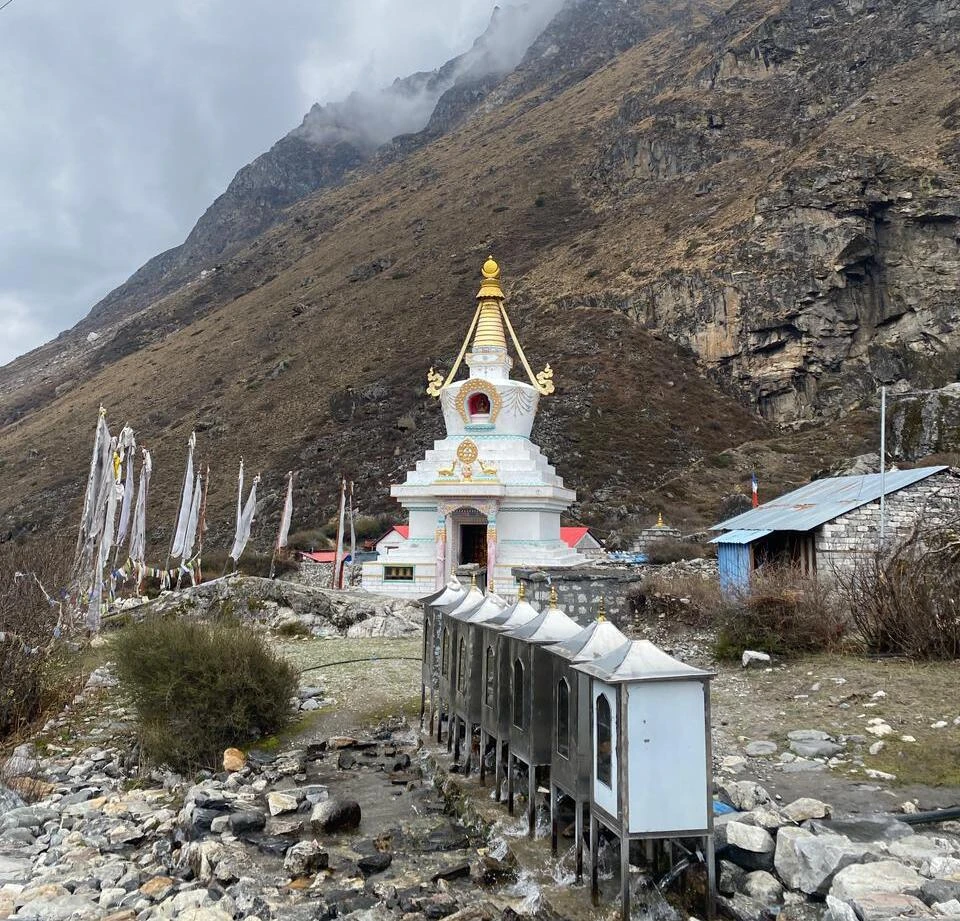
Kyanjin Gompa is a small and beautiful Himalayan village, which is located in the center of the Langtang Valley, north of Kathmandu. It is close to the Tibetan border. It is located in Rasuwa, District of Bagmati Province in Nepal, near the Tibetan border. It is one of the highest settlements in the Langtang region, situated at an altitude of about 3,870 meters (12,697 feet).
The village is named after the ancient Kyanjin Monastery, an important center of Tibetan Buddhist culture and spirituality. According to local belief, the name “Kyanjin” comes from Tibetan words associated with “yak” and "ribs," reflecting the region’s cultural and historical roots.
Kyanjin Gompa serves as an important spiritual center of the Langtang Village. It reflects the rich culture and traditions of Tibetan Buddhism and attracts visitors and trekkers from around the world. Although the monastery has a calm and quiet atmosphere, many travelers stop there to experience its spiritual significance and peaceful surroundings.
Devotees from Nepal and other countries visit the monastery to pray, meditate, and take part in religious rituals. Every morning, the sound of monks chanting fills the monastery, creating a calm and spiritual environment for visitors seeking reflection and inner peace.
Visitors also admire the monastery’s rich history, intricate carvings, colorful murals, and beautiful thangka paintings. These artworks portray important Buddhist stories and teachings, adding to the monastery’s cultural and spiritual value.
Surrounded by the majestic Himalayan mountains, the monastery offers breathtaking views along with a peaceful atmosphere. The sound of prayer flags fluttering in the breeze and the quiet surroundings make Kyanjin Monastery a special place for spiritual connection, relaxation, and reflection.
Kyanjin Gompa offers breathtaking Himalayan views with plenty of top attractive places. The top places to visit in Kyanjin Gompa are as follows:
The village is named after this ancient Buddhist monastery. It’s a peaceful and serene place to visit. It offers insights into local and spiritual life and traditions. We can observe the monks, spin prayer wheels, and enjoy the quiet ambiance.
Kyanjin Ri is the highest point of the Langtang trek. From Kyanjin Gompa, the trail to Kyanjin Ri rises steeply, offering trekkers two horizons. Each view point is a chapter in the mountain’s diary. This is also known as a popular day hike from Kyanjin Gompa.
To climb Kyanjin Ri is to walk a path that offers two horizons in one journey. The lower viewpoint, reached in a gentle two hours, opens into serenity—valleys wide, Langtang Lirung rising with quiet majesty, and the calm of prayer flags fluttering in the crisp air. In addition, for those who continue upward, the higher viewpoint unveils a panorama of infinitely beautiful peaks.
Together these two horizons remind every traveler that the Himalayas are not a single view but a layered revelation: serenity below, infinity above, both bound in one sacred climb. The two main viewpoints on Kyanjin Ri and their explanation are as follows:
Kyanjin Ri lower—It's at around 4,300 meters
Its lower viewpoint can be reached in about 15 hours. Here, the valley opens up wide. Langtang Lirung towers magnificently ahead, and the air feels crisp yet welcoming. It is a place of serenity—where trekkers pause, take a deep breath, and let the peaceful spirit of the Himalayas settle into their hearts and souls.
Kyanjin Ri Higher—It's at around 4,733 meters
Another hour of climbing leads to the higher viewpoint. The trail is steeper, the air thinner, but the reward is vast: Dorje Lapka, Gangchenpo, Yala Peak, and glaciers shimmering like silver rivers. Standing here feels like gazing upon infinite beautiful peaks, just like a horizon that stretches endlessly where silence deepens into eternity.
Tserko Ri is another excellent viewpoint and a more strenuous hike than Kyanjin Ri. Tserko Ri stands at an elevation of around 4,984 meters. The views from the top are even more expansive, offering incredible vistas of the Langtang range. It is best to start this hike early in the morning to catch the best light and avoid afternoon clouds.
The Langtang Glacier is an 18 km long glacier located in Nepal’s Langtang National Park. It lies in the core heart of the Himalayan region. It covers approximately 46.5km. We can hike up to the Langtang Glacier from Kyanjin Gompa. It is a relatively easy walk to witness the impressive glacier up close. This offers a unique perspective on the power and beauty of the Himalayan landscapes.
Kyanjin Gompa has a small yak cheese factory. We can visit to see how the local cheese is made and purchase some fresh yak cheese and butter. It is a great way to support the local economy and taste a regional specialty.
Hiking around the village for scenic meadows is like stepping into a living canvas. Where we can see rolling green fields, wildflowers, swaying trees, and the quiet hum of nature wrapping us in serenity. These scenic meadows are not just landscapes; they are breathing spaces where our souls feel serene. Here is how such a hike unfolds:
Hiking here is more than a walk—it is a meditation. The meadows around Kyanjin Gompa are not just landscapes; they are sanctuaries where silence, color, and mountain air weave together. The sound of cowbells mingles with the wind, reminding us that life here flows in harmony with nature’s rhythm.
For a longer day of the trip, we can trek to the Yala Cheese Factory, which is located at a higher altitude. This offers another opportunity to see yak cheese production in a more remote setting.
As Kyanjin Gompa is at a high altitude (around 3870 meters), we should remember to acclimatize properly. The best time to visit is during the spring (March–May) and autumn (September–November) for clear weather and stable conditions.
Kyanjin Gompa is famous for its breathtaking Himalayan scenery; rare wildlife like the red panda; and natural attractions, including glaciers, alkaline meadows, and panoramic viewpoints such as Kyanjin Ri and Tserko Ri. It’s a sanctuary for trekkers and nature lovers seeking both adventure and cultural immersion.
In order to reach Kyanjin Gompa, we would probably have to take bus from Kathmandu to Syabrubesi which is roughly around 122km away. Busses usually depart from the Machha Pokhari Bus Park. The travel cost can be around NPR 900 to 1200 and the time is around 7 to 9 hours, which depends on the vehicle we prefer.
From Syabrubesi, the trek begins. The trail passes through Dunche at Langtang National Park Office. Over there we should register with the police and pay our park entry permit fee of about NPR 1500 rupees. After completing the formalities, we can head to bamboo village. This part of the trek takes about 3-4 hours and it is about approximately 1,960m.
Next we can head towards the Ghoda Tabela. It is located at around 3,000m and 9,842ft. It is often considered as a resting spot which is situated between Lama Hotel and Langtang Village. It also has some teahouses for tired workers.
Continuing onwards and after walking for several hours we can find old Langtang village or the village, which was turned into rubbles by massive 2015 Nepal earthquake. It resulted in 300 deaths and the area was completely destroyed and later rebuilt. There is also trails reopened for trekking and memorials for honoring the victims. Today, the village has been rebuilt, and trekking routes have reopened.
From Langtang Village, we can trek towards the landslide area we can reach to Langtang. The walking distance from Bamboo to Rimche (2,400m) is 4km. There we can reach Lama Hotel with 15 or 16 minutes of walking. This hotel was build in 1980s to support tourism. This hotel is also a key stop on the Langtang valley trek. It is located at an altitude of 2,470 meters within the Langtang National Park. Despite its name “Lama Hotel” it’s not a single hotel but an area with several lodges.
When we reach the third day of our journey we walk about 30 more minutes from the reconstructed Langtang village we reach Mundu which has an altitude of approximately 3,500m3,543m. This village features a stunning Tibetan style stone houses and stunning views of Langtang Himal. Which is a small historic village located in the upper Langtang valley.
In the same day, we can reach Kyanjin Gompa, which is the second final travel of Langtang valley trek. From here, we can enjoy breathtaking views of Langtang Lirung and glaciers. Before reaching the monastery, we also pass by a local cheese factory.
After arriving, we can visit the Langtang Cheese factory, which is which is a well known factory for producing high quality yak and chauri cheese.
The next day, after reaching Kanjyn Gompa, we can go visit Kyanjin Ri peak 4773m or 15655 ft. It is also known as Kala Patthar or Langtang. It is one of the highest view point of the Langtang Trek. The hike to the summit takes arround 3 to 5 hours. From the top, we can see a white pipeline and beyond it, there is a beautiful lake.
We can then continue to Kyanjin Ri Peak 2, which takes about one more hour from the first summit.
After completing the trek, we descend from Kyanjin Ri and return to Ghoda Tabela. From there, we continue back to Syabrubesi, and finally return to Kathmandu.
Kyanjin Gompa has several teahouses and lodges for trekkers. During the peak trekking seasons – spring (March to May) and autumn (September to November) – it is recommended to book accommodation in advance because rooms can fill up quickly.
Visitors should also carry a warm sleeping bag, as blankets provided by teahouses may not be warm enough at higher altitudes. Bringing a power bank is also useful because charging electronic devices may cost extra and electricity may not always be available.
Meals offered and Recommended Choices
Breakfast
A popular breakfast choice is Tibetan flatbread, also known as phaley. It is a soft and chewy flat bread often served with jam, honey or peanut butter.
Other breakfast options include:
These meals are commonly enjoyed with Tibetan butter tea or po cha, Nepali black tea or coffee.
Lunch and Dinner
The food menu in Kyanjin Gompa is simple but filling. Common meals include
Some teahouses also offer western dishes such as pizza, pasta and noodles. Desserts and snacks like cookies, chocolate bars, and apple pie may also be available.
To avoid food poisoning during the trek, it is better to eat freshly cooked meals such as rice, dal, soup, and boiled vegetables rather than raw salads.
Trekkers should carry a reusable water bottle because many teahouses provide refill stations for drinking water. Packing snacks such as energy bars, nuts, or dried fruits is also recommended, as food prices become more expensive at higher altitudes.
I think for Kyanjin Gompa we should pack for both comfort and survival. We should carry warm jacket for fighting cold nights, We should have comfortable trekking shoes, a water bottle, small snacks like nuts chocolate, chips or chauchau noodles can keep our energy flowing.
We should also carry a raincoat, a pouch of basic medicine like headache pills altitude tablets, and Band-Aids. A torch or headlamp helps with early hikes or power cuts. Moreover, cash is necessary since teahouses do not take cards. We should protect our self with sunglasses and sunscreen against the strong mountain sun, and scarf or buff for dust, wind or warmth. Finally and obviously, we should also carry a camera or a phone with us.
Altitude sickness can surprise anyone, even strong trekkers, so listen to your body – headaches, dizziness, or fatigue means it’s time to rest. The weather shifts quickly: Sunny mornings can turn into cloudy afternoons and chilly nights, so layers are your best friend. Trails can be slippery in monsoon and icy in winter, so for that reason we should trek carefully. We should also remember to dress up modestly as Gompa is a sacred place.
On the Kyanjin Gompa tail, it is wise to walk slow and drink plenty of water to avoid altitude sickness. The Langtang National permit is necessary usually around NPR 3,000 so we should keep it ready. For phone service, NTC works great NCELL not so much. In addition, when we are choosing the season October, November gives us crystal skies, while March-April presents us with rhododendron flowers along the path.
1. How do you go to Kyanjin Gompa?
Most trekkers start from Syabrubesi, a village reachable by road from Kathmandu. From there, it usually takes 5-7 days of trekking to reach Kyanjin Gompa.
2. Where is Kyanjin Gompa?
It is located in Langtang Valley, Nepal. located at about 3,870 meters (12,697 ft) above sea level.
3. Why is Kyanjin Gompa famous?
It is famous for its Buddhist monastery, panoramic Himalayan views, yak cheese factory, and being a base for treks to higher viewpoints like Kyanjin Ri and Tsergo Ri.
4. What kind of weather does Kyanjin Gompa have?
The weather here in Kyanjin Gompa during the daytime is cool and fresh, usually 5°C to 15°C, but once the sun sets, it gets icy; it goes around. -3°C to –8°C
5. What is the best season to visit in Kyanjin Gompa?
The best season, or the sweet spot, to visit Kyanjin Gompa is definitely autumn (September-November) as the skies are clear. Spring (March-May) is also a great time as the weather is stable and the rhododendrons are in full bloom, which makes the forests look magical. The mornings are usually clear, so we can still get good views, but afternoons can be a bit hazy.
6. What are the things to do in Kyanjin Gompa?
Climb Tresko Ri, visit the monastery, explore the cheese factory, and do a day hike to the Langtang glaciers. Have short hikes around the village for stunning sunrise and sunset views over the Himalayas, chat with locals, learn about Tibetan-influenced traditions, enjoy warm hospitality, and be culturally immersed.
7. What hikes can we do from Kyanjin Gompa?
The hikes we can do are Tserko Ri (4,894 m), Kyanjin Ri (4,773 m), and Langtang Lirung base camp.
8. What kind of food is available in Kyanjin Gompa?
There is less availability of non-veg items due to religious sensitivity. The food choices are fewer here, but the food options are always fresh. Here we usually get plain and hot food. The food options are dal bhat, porridge, eggs, chapattis, and tea. Ginger, lemon, and honey tea helps in altitude relief. For breakfast we can get chapatti; Tibetan salty butter tea or po cha is common; Tibetan dumplings; and Tibetan bread known as phaley and thupka are available.
One of the most cherished delicacies here is yak cheese. As yak cheese is different from cow or goat cheese as it is richer in protein, it has a rich flavor and a creamy texture. This cheese also melts in steaming dishes.
9. Is it safe here?
The trek is considered safe for most hikers, though altitude sickness can be a concern. Proper acclimatization and preparation are important.
10. Do you need permits?
Yes, trekkers need a TIMS card (Trekkers’ Information Management System) and a Langtang National Park entry permit.