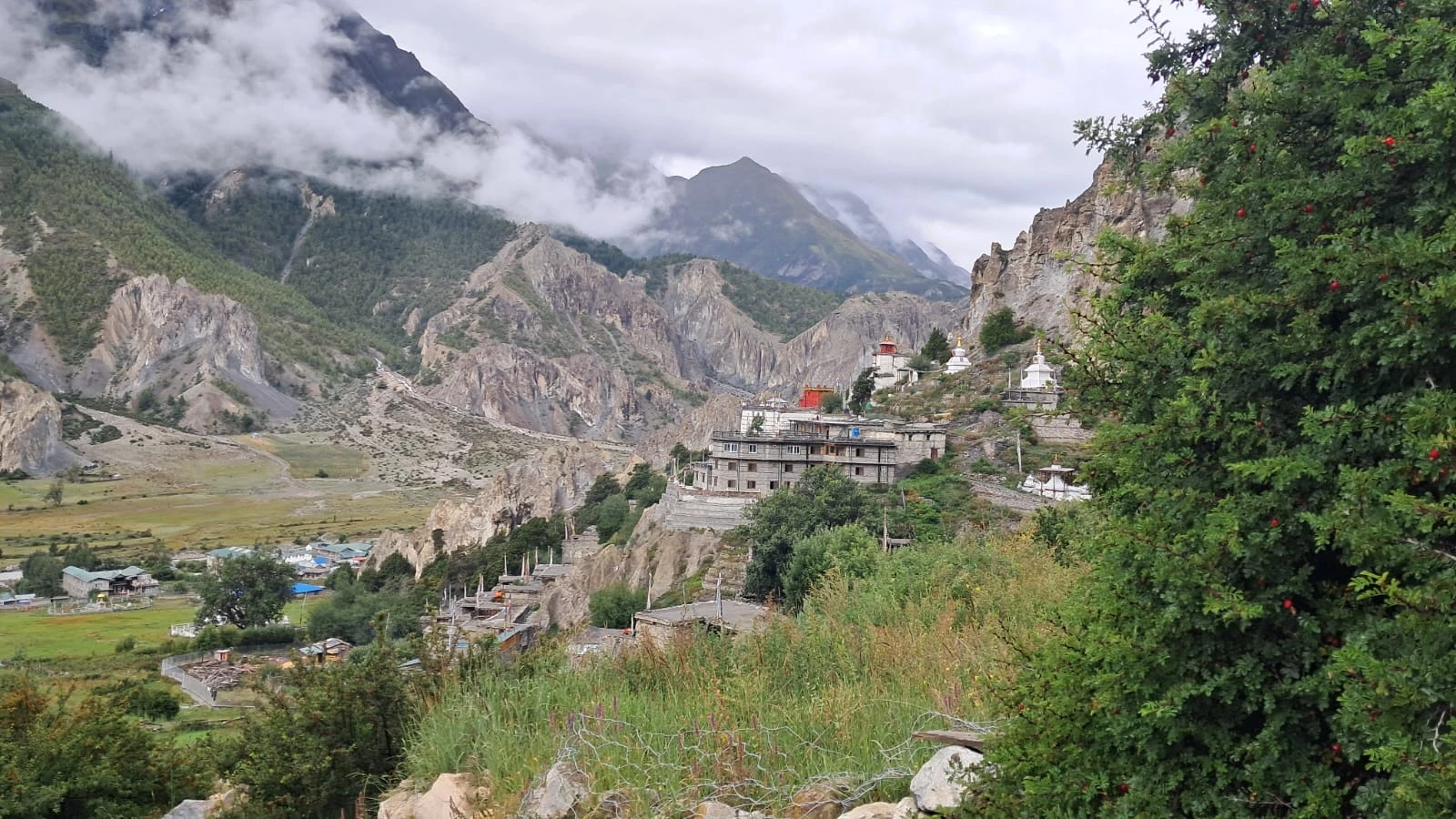
Manang (3,518 meters) is a mountain village in the northern part of the Annapurna region of Nepal. Surrounded by rugged hills and high mountains, the village has a dry, barren landscape that feels quite different from the greener lower sections of the Annapurna Circuit. Despite its harsh surroundings, Manang has a warm local culture and a distinctive way of life shaped by the people who have lived here for generations.
Manang is also a popular stop for trekkers exploring the Annapurna Circuit Trek. The village sits along the main trekking route and is an important place to rest and acclimatize before heading toward higher elevations. Trekkers can also take short side trips around the valley to experience the landscape, villages, monasteries, lakes, and mountain views.
From Manang, trekkers can see several prominent Himalayan peaks, including Annapurna II, Annapurna III, Gangapurna, Tilicho Peak, and other surrounding mountains. The nearby Gangapurna Lake and Glacier are among the popular places to visit, while a short hike to Braga offers an opportunity to explore its traditional village and ancient monastery.
The village is closely connected with the Manang Valley, where local traditions, Tibetan-influenced culture, and mountain lifestyles remain an important part of daily life. Many trekkers stay an extra night or two in Manang to acclimatize and explore the nearby villages and landscapes.
Whether you are planning the Annapurna Circuit or simply want to learn about life in the high Himalayas, Manang offers a fascinating combination of mountain scenery, local culture, and traditional village life. In this guide, you will find useful information about Manang, its location, altitude, culture, attractions, accommodation, transportation, and trekking opportunities.
| Fact | Details |
| Location | Manang District, Gandaki Province |
| Elevation | 3,519 m |
| Region | Annapurna |
| Popular Trek | Annapurna Circuit |
| Nearby Attraction | Tilicho Lake |
| Major Pass | Thorong La – 5,416 m |
| Best Time | Spring and Autumn |
| Known For | Mountain scenery and Manangi culture |
Manang is a mountain village in Manang District of Gandaki Province, Nepal, located at about 3,519 meters above sea level. It sits in the Marsyangdi Valley, surrounded by the Annapurna and Gangapurna mountain ranges. The area has a dry mountain landscape, with rocky slopes, barren hills and scattered patches of vegetation that become more common as you move toward the higher parts of the valley.
Manang is one of the key settlements on the Annapurna Circuit Trek. Most trekkers spend time here before continuing toward Thorong La Pass, which stands at 5,416 meters. The village is also a popular place for acclimatization, giving trekkers time to adjust to the increasing elevation before heading into the higher sections of the route.
The landscape around Manang is noticeably different from the lower Marsyangdi Valley. Green forests, terraced fields and warmer surroundings gradually give way to dry hills, exposed rock and cooler mountain conditions. This change in scenery makes Manang an important transition point on the Annapurna Circuit.
Manang also has a distinct cultural identity influenced by Tibetan Buddhism. Traditional stone houses, chortens, prayer wheels and monasteries are found in and around the village. Local communities have long adapted to life in this remote mountain region through farming, livestock keeping, seasonal movement and trade.
For trekkers, Manang is more than an overnight stop. It is a place to walk through nearby villages, visit local cultural sites, enjoy views of the surrounding mountains and experience the everyday lifestyle of people living in the high Himalayas.
Manang can be reached by road or on foot. Most travelers first make their way to Pokhara and then continue toward Manang by jeep or bus. The journey follows the Marsyangdi Valley, with the road becoming rougher and more winding as it climbs into the mountains.
By Road
By Trekking
Manang is also an important stop on the Annapurna Circuit Trek. Trekkers can follow the trail through the Marsyangdi Valley, passing villages such as Dharapani, Chame, Pisang, and Braga before reaching Manang. This option takes several days but allows travelers to gradually gain altitude and experience the changing landscapes along the route.
Since Manang sits at around 3,519 meters, travelers should be prepared for colder temperatures and the effects of increasing altitude. If traveling by road, it is still important to allow time for acclimatization before continuing to higher elevations.
The Annapurna Circuit Trek is one of Nepal’s most popular long-distance trekking routes. The trail circles the Annapurna mountain range and passes through Manang Valley, making Manang an important stop before heading toward the high-altitude Thorong La Pass (5,416 m).
Most trekkers spend at least two nights in Manang to rest and acclimatize before continuing higher. The extra time helps the body adjust to the increasing altitude and lower oxygen levels, which can reduce the risk of Acute Mountain Sickness (AMS).
During the acclimatization day, trekkers can take a short hike around Manang. Popular options include Ice Lake (4,600 m) and Gangapurna Lake. These hikes provide an opportunity to gain some altitude during the day while returning to Manang to sleep at a lower elevation.
Manang also adds a strong cultural and geographical element to the Annapurna Circuit. The landscape changes from green valleys and villages to dry Himalayan terrain as the trail moves toward Thorong La. Compared with the Annapurna Base Camp (ABC) Trek, the Annapurna Circuit covers a longer and more varied route, with greater changes in landscape, altitude, and local culture. The ABC Trek is shorter and follows a more direct route toward the Annapurna Sanctuary.
For trekkers looking for a longer journey with changing landscapes, mountain communities, and a high-altitude pass, the Annapurna Circuit through Manang offers a distinctly different experience from the ABC Trek.
Manang is surrounded by several interesting places that can be explored on short hikes or acclimatization walks. These nearby spots also give trekkers a chance to see more of the valley without moving to a higher overnight altitude.
These short hikes are also useful for acclimatization, allowing trekkers to spend time at higher elevations before returning to Manang for the night.
The best time to visit Manang Valley is generally during spring (March to May) and autumn (September to November). These seasons offer relatively stable weather, clear mountain views, comfortable trekking conditions, and better trail accessibility. The skies are usually clearer, making it easier to enjoy the surrounding Annapurna and Gangapurna ranges.
Spring is a good season for exploring Manang, especially from March to May. As temperatures gradually rise, the trails become more accessible, and rhododendrons begin to bloom along the lower sections of the route. The weather is generally stable, although conditions can still change quickly at higher elevations.
Autumn, from September to November, is another popular period for visiting Manang Valley. The monsoon has usually cleared the atmosphere, bringing clearer skies and good mountain visibility. Daytime temperatures are generally comfortable for trekking, while mornings and nights can be cold at higher elevations.
Although summer (June to August) is the monsoon season in much of Nepal, Manang lies in a rain-shadow area, so it receives considerably less rainfall than many other parts of the Annapurna region. This makes Manang a possible destination during the monsoon, although road conditions, landslides on lower sections, and changing mountain weather should still be considered.
Winter (December to February) brings much colder conditions to Manang. Snowfall can affect higher sections of the route, and Thorong La Pass (5,416 m) may become difficult or temporarily inaccessible during periods of heavy snow. For trekkers planning to cross the pass, winter requires careful preparation and up-to-date information about trail and weather conditions.
Overall, March to May and September to November are the most practical seasons for visiting Manang Valley, while the monsoon and winter months require greater flexibility and preparation.
Manang has a cool mountain climate, with temperatures varying by season. Days are generally mild, while nights can be very cold, especially in winter.
| Season | Day | Night |
| Spring | 8°C to 15°C | -5°C to 0°C |
| Autumn | 8°C to 14°C | -6°C to -1°C |
| Winter | -5°C to 5°C | -15°C to -8°C |
| Monsoon | 12°C to 18°C | 2°C to 7°C |
Manang is mainly home to Gurung and Ghale communities. Gurung and Ghale communities have lived in Manang for years. Their everyday life has always been shaped by the Himalayan environment. I hear that the people of Manang have learned to adapt to the cold and the steep mountains.
In the winter months many families from Manang move to warmer places in the southern parts of Nepal. Agriculture and tourism are the jobs in Manang. Both agriculture and tourism in Manang depend on the weather. When the weather changes the work in Manang changes too.
Manang is split into Lower Manang and Upper Manang. Upper Manang is a place with a Buddhist influence. In Upper Manang you can see prayer flags, chortens, monasteries and other religious symbols. Upper Manang also keeps Bon traditions. Those old Bon traditions still shape the beliefs and customs of Manang people.
Manang people say that chortens built by lamas protect the village from natural disasters and other bad events. In Manang there are monasteries, which locals call gumbas or gompas. Buddhist lamas live in those monasteries. Buddhist lamas perform rituals and ceremonies for the people of Manang.
Manang has funeral customs. In the past some communities in Manang let the bodies of people who died during harvest season go to the sky. Those bodies were offered to vultures as part of a ceremony. Today many people in Manang use cremation instead. The old Bon religion still shows up in Manang customs. Some people in Manang worship stones, trees, wind and storms. They think these nature elements protect Manang from disasters. Despite these customs Buddhism is still a big part of daily life and cultural identity, in Manang.
Manang Village sits at a height of 3,519 meters, which equals 11,545 feet, above sea level. Because of this height temperatures change a lot over the year. In summer daytime temperatures in Manang Village stay below 15 °C. In winter nights in Manang Village can drop to low as –20 °C. In spring and autumn nights in Manang Village can also fall below freezing at higher spots in Manang Village.
Altitude Sickness in Manang
Altitude sickness in Manang can affect trekkers. Because Manang is so high the body may not adapt immediately. A good way to lower the risk is to acclimatise. The old rule for trekkers is "climb, sleep low " and trekkers in Manang use it. Stay very hydrated in Manang Village, avoid alcohol in the nights at Manang altitude and give the body time to adjust while climbing in Manang. Some trekkers in Manang carry Diamox (acetazolamide) as a treatment option but it must be used after a doctor tells them. It is important to watch how trekkers feel while trekking in Manang. If altitude sickness symptoms in Manang worsen, stop climbing in Manang. Descend to a place in Manang and seek medical help if needed.
Manang is an important stop on several trekking routes in the Annapurna region. Its location, mountain scenery, and access to high-altitude trails make it a key base for trekkers exploring the northern Annapurna area.
Manang is famous for its high-altitude mountain landscape, traditional villages, Tibetan-influenced culture, monasteries, and its important location on the Annapurna Circuit Trek. It is also a popular acclimatization stop before crossing Thorong La Pass.
Manang is located in Manang District of Gandaki Province in north-central Nepal. The village lies in the Marsyangdi Valley at an elevation of about 3,519 meters and is surrounded by the Annapurna and Gangapurna ranges.
Manang Village is located at approximately 3,519 meters (11,545 feet) above sea level. Because of this elevation, trekkers should allow enough time to acclimatize before continuing toward higher parts of the Annapurna Circuit.
Manang can be reached by road or trekking. Travelers can take a bus or jeep from Pokhara through the Marsyangdi Valley. Trekkers can also reach Manang on foot via Dharapani, Chame, Pisang, and Braga along the Annapurna Circuit.
Manang is roughly 140 km by road from Pokhara, although the actual travel distance and journey time can vary depending on the route and road conditions. A jeep is generally more convenient than a local bus.
Traveling from Pokhara to Manang by road can take around 7–10 hours or longer, depending on the vehicle, road conditions, weather, and stops. The journey can take longer during periods of poor road conditions.
Manang is an important acclimatization stop on the Annapurna Circuit because it is located at around 3,519 meters. Trekkers commonly spend an additional night here before ascending toward Yak Kharka, Thorong Phedi, and Thorong La Pass.
Most trekkers spend two nights in Manang as part of their Annapurna Circuit itinerary. The extra day is usually used for acclimatization and short hikes around the valley, such as Gangapurna Lake or higher viewpoints.
Popular places around Manang include Gangapurna Lake, Gangapurna Glacier, Ice Lake, Braga Village, Braga Monastery, and Praken Gompa. These places can be visited through short hikes or acclimatization walks.
The best time to visit Manang is generally spring (March to May) and autumn (September to November). These seasons usually offer more stable weather, clearer mountain views, and favorable trekking conditions.
Yes, Manang can be visited during the monsoon because it lies in the rain-shadow area of the Annapurna region. However, travelers should still consider road conditions, possible landslides on lower sections, and changing mountain weather.
Yes, trekkers can experience altitude sickness in Manang because the village sits at around 3,519 meters. Gradual ascent, proper acclimatization, hydration, and avoiding rapid altitude gain can help reduce the risk.
For Manang, pack warm layered clothing, a suitable sleeping bag, trekking boots, sunglasses, sunscreen, a water bottle, personal medicines, a first-aid kit, and enough Nepali cash. Nights can be cold, so warm clothing is particularly important.
From Manang and its surrounding viewpoints, trekkers can see several Himalayan peaks, including Annapurna II, Annapurna III, Gangapurna, and Tilicho Peak. The exact views depend on the weather and viewpoint.
The main trekking routes connected with Manang include the Annapurna Circuit Trek, Tilicho Lake Trek, Nar Phu Valley Trek, and Annapurna Circuit with Tilicho Lake. Manang serves as an important base and acclimatization point for several of these routes.