The Manaslu Circuit Trek Map is an important planning tool for trekkers preparing to explore this remote Himalayan route in Nepal. With rugged mountain terrain, scattered villages, and limited facilities, the Manaslu trekking trail requires careful navigation and itinerary planning. Unlike the busier Everest and Annapurna trekking routes, the Manaslu Circuit offers a quieter, less-travelled experience. A reliable Nepal trekking map helps trekkers understand the trail, elevation changes, and daily walking distances before starting the journey.
A detailed Manaslu trekking map shows more than the main trail. It identifies teahouse stops, mountain villages, river crossings, acclimatization locations, and important landmarks along the route. Trekkers can follow daily elevation changes, plan rest days, and prepare for demanding sections such as Larke La Pass (5,106 m). The map can also help with planning optional excursions, including the Manaslu Base Camp side trek and the Tsum Valley extension.
Whether you are a first-time trekker or an experienced hiker, a clear map makes route planning easier and helps you understand the challenges ahead. In this guide, you will find useful information about the Manaslu Circuit Trek Map, including the main route, key villages, walking distances, elevations, and important landmarks to help you prepare for the trek.
The following quick facts provide an overview of the Manaslu Circuit Trek route and its main features:
| Trek Details | Information |
| Duration | 14–16 days |
| Difficulty Level | Strenuous |
| Total Distance | Approximately 177 km (110 miles) |
| Highest Point | Larkya La Pass (5,106 m) |
| Best Seasons | Spring (March–May) and Autumn (September–November) |
| Required Permits | Manaslu Restricted Area Permit (RAP), Manaslu Conservation Area Permit (MCAP), and Annapurna Conservation Area Permit (ACAP) |
| Route Highlights | Tibetan-influenced villages, Buddhist monasteries, diverse wildlife, and Himalayan mountain views |
As the Manaslu region is a restricted trekking area, trekkers must follow the applicable permit regulations and travel with a licensed guide through a registered trekking agency. Having a reliable map alongside proper preparation and local guidance makes it easier to understand the route and plan the journey safely.
Compared to 8–10 years ago, road construction has significantly changed the traditional Manaslu Circuit route, including its starting and ending points. These developments have shortened the overall trekking duration by approximately 1–2 days.
Previously, the classic route started from Arughat or Soti Khola, reached by local public bus, and ended at Dharapani before continuing towards Besisahar. Today, trekkers can take a bus to Arughat and continue by private or shared jeep along the rough, unpaved road to Machha Khola or Jagat. This allows them to skip the additional 1–2 days of walking required on the old route. The trek can now end at Tilije or Dharapani, both of which connect with the Annapurna Circuit trail.
As of 2026, regular public vehicles do not operate beyond Machha Khola. However, private jeeps can travel further towards Philim via Jagat, allowing trekkers to shorten their walking distance. Despite this option, starting the trek from Machha Khola is generally a safer choice than gaining a significant amount of altitude in a single day. It also provides more time for gradual acclimatisation.
Accommodation and connectivity have also improved along the route. Some teahouses in Samagaun now offer 4G connectivity, while new teahouses with attached bathrooms are being developed to improve accommodation standards. Meanwhile, sustainability and ecotourism initiatives are gradually progressing to protect the region's natural environment and preserve its relatively untouched landscapes.
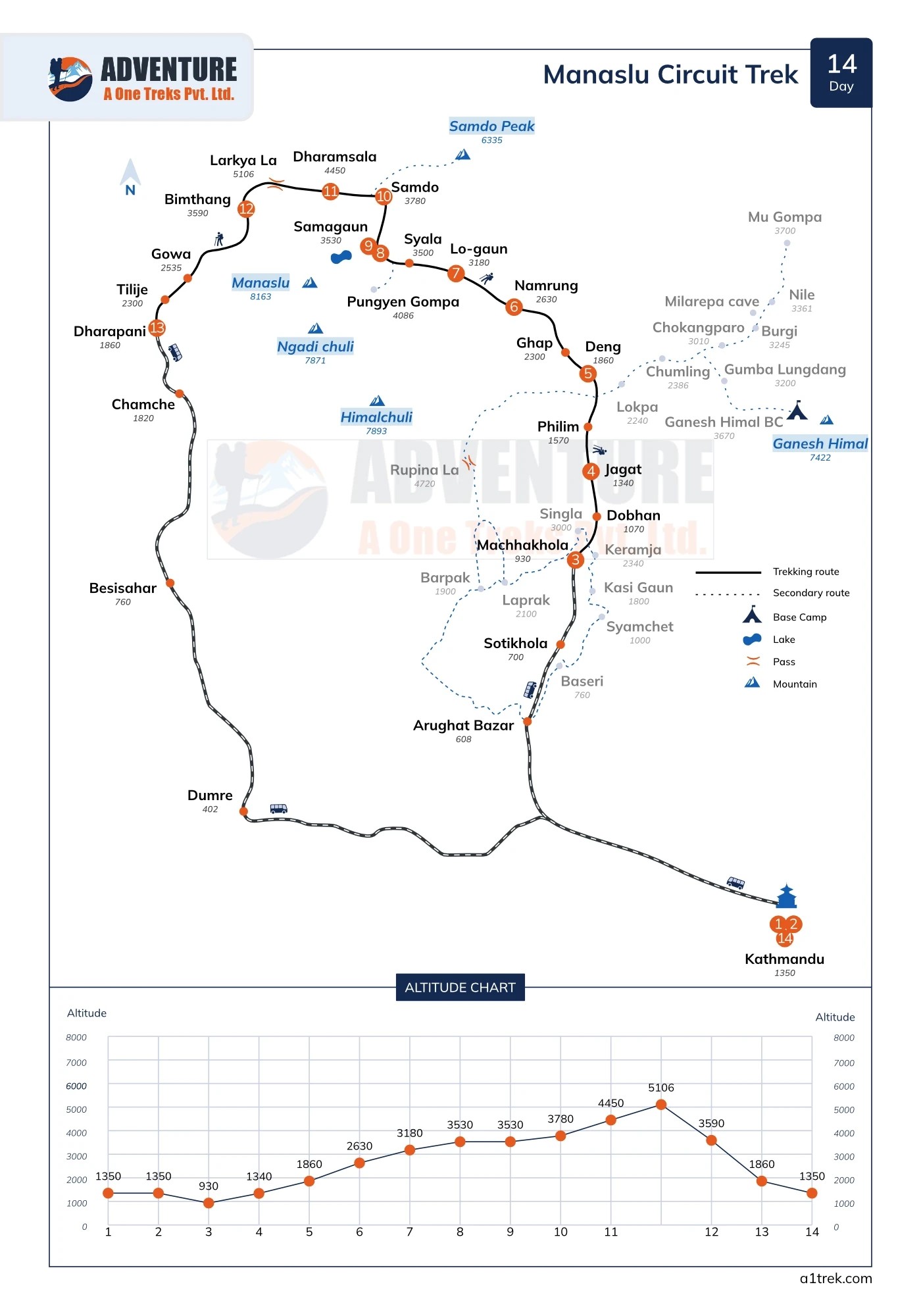
Reading the Manaslu Circuit Trek Map is easier when you understand the route symbols, village names, elevation markings, and distance indicators. First, identify the starting point at Machha Khola and follow the main trekking route through Jagat, Deng, Namrung, Lho, Samagaon, Samdo, and Dharamsala before reaching Larke La Pass. The trail then descends towards Bimthang and Dharapani.
Pay attention to the following details when reading the map:
Before starting the trek, download an offline map or carry a printed trekking map because mobile network coverage can be limited in remote sections. Compare the map with your daily itinerary and follow your licensed guide for route navigation and current trail conditions.
The Manaslu Circuit Trek is a demanding mountain journey that typically takes 12–18 days to complete, covering approximately 177 kilometers. Trekkers generally walk 10–15 kilometers per day, with an average walking time of 6–8 hours, depending on the route, terrain, and daily elevation gain. The long trekking days and remote mountain setting require good preparation, stamina, and a steady pace.
The trails in the Manaslu region are often rugged, rocky, and uneven, with steep ascents and descents that can be physically demanding, particularly for beginners. Walking for several hours across challenging Himalayan terrain requires both physical fitness and mental determination. Although previous trekking experience is helpful, beginners with proper preparation, good endurance, and sound health can also complete the trek. Regular cardio exercises, strength training, and practice hikes before departure can help build the fitness needed for the journey.
The Manaslu Circuit Trek reaches high elevations, with its highest point at Larkya La Pass (5,106 m / 16,752 ft) . As trekkers gain altitude, the risk of altitude sickness increases, making proper acclimatization an important part of the journey. A detailed trekking map helps you understand the elevation changes along the route and identify suitable places for rest and acclimatization.
The map provides an overview of the altitude at major checkpoints, helping you prepare for each section of the trek. By understanding the elevation gain and distance between villages, you can plan a steady walking pace and allow enough time for your body to adjust. Proper acclimatization, gradual ascent, and awareness of altitude sickness symptoms can reduce altitude-related risks and make your Manaslu Circuit Trek safer.
Day 1 : Arrival in Kathmandu
Day 2 : Kathmandu Sightseeing and Preparation
Day 3 : Drive to Machha Khola (930m | 160km | 7-8 hrs)
Day 4 : Machha Khola to Jagat (1,340m | 22km | 6-7 hrs)
Day 5 : Jagat to Deng (1,860m | 20km | 6-7 hrs)
Day 6 : Deng to Namrung (2,630m | 19.5km | 6-7 hrs)
Day 7 : Namrung to Lho Gaon (3,180m | 11km | 4-5 hrs)
Day 8 : Lho Gaon to Sama Gaon (3,530m | 9km | 4-5 hrs)
Day 9 : Rest Day in Sama Gaon (3,530m | Acclimatization Day)
Day 10 : Sama Gaon to Samdo (3,780m | 8km | 4–5 hrs)
Day 11 : Samdo to Dharamshala (Larkya Phedi) (4,450m | 7km | 4–5 hrs)
Day 12 : Crossing the Larkya La Pass (5,106m | 24km | 8-9 hrs)
Day 13 : Trek from Bhimtang to Dharapani 1860m/6100ft 6/7hours walking
Day 14 : Drive to Kathmandu (1,350m | 210km | 7-8 hrs)
Larkya La Pass is the highest point of the Manaslu Circuit Trek, reaching approximately 5,106 metres above sea level. However, its importance goes beyond elevation. Understanding where the pass sits along the trekking route helps you prepare for this demanding section of the journey.
Before reaching Larkya La, you spend several days gradually ascending through the Manaslu region. The itinerary also includes acclimatization stops at Sama Gaun and Samdo, allowing your body time to adjust to the increasing altitude. This gradual progression is important for managing altitude-related risks and preparing for the pass crossing.
Rather than viewing Larkya La as an isolated destination, consider it part of the overall trekking journey. The previous walking days, altitude gain, and acclimatization stops all contribute to your preparation for crossing the pass.
For more information about its location, elevation, walking route, and crossing conditions, read our detailed guide to Larkya La Pass.
The Manaslu Circuit Trek takes you from lower river valleys to elevations above 5,000 metres, where oxygen availability decreases significantly. At higher altitudes, your body needs time to adjust to the reduced oxygen levels. Ascending too quickly without proper acclimatization can increase the risk of acute mountain sickness (AMS). A Manaslu Circuit Trek map helps you understand the elevation changes along the route and prepare for gradual altitude gain.
From Soti Khola to Sama Gaun, the trail gradually climbs through different mountain settlements, with daily elevation gains varying according to the overnight stops. After reaching Sama Gaun, the itinerary generally includes an acclimatization day before continuing towards Samdo and Larkya La Pass. The final ascent to the pass reaches approximately 5,106 metres, making it one of the most physically demanding sections of the trek. After crossing the pass, the trail descends towards Bimthang and Dharapani.
When reviewing the Manaslu Circuit Trek map with distance and elevation details, pay attention to daily altitude changes rather than just the total elevation gain. Maintain a steady walking pace, drink enough water, follow a properly planned acclimatization schedule, and inform your guide if you experience symptoms of altitude sickness.
The elevation map helps trekkers understand how altitude changes along the Manaslu Circuit Trek and identify sections where the risk of altitude sickness may increase. By studying the altitude profile, trekkers can identify suitable places for acclimatization, particularly in Samagaon or Samdo before crossing Larke La Pass.
It also shows how quickly the trail gains elevation between villages and overnight stops. Since rapid altitude gain can increase the risk of altitude sickness, understanding these changes helps trekkers plan gradual ascents, maintain a steady walking pace, and allow enough time for proper acclimatization.
The elevation map is also useful for preparing for the more demanding sections of the trek. Knowing the highest point near Larke La Pass (5,106 m) helps trekkers anticipate steep climbs, manage their energy, and prepare for a physically demanding day. This makes it easier to plan daily walking distances and approach the high mountain sections with realistic expectations.
The Manaslu Circuit Trek is a multi-day high-altitude journey through remote Himalayan valleys, traditional mountain settlements, and challenging mountain terrain. Crossing Larkya La Pass (5,106 m) is one of the major highlights of the trek, connecting the Budhi Gandaki Valley with the descent towards Bimthang and Dharapani. A detailed Manaslu Circuit Trek Map helps you understand the route, prepare for elevation changes, and identify important villages, overnight stops, and optional side trips.
Understanding the total trekking distance, daily altitude gain, trail conditions, and suitable trekking seasons makes itinerary planning easier. Whether you are a first-time high-altitude trekker or an experienced hiker, studying the Manaslu Circuit Trek Map before departure helps you manage your walking pace, prepare for demanding sections, and navigate the route with greater confidence.
1. What is a Manaslu Circuit Trek map?
A Manaslu Circuit Trek map provides an overview of the trekking route, showing villages, mountain passes, rivers, trail sections, and overnight stops. It helps trekkers understand how the route connects from Machha Khola to Dharapani.
2. Where can I get a Manaslu Circuit Trek map?
You can get a Manaslu trekking map from local trekking agencies, bookshops in Kathmandu, or online map platforms. Your trekking agency can also provide a route map before the journey begins.
3. Where does the Manaslu Circuit Trek start on the map?
The standard Manaslu Circuit Trek usually begins at Machha Khola in the Gorkha District. From there, the trail follows the Budhi Gandaki River towards Jagat and the upper Manaslu region.
4. Where does the Manaslu Circuit Trek end?
The main trekking route crosses Larke La Pass and descends towards Bimthang before reaching Dharapani. Dharapani is generally considered the ending point of the classic Manaslu Circuit route.
5. Does the Manaslu Trek map show all overnight villages?
Most detailed maps include the main overnight settlements, such as Machha Khola, Jagat, Deng, Namrung, Lho, Samagaun, Samdo, Dharamsala, and Bimthang. However, the exact overnight stops depend on your itinerary.
6. Does the map show the elevation of each village?
Many trekking maps include altitude information for major villages and landmarks. This helps you understand how the trail gradually climbs from the lower Budhi Gandaki valley towards the high mountain settlements.
7. How can I find Larke La Pass on the Manaslu Circuit map?
Look for the section between Dharamsala and Bimthang. Larke La Pass, at approximately 5,106 metres, is marked as the highest crossing on the standard Manaslu Circuit route.
8. Can I use Google Maps for the Manaslu Circuit Trek?
Google Maps is useful for locating major settlements and roads, but it does not always display detailed trekking trails. A dedicated trekking map or offline navigation app is more suitable for following remote sections.
9. Which offline map is useful for the Manaslu Circuit Trek?
Organic Maps and Maps.me are two options for offline navigation. Download the relevant Nepal map before leaving Kathmandu so you can access basic location information without an internet connection.
10. Does the Manaslu Circuit Trek map show walking distances?
Some maps display approximate distances between villages and important trail points. However, not every map includes daily walking distances, so it is useful to compare the map with your trekking itinerary.
11. Can beginners understand the Manaslu Circuit Trek map?
Yes. Most standard trekking maps are relatively easy to understand, even for first-time trekkers. Knowing the village names, altitude markings, and route direction will make it easier to follow the journey.
12. Does the Manaslu map include the Tsum Valley route?
Some extended maps show both the Manaslu Circuit and the Tsum Valley. However, the Tsum Valley is a separate trekking route that branches from the main trail near Lokpa and requires additional planning and permits.
13. Does the Manaslu Circuit map show mountain viewpoints?
Detailed maps may include mountain peaks, glaciers, viewpoints, and surrounding geographical features. These markings help trekkers understand the landscape around Samagaun, Samdo, and the upper valley.
14. Can I see teahouses on the Manaslu Circuit Trek map?
Some maps mark villages and accommodation areas rather than individual teahouses. You can use these locations to identify possible overnight stops, but current accommodation availability should be checked along the trail.
15. Is the Manaslu Circuit Trek route marked clearly?
The main trekking route is generally identifiable, but some remote sections may have confusing junctions or changing trail conditions. Following your guide and checking the map together is a practical way to stay on the correct route.
16. Does the Manaslu Trek map show river crossings and bridges?
Some detailed maps include rivers, suspension bridges, and major crossings along the Budhi Gandaki valley. These features are useful for understanding the geography, although the condition of individual bridges may change.
17. How many kilometres does the Manaslu Circuit Trek cover?
The total distance is commonly estimated at around 177 km (110 miles), although the actual distance depends on the starting point, ending point, and selected itinerary.
18. Can I use a printed map during the Manaslu Circuit Trek?
Yes. A printed trekking map is useful because it does not depend on battery power or mobile network coverage. Many trekkers carry one as a backup alongside their phone-based navigation.
19. Do I need a guide if I already have a Manaslu Circuit Trek map?
Yes. The Manaslu region is a restricted trekking area, and independent trekking without a licensed guide is not permitted under the applicable regulations. A map is a navigation aid, not a replacement for a guide.
20. What should I check before following a Manaslu Circuit Trek map?
Check that your map covers the complete route, includes village names and elevations, and shows Larke La Pass. It is also worth checking the map's publication date because trail access and local conditions can change.