
The Tamang Heritage Trek is a 10-day, roughly 65-kilometer village-to-village loop in Nepal's Rasuwa district that trades high passes for high hospitality: stone-and-slate Tamang villages, family homestays, natural hot springs, and a 360° Himalayan panorama from Nagthali Danda at 3,165 meters — all within a day's drive of Kathmandu and without the altitude risk of Everest or Annapurna routes.
It was purpose-built for community tourism. The trail was developed through Nepal's Tourism for Rural Poverty Alleviation Programme (TRPAP), a UNDP-supported initiative active in six districts including Rasuwa (UNDP, retrieved 2026-08-23), to route trekkers — and their money — directly into villages that the classic Langtang Valley trail bypassed. Two decades later it remains one of the quietest multi-day treks in the country, and one of the few where your guesthouse fee visibly stays with the family hosting you.
This guide covers the full picture: a day-by-day itinerary based on our 10-day Tamang Heritage Trek departure, difficulty, permits and costs for 2026, cultural etiquette, packing essentials, and how the route compares with its famous neighbor, the Langtang Valley trek.
Key Takeaways
The Tamang Heritage Trek is an easy-to-moderate, culture-focused loop through Gatlang, Tatopani, Thuman, and Briddim, with overnight elevations below 2,700m and an optional viewpoint at 3,165m
The standard itinerary runs 10 days door to door from Kathmandu; guided packages start from US$790 per person including permits, guide, porter, meals, and transport
Permits are simple: Langtang National Park entry (NPR 3,000) plus a TIMS card (~NPR 1,000 via an agency) — no restricted-area permit needed
A licensed guide has been mandatory on Langtang-region treks since February 2025
Best seasons: September–December for clear skies, March–May for rhododendron blooms
The trail threads through the ancestral lands of the Tamang people, Nepal's fifth-largest ethnic group — 1,639,866 people, or 5.62% of the population, according to the 2021 National Population and Housing Census (National Statistics Office, Nepal, retrieved 2026-08-23). The name Tamang is often translated as “horse trader,” a nod to the caravan era when these valleys formed a salt-and-grain trade corridor between Kathmandu and Tibet. Tibetan traders bartered salt and mountain goats for rice and grain from the south, and the stone-paved paths you'll walk on were built by those caravans.
Long before it carried trekkers, this borderland traded everything. Rasuwagadhi, the historic fort at Timure, guarded the crossing into Tibet's Kyirong valley — today one of Nepal's official land borders.
The modern trail came later. TRPAP launched in Rasuwa in August 2002 with funding from UNDP, DFID, and SNV-Nepal, working through the District Development Committee to develop the Tamang Heritage Trail as a new tourism product in villages like Goljung, Gatlang, Chilime, Thuman, Timure, and Briddim (CUTS CITEE, retrieved 2026-08-23). Villagers restored the caravan paths, opened community homestays, and kept tourism revenue local by design. That origin still defines the experience: accommodation is family-run, food comes from terraced fields above the village, and cultural shows happen because the hosts want them to — not because a hotel chain booked them.
Geographically, the route sits between the Ganesh Himal and Langtang ranges, inside Langtang National Park — established in 1976 as Nepal's first Himalayan national park (DNPWC, retrieved 2026-08-23). Forest sections hide red pandas, Himalayan black bears, langur monkeys, and danphe pheasants, though most visitors' only wildlife sighting is a sure-footed herd of changra goats being driven to market.
| Fact | Detail |
|---|---|
| Duration | 10 days from Kathmandu (5–6 trekking days; shorter 7–8-day variants exist) |
| Distance | ~60–70 km of walking |
| Max sleeping altitude | 2,607m (Tatopani) |
| Highest point | 3,165m at Nagthali Danda viewpoint (optional side hike) |
| Difficulty | Easy to moderate |
| Permits | Langtang National Park entry + TIMS card |
| Accommodation | Tea houses and community homestays |
| Starts / ends | Kathmandu / Kathmandu |
| Guided package from | US$790 per person (A One Treks) |
This is our standard 10-day Tamang Heritage Trek itinerary. Every day below shows the maximum elevation reached.
Land at Tribhuvan International Airport, settle into your hotel, and meet your guide for a briefing and gear check. Day 2 is a 6–7 hour drive north-west via Trishuli Bazar and Dhunche, following the Trishuli River through terraced hills and roadside market towns. Syabrubesi (1,470m), the gateway village where the Tamang Heritage Trail and Langtang Valley trails diverge, is your first night on trail.
The first trekking day climbs steadily out of the Bhote Koshi valley through farm villages and pine forest — about 5–6 hours to Gatlang, a photogenic stone-and-slate village stacked on a ridgeline. Above the village sits Parvati Kunda, a sacred pond wrapped in prayer flags, and a hilltop monastery with views toward the Ganesh Himal range. Gatlang is where the trail's community-tourism roots show clearest: many families here hosted their first paying guests under the original TRPAP homestay program.
A 5–6 hour ridge walk with Ganesh Himal ahead and the snow walls of the Tibet frontier appearing to the north. Tatopani translates literally as “hot water” — the draw is a natural hot-spring pool where trekkers have soaked trail-weary legs for generations. Bring a swimsuit and modesty: it's a shared local bath, not a spa.
The trek's big view day. The trail tops out at Nagthali Danda (3,165m), once a meditation retreat for local lamas and now the best panorama on the route: Langtang Lirung to the east, the Ganesh Himal range west, and across the line in Tibet, Shishapangma (8,027m) — the only 8,000er lying entirely on Tibetan soil — with Kerung Himal beside it. After lunch at the small tea settlement, a long descent leads to Thuman (2,400m), a compact village known for its warm welcome and evening cultural programs of Tamang song and dance.
An easier day through rhododendron and oak forest, passing mani walls and chortens — the trail near Briddim is often described by local operators as home to one of Nepal's longest carved mani-wall complexes. Briddim itself is a horseshoe-shaped village of around 40-plus households running one of Langtang's model homestay programs. Visit Dukchu Gomba, the village monastery believed to have been blessed by Guru Rinpoche, then spend the evening in a family kitchen over butter tea and locally brewed millet.
The route now drops into the Langtang Khola valley and joins the classic Langtang Valley trail at Lama Hotel, a forest settlement of lodges named after its most famous regulars — the langur monkeys in the surrounding oaks.
Your final trekking day follows the river downhill back to Syabrubesi — 5–6 hours through bird-filled forest. Celebrate tonight; the crew usually will too.
Retrace the Trishuli road to Kathmandu (6–7 hours) with a free afternoon for souvenir shopping in Thamel, then transfer to the airport for your flight home. Nepali friends say goodbye with feri bhetaula — “see you again.”
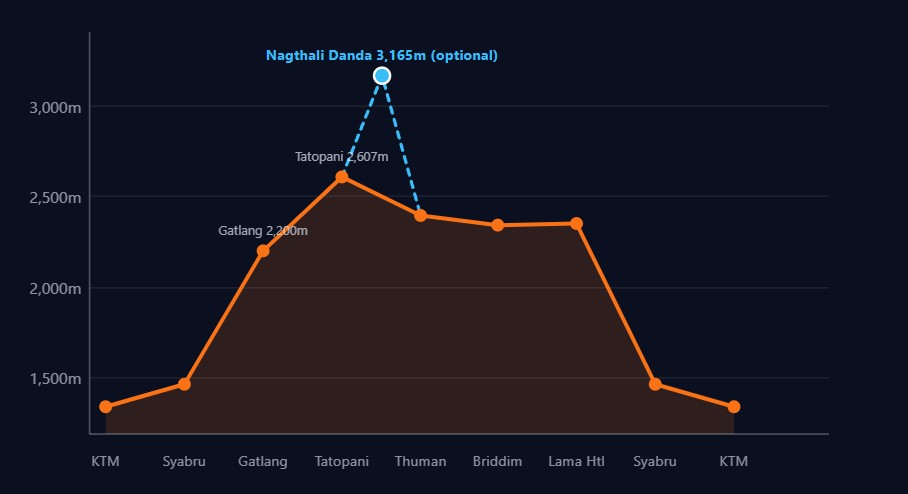
| Stop | Elevation |
|---|---|
| Kathmandu | 1,350m |
| Syabrubesi (Day 2) | 1,470m |
| Gatlang (Day 3) | 2,200m |
| Tatopani (Day 4) | 2,607m |
| Nagthali Danda (Day 5, optional side hike) | 3,165m |
| Thuman (Day 5) | 2,400m |
| Briddim (Day 6) | 2,345m |
| Lama Hotel (Day 7) | 2,350m |
| Syabrubesi (Day 8) | 1,470m |
| Kathmandu (Days 9–10) | 1,350m |
Source: Adventure A One Treks itinerary data (2026).
Most Himalayan treks use villages as fuel stops. Here, they're the destination.
Homestays, not hotels. In Briddim and several other villages you sleep in the family home — thick stone walls, wooden shutters, a tinaga stove burning wood in the kitchen. You eat what the family eats: dal bhat, tsampa porridge, potatoes from fields you walked past that afternoon. Homestay income is the trail's founding idea; when TRPAP surveyed early results in Rasuwa, host families like Yog Tamang of Goljung were earning their first-ever cash income from guests (CUTS CITEE, retrieved 2026-08-23).
Living Tibetan Buddhism. Chortens at every pass entry, mani wheels turned by hand as you pass, and monasteries like Gatlang's and Briddim's Dukchu Gomba anchoring village life. The Tamang practice Nyingma-tradition Tibetan Buddhism layered over older Bon shamanism, and if your dates catch Sonam Lhosar — the Tamang new year, falling in January or February — villages fill with masked cham dances and family feasts.
A working trade landscape. Between Thuman and Timure you're walking the old caravan road to Rasuwagadhi fort on the Tibet border, where customs stations replaced salt traders. The 2015 earthquake hit this district hard, and rebuilt homes, gompas, and homestay rooms you see along the trail are part of that recovery — every booking helps it continue.
It's one of the gentlest multi-day treks in Nepal. Daily walking time runs 5–6 hours on well-graded paths, with one sustained climb (Day 3 to Gatlang) and one long descent (Day 8). Sleeping altitude never exceeds 2,607m — barely half the height where acute mountain sickness becomes a serious concern on Nepali trails — so AMS risk is minimal even for first-time trekkers.
Fitness matters more than experience: expect stairs, stone steps, and some steep forest sections. If you can walk briskly for five hours with a light daypack, you can finish this trek comfortably. Porters carry the main luggage; you walk with 4–6 kg. Families with children of roughly 10+ regularly complete this route, which is why we rate it the best beginner trek in the Langtang region.
Two permits cover the entire route — there's no restricted-area paperwork like Manaslu or Upper Mustang:
| Permit | Foreign nationals | SAARC nationals | Where issued |
|---|---|---|---|
| Langtang National Park entry | NPR 3,000 (~US$22) | NPR 1,500 (~US$11) | Nepal Tourism Board, Kathmandu, or Dhunche checkpoint |
| TIMS card (via registered agency) | NPR 2,000 (~US$15) | NPR 1000 (~US$7.50) | Your trekking agency |
| Total | ~US$37 | ~US$19 | Included in our packages |
Fees verified against current operator guidance for 2026 . Since April 1, 2023" -- NTB, foreign trekkers must be accompanied by a licensed guide, and TIMS cards are issued through registered agencies rather than independently — checkpoints at Dhunche, Syabrubesi, and TIMS post on the Thuman side verify both documents and your guide registration.
What the US$790 package includes: airport transfers, two nights' three-star hotel with breakfast in Kathmandu, round-trip transport to Syabrubesi, both permits, a licensed guide, a porter (one per two trekkers), all meals on trek, teahouse/homestay lodging, and government taxes. Budget separately for your Nepal visa (see our visa information page), travel insurance with evacuation coverage (roughly $100–150 for a two-week policy), drinks and personal snacks, and tips for the crew.
| Trek | Duration | From (per person) |
|---|---|---|
| Helambu Trek | 9 days | $555 |
| Langtang Valley Trek | 10 days | $561 |
| Tamang Heritage Trek | 10 days | $790 |
| Langtang Ganja La Pass Trek | 13 days | $866 |
| Langtang Gosaikunda Trek | 15 days | $920 |
Both treks start at Syabrubesi, cost less than most Annapurna routes, and sit a day's drive from Kathmandu. They deliver completely different experiences:
| Feature | Tamang Heritage Trek | Langtang Valley Trek |
|---|---|---|
| Route style | Village loop west of the valley | Out-and-back alpine valley |
| Max altitude | 2,607m (3,165m optional) | 3,870m Kyanjin Gompa |
| Focus | Tamang culture, homestays, hot springs | Glaciers, 7,000m peaks, yak cheese factory |
| Crowds | Very low | Moderate |
| Difficulty | Easy–moderate | Moderate |
| Duration & price (ours) | 10 days, from $790 | 10 days, from $561 |
Choose the Tamang Heritage Trek if you want depth over altitude: fewer people, closer contact with families, and gentler elevation. Choose Langtang Valley if dramatic glacial scenery is the priority. With three extra days you can combine both into a single circuit — or push on over Lauribina Pass to the sacred lakes of Gosaikunda on our 15-day Langtang Gosaikunda trek.
| Season | Months | Conditions |
|---|---|---|
| Autumn | Sep–Nov | Clear skies, stable weather, harvest season in the villages; the busiest window but still quiet compared with Everest |
| Early winter | Dec | Cold mornings, crystal-clear views, empty trails; hot springs shine here |
| Spring | Mar–May | Rhododendron forests in bloom, warming days, occasional haze before pre-monsoon showers |
| Monsoon | Jun–Aug | Avoid: rain, leeches, cloud-obscured mountains, slippery stone paths |
Our departures run September–December and March–May, matching the windows we've found most reliable over 15+ years of operating in Rasuwa. Check current fixed departure dates to join a group and share costs.
Expect basic but warm rooms — twin beds, shared squat or Western toilets, blankets provided (bring a liner if you're particular). The homestay nights are the highlight and also the simplest: thin mattresses, roaring kitchens, and conversations that go late. Charging is possible in most tea houses for a small fee; Wi-Fi exists patchily up to Syabrubesi and disappears quickly beyond it — treat the digital detox as a feature.
Meals follow the teahouse standard: dal bhat power, thukpa noodle soup, momos, fried rice, and Tibetan bread. Portions are generous because porters and guides order the same menu. Drink only boiled or treated water and carry purification tablets to cut plastic bottle waste.
Full kit list on our equipment page; the short version:
• Broken-in waterproof boots with ankle support
• Layers: base layers, fleece, insulated jacket, shell (nights drop near freezing outside summer)
• 30–40L daypack; sleeping bag rated to -5°C
• Headlamp, water purification, sun protection (the ridge sun at 2,500m+ deceives)
• Swimwear and quick-dry towel for the Tatopani hot spring
• Cash in small NPR notes — no ATMs beyond Dhunche/Syabrubesi
• Passport copies, permits (your agency provides), insurance details
This route exists so tourism benefits its host communities, and a few habits keep that promise intact:
• Book homestay nights where offered rather than defaulting to the biggest lodge in each village.
• Refill, don't rebuy — boiled water costs pennies and saves hundreds of bottles.
• Ask before photographing people , especially during festivals and inside gompas.
• Respect hot-spring etiquette : modest swimwear, no alcohol, and keep the pool clean.
• Carry out what you carry in , including batteries and wrappers — village waste systems are rudimentary.
• Tip fairly : 10% of your trek cost split among guide, porter, and driver is customary when service earns it.
No. Guide rule since April 2023.
The classic circuit takes 5–6 trekking days, which most operators package as 8–10 days from Kathmandu including drives and arrival/departure days. Our standard departure is 10 days door to door, and the trail links naturally with Langtang Valley or Gosaikunda if you want longer.
Yes. Since February 2025, foreign trekkers in Langtang National Park must be accompanied by a licensed guide, arranged through a registered agency. Your guide handles permits, checkpoints, homestay bookings, and translation — most villagers speak limited English, and the cultural context is half the reason to come.
Unlikely. You sleep below 2,700m every night — lower than many European ski resorts. The only brief exposure is the optional Nagthali Danda hike to 3,165m, and symptoms there resolve quickly on descent. Basic precautions still apply: hydrate, pace yourself on Day 3's climb, and tell your guide about headaches.
It's arguably the best beginner multi-day trek in Nepal: moderate daily distances, low altitude, comfortable villages, and easy evacuation logistics along the road head. We regularly host families with children aged 10 and up.
Absolutely, and many trekkers do. The heritage loop rejoins the Langtang trail at Lama Hotel, so adding Kyanjin Gompa typically adds 3–4 days. See how the routes connect in the comparison table above, or ask us for a combined itinerary quote.
Our published package starts at US$790 per person on current offer pricing. Add your international flights, Nepal visa ($30–125 depending on duration), travel insurance (~$100–150), personal drinks and snacks, and tips. Most trekkers budget $1,000–1,200 all-in excluding flights.
The Tamang Heritage Trek won't take you to a base camp or a famous pass. Instead, it offers something rarer in 2026's Himalaya: a week of quiet ridgelines, hot springs under stars, monastery mornings, and dinners eaten cross-legged in kitchens whose owners built the tourism economy themselves, one homestay at a time. For trekkers who measure trips in conversations rather than altitude records, nothing else in Nepal comes close at this price point.
Ready to walk it? Compare dates on the full Tamang Heritage Trek listing, browse the wider Langtang region options, or message us through WhatsApp for a custom itinerary — groups of two or more can request private departure dates year-round.