Annapurna Circuit versus Annapurna Base Camp Trek
8 Jan 2023

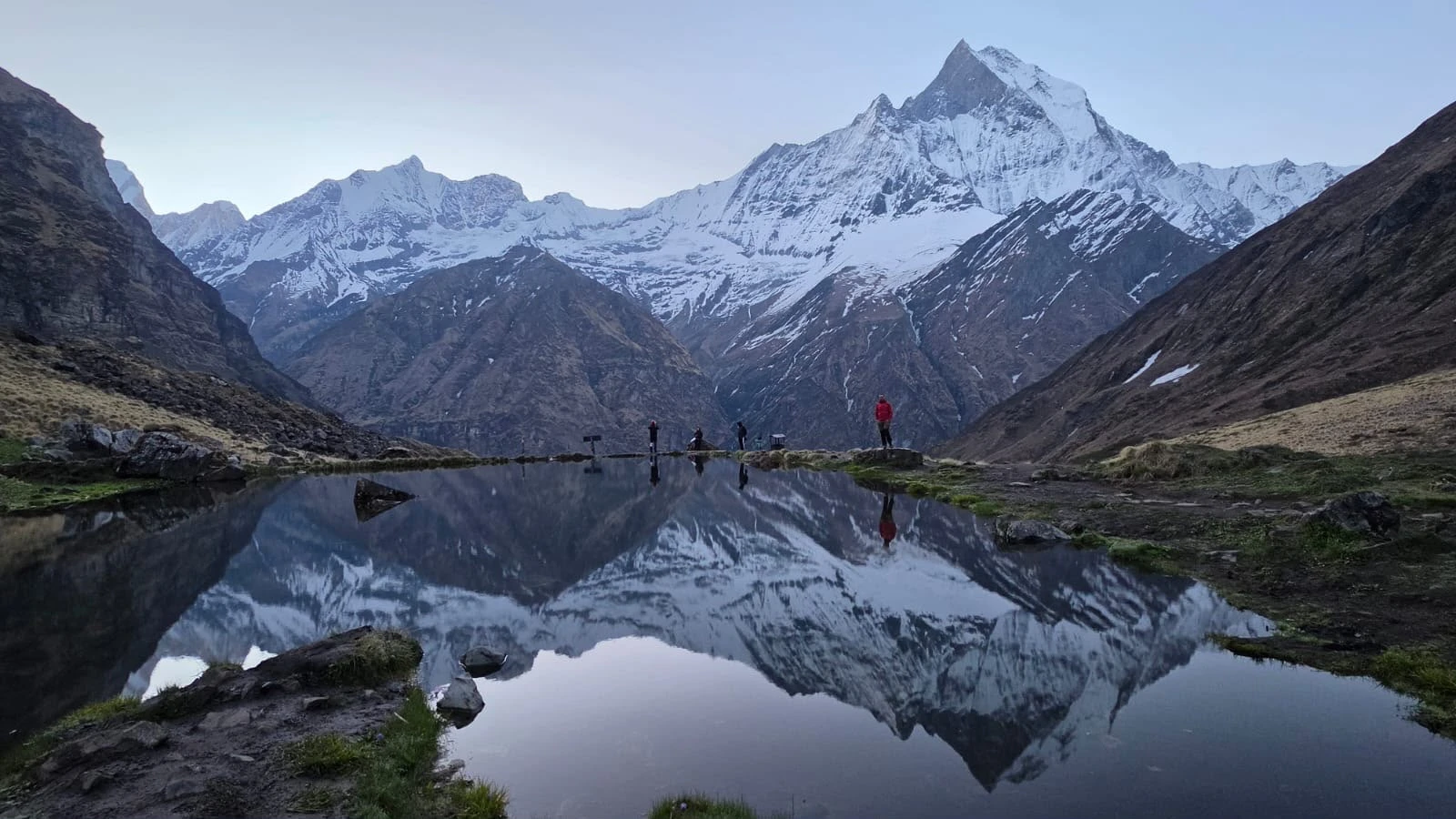
The Annapurna Base Camp Trek -- usually called "ABC" -- drops you into a natural amphitheatre of rock and ice ringed by 6,000- and 7,000-meter peaks. Unlike the Everest Base Camp route, which is a long approach up a single valley, the Annapurna Sanctuary is a bowl: at its floor you stand nearly surrounded by Annapurna I (10th highest mountain on Earth at 8,091m), Machhapuchhre (Fishtail, 6,993m), Hiunchuli, and Gangapurna. The payoff for the journey into the bowl is one of the most dramatic 360-degree mountain views in all of Nepal.
Few treks anywhere in the Himalaya reward you with such a compact, close-up amphitheatre of giants. At Annapurna Base Camp the peaks are so near that on a clear morning you feel you could reach out and touch the sweeping south face of Annapurna I. The scale is humbling, and for many trekkers it is the single most iconic photograph of their Nepal trip. It is this combination of accessibility and drama that has made ABC the most popular trek in the Annapurna region and one of the highest-selling treks in Nepal overall.
There is also a cultural layer that many visitors miss until they are on the trail. The villages you pass through -- Ghandruk, Chhomrong, Sinuwa -- are home to the Gurung people, an ethnic group with a proud history of service in the British and Indian Gurkha regiments. Stone houses with slate roofs, terraced fields, and mani walls (prayer walls of carved stones) tell a story of a farming and trading culture that has lived in these valleys for centuries. The trail threads through this human landscape of villages and rhododendron forests before it finally leaves the trees and enters the bare, high glacial world of the Sanctuary.
This guide covers everything you need to plan and book the trek as of the 2026-27 season: a realistic day-by-day itinerary, difficulty and altitude strategy, the two permits you need, a transparent cost breakdown using confirmed 2026 pricing, what's included in a guided package, and honest packing and safety notes from a Kathmandu-based agency that runs this route weekly.
Key Takeaways
- The classic ABC trek is 13 days from Kathmandu and our 2026 package price is US$735 per person, down from the US$855 list price
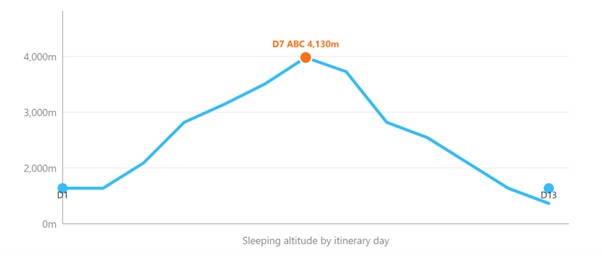
- Maximum altitude is 4,130m at Annapurna Base Camp -- reachable without mountaineering gear, but acclimatization days before it are non-negotiable
- Only two permits are required: the Annapurna Conservation Area Project (ACAP) permit and a TIMS card
- Best seasons are autumn (Sep-Nov) and spring (Mar-May); October and the shoulder of the season give the clearest views
- A licensed guide is mandatory under Nepal's 2023 trekking regulations for foreign independent trekkers
- Ready to book? Chat with Adventure A One Treks on WhatsApp or see the full trip itinerary
Start planning with our Annapurna Region Trek overview -- the hub covering every Annapurna trek we run.
What Is the Annapurna Base Camp Trek?
The Annapurna Base Camp route climbs from the lake town of Pokhara, through the terraced Gurung villages of Ghandruk and Chhomrong, up the Modi Khola valley, and into the Annapurna Sanctuary. It ends at Annapurna Base Camp, an open glacial plateau at 4,130m that in fair weather offers direct views of the south face of Annapurna I.
The Annapurna Sanctuary: a bowl, not a peak
The word "sanctuary" is the key to understanding ABC. The Annapurna Sanctuary is a high glacial basin -- an elongated, U-shaped bowl carved by glaciers at the head of the Modi Khola river. Unlike Summit or Base Camp treks that push up a single ridge, you climb a steep-walled valley and then step out onto a flat, open floor where eight peaks above 7,000m ring the horizon. Because the floor of the Sanctuary is enclosed by mountains on nearly every side, weather travels slowly in and out, and the views are famously intimate and close.
The name "Annapurna" comes from Sanskrit and translates loosely to "full of grain" or "goddess of the harvest." The Hindu goddess Annapurna is the goddess of food and nourishment, and a small temple still stands at the base camp as a reminder of the sacred status the mountain and its valleys have held for generations. For the Gurung and other local communities, the peaks within the Sanctuary were long considered the home of deities, and only in the twentieth century did outsiders begin to walk to their feet.
The protected landscape around it
The region is managed as the Annapurna Conservation Area Project (ACAP), Nepal's largest protected area, spanning 7,629 square kilometers across the Massif. ACAP was established in 1986 and is run by the National Trust for Nature Conservation. What makes it unusual is that it is a "multiple-use" protected area: rather than excluding people, it works with local communities to combine conservation with sustainable development, tourism, and farming. When you pay your ACAP permit, a portion of that money goes back into trail maintenance, forest regeneration, and community projects in the very villages you will walk through.
The ecosystems change dramatically as you climb. You begin among terraced rice fields and subtropical forest at low elevation, rise into dense rhododendron and oak forest, then cross into subalpine scrub, and finally reach bare rock, ice, and snow in the high Sanctuary. This variety means wildlife changes too: look quietly and you may spot langur monkeys, Himalayan tahr, musk deer, and, very rarely, a snow leopard far up on the cliffs. Birders enjoy the trail for its vultures, eagles, and the colorful Himalayan monal.
The three practical route variants
Most people walk a version of one of three routes:
Looking for a shorter, lower-altitude option? Try the Ghorepani Poon Hill Trek -- an 8-day sunrise-viewpoint route that's gentler than ABC. Or, if you want even fewer crowds with Machhapuchhre up close, compare our Mardi Himal Trek guide. Still deciding between routes? See how they all stack up in our Top 7 Annapurna Treks guide.
| Day | Section | Highest point | Walk time |
| 1 | Kathmandu Pokhara (drive or fly) | ~1,400m | 6-7h drive |
| 2 | Pokhara Ghandruk | ~1,940m | 4-5h |
| 3 | Ghandruk Chhomrong | ~2,170m | 4-5h |
| 4 | Chhomrong Dovan | ~2,600m | 5-6h |
| 5 | Dovan Deurali | ~3,230m | 4-5h |
| 6 | Deurali Annapurna Base Camp | 4,130m | 5-6h |
| 7 | Acclimatization / exploration at ABC | 4,130m | rest |
| 8 | ABC Bamboo | ~2,300m | 6h |
| 9 | Bamboo Sinuwa or Chhomrong | ~2,340m | 5h |
| 10 | Chhomrong Jhinu Danda (hot springs) | ~1,780m | 4-5h |
| 11 | Jhinu Danda Pokhara | ~820m | 6h |
| 12 | Pokhara Kathmandu (buffer/rest day) | -- | 6-7h |
| 13 | Departure | -- | -- |
Timings are for a standard guided group. Fit trekkers can trim rest/buffer days; less fit trekkers should add them.
Day 1: Kathmandu to Pokhara
Most ABC treks begin with the drive (roughly 6-7 hours) or a short 25-minute flight from Kathmandu to Pokhara. The drive follows the Prithvi Highway along the Trishuli river and, in clear weather, offers its own glimpses of the Himalaya. Flights are faster but can be delayed by weather; the bus is reliable and cheaper and lets you break the journey. We generally recommend the tourist bus for value and the early-morning flight for comfort. Either way, you overnight in Pokhara's lakeside district, where you can see the trail's first views of Machhapuchhre reflected in Phewa Lake. If time allows, watch the sunrise from Sarangkot or take a short boat ride before bed.
Day 2: Pokhara to Ghandruk
A morning drive (roughly 2.5-3 hours) takes you to the trailhead near Nayapul or Kimche, then you climb through terraced fields and forest to the large Gurung village of Ghandruk at about 1,940m. Ghandruk is one of the finest villages on the route, with its Gurung museum, stone-paved lanes, and close views of Annapurna South and Hiunchuli. This is a steady, comfortable first walking day that eases you into the trail.
Day 3: Ghandruk to Chhomrong
Leave Ghandruk and descend to cross the Modi Khola, then climb a long, steep series of stone steps to Chhomrong at 2,170m. Chhomrong sits high above the incised valley and is your first proper acclimatization stop. The views back across the valley and up toward the Sanctuary are superb, and the village is a natural staging point before the valley narrows.
Day 4: Chhomrong to Dovan
From Chhomrong you descend a huge flight of steps to the river (losing most of the day's altitude), cross the Modi Khola, and climb again through dense forest to Dovan at roughly 2,600m. This is one of the physically harder days because of the repeated up-and-down, but the cool forest and the sound of the river keep it pleasant. The landscape grows wilder and the lodges simpler as you push deeper.
Day 5: Dovan to Deurali
The trail continues up the Modi Khola valley through increasingly alpine forest and eventually opens onto more exposed terrain. Deurali sits at about 3,230m, where the last trees thin out and the views of the surrounding peaks open up dramatically. This day is a critical acclimatization step -- you sleep higher but still below the ultimate goal of the day after.
Day 6: Deurali to Annapurna Base Camp
The big day. From Deurali you climb past Himalayan Hotel and Machhapuchhre Base Camp, then make the final push across the glacial flats to Annapurna Base Camp at 4,130m. Weather permitting, the arrival is overwhelming: the amphitheatre of peaks closes in around you and the base camp's lodges sit right at the foot of the sanctuary. You sleep here tonight, which is why a rest day is built in next.
Day 7: Acclimatization and exploration at ABC
This built-in rest day is not optional for most people. You have already reached the highest sleeping point of the trek, so this is the day your body needs to adjust before heading back down. It is also a photographic gift: early morning at the base camp, with the peaks lit up in the first light over the glacial floor, is among the best sunrises in Nepal. Short walks, plenty of water, and time outdoors are the agenda.
Days 8-10: The descent
Descent days are fast but not trivial. On day 8 you drop from ABC to Bamboo (~2,300m), retracing the climb through the forest. Day 9 takes you back up to Sinuwa or Chhomrong. On day 10 you end at Jhinu Danda (~1,780m), famous for its natural hot springs beside the Modi Khola -- a genuinely welcome reward for tired legs after days on the trail.
Days 11-13: Return to Pokhara, then home
From Jhinu Danda you walk out to the road, drive back to Pokhara, and then return overland or by flight to Kathmandu, with a buffer/rest day built in before departure. Because ours includes a spare day, you have slack if the trail or weather forces a slower pace.
Planning your specific dates? Message Adventure A One Treks on WhatsApp and we'll tailor this itinerary to your schedule and fitness.
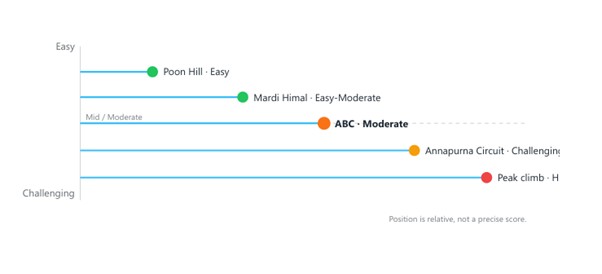
ABC is rated moderate on Nepal's standard difficulty scale -- harder than the Poon Hill walk, easier than the Annapurna Circuit or any peak climb. You'll climb 4,130m over days, so acute mountain sickness (AMS) risk is real but manageable with a slow pace and rest days. The key rule: once you pass 3,000m, sleep no higher than your body has already adjusted to -- the itinerary above builds in the ABC acclimatization day for exactly this reason.
Because you're trekking into a steep valley and back out, most descents are short and the climb is steady rather than technical. No ropes, crampons, or mountaineering experience are required; the trail is well-marked with teahouse lodges every few hours.
What "moderate" actually means on the ground
Moderate does not mean easy. On ABC you face long days of continuous up-and-down on stone steps, especially on the approaches to and around Chhomrong, and you climb from roughly 1,400m to 4,130m over six walking days. The altitude is the real test, not the terrain. Anyone of average fitness who can walk steadily for five to seven hours a day and climb several hundred meters of stairs without stopping is fit enough for ABC with a guided group. Prior high-altitude experience helps but is not required if you take the standard itinerary seriously.
Where ABC sits on the difficulty scale, relative to other Annapurna routes, is easy to see at a glance:
Only two documents are required for ABC, both obtainable in Kathmandu or Pokhara through your agency:
| Permit | Cost (approx.) | Notes |
|---|---|---|
| ACAP (Annapurna Conservation Area Project) | ~NPR 3,000 (~US$23) | Covers the protected area; included in packages |
| TIMS card | ~NPR 2,000 (~US$15) standalone | Trekker Information Management System |
Foreign independent trekkers must also be accompanied by a licensed guide under Nepal's 2023 regulation. Our guided packages bundle permits, guide, porter, teahouse lodging, and most meals, so you don't handle any of this on-trail.
The ACAP entry permit
The Annapurna Conservation Area Project (ACAP) permit is your ticket into Nepal's largest protected area. It is a simple paper permit issued by the National Trust for Nature Conservation and is checked at entry points along the trail. When you trek with us, we arrange your ACAP permit in advance in Kathmandu or Pokhara, so your name and passport number are already registered and you simply carry your copy. The permit fee funds conservation and community development across the protected area, which is why your fee is not just an administrative cost.
The TIMS card
The Trekker Information Management System (TIMS) card was introduced as a trail-safety and management tool across Nepal. Your TIMS registration records your planned route, contact details, and emergency information so that search and rescue authorities have a record of who is on which trail. For a single trek like ABC it is one card per trekker. Under the 2023 regulations the rules around TIMS and guiding requirements were tightened for foreign independent trekkers, which is one reason we strongly recommend the guided, all-inclusive option.
Why the guided route removes the paperwork
The 2023 trekking regulation requires foreign independent trekkers to walk with a licensed guide. In practice this means you will not need to solve permits, logistics, or route decisions alone. Our packages include both permits, your licensed guide, a porter for up to about 15 kg of your belongings, teahouse lodging, most meals, and all the transfers you need. You arrive, walk, and enjoy the sanctuary without handling any of the administrative friction on-trail.
Our guided 13-day ABC package is US$735 per person.Here's what that includes and a rough independent budget for comparison:
| Item | In our package | Independent (approx.) |
|---|---|---|
| Guide + porter | Included | $20-$30/day |
| Teahouse lodging | Included | $5-$12/night |
| Meals on trail | Included | $15-$25/day |
| Transport Kathmandu-Pokhara return | Included | $25-$50 |
| ACAP + TIMS permits | Included | ~$38 |
| Total (13 days) | US$735 | ~$700-$950 |
A guided package removes the logistics and teahouse-haggling friction; independent trekking is viable and slightly cheaper at the low end but adds planning and carries the full risk of poor route/altitude decisions. For first-timers we recommend the guided option.
What your package money buys you
The guide is the single most valuable line item. A licensed, first-aid-trained guide adds safety, local knowledge, and on-trail problem-solving that no map can replace. The porter carries a heavy share of the load so you hike lighter and faster. Tea-house lodging and meals remove the daily decision of where to sleep and what to pack for dinner, and the transport bundle means you are never negotiating shared jeeps or buses with a pack on your back.
Where an independent budget adds up
If you choose to go independent (with a licensed guide you hire separately), your daily costs will be dominated by guide and porter wages, teahouse beds, and meals. The low end of the independent range is achievable but leaves little margin for the unexpected, such as a bad-weather rest day or a last-minute flight. Many trekkers find the guided bundle better value once they total up a guide, a porter, lodging, and meals separately -- the package is not only simpler but often no more expensive in practice.
Tips for saving without cutting safety
Ready to go? You don't organize anything yourself. Adventure A One Treks arranges your permits, guide, porter, lodging, and meals. See the full ABC trip itinerary, dates & inclusions or message us on WhatsApp to check availability for your travel dates.
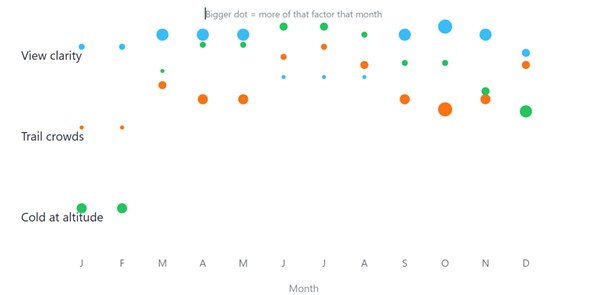
The chart below condenses the year into three factors -- how clear the views are, how busy the trails are, and how cold it gets at altitude. Bigger dots mean more of that factor in any given month.
Autumn: the classic window (September-November)
Autumn is the most reliable season. The monsoon has cleared the skies, the air is crisp, temperatures are pleasant by day, and mountain views are at their best and steadiest. October is the peak month, with the clearest weather and the highest number of trekkers, which means busier lodges and a livelier trail. Late September and early November offer slightly lighter crowds with still-excellent views -- a sweet spot many return trekkers prefer.
Spring: rhododendrons and warming days (March-May)
Spring is the second best window. Days are warm and the lower forests explode with rhododendron blossoms in vivid reds, pinks, and whites. Views are generally very good, though not quite as steady as autumn, and the occasional afternoon shower is possible. Late March through April is the height of the spring season, with the best balance of weather and clear skies.
Monsoon: a season to avoid (June-August)
The summer monsoon brings heavy rain, cloud, and leeches to the lower reaches of the trail. The Modi Khola swells, trails turn to mud, and views at altitude are frequently obscured. Trekkers who attempt ABC in the monsoon must be flexible with itineraries and carry rain gear and leech protection. Unless you have no other choice, plan for autumn or spring instead.
Winter: cold, empty, and for the well-equipped (December-February)
Winter at altitude is cold, with deep snow above the treeline and only some lodges open. Skies can be extremely clear and the trail far emptier, but the cold at 4,130m is serious and the risk of being caught by snow or a closed lodge is real. Winter ABC is only for experienced, well-equipped trekkers who understand the risks and carry serious cold-weather gear.
Packing right is half the battle on ABC. You want a pack that is light enough to carry (or that your porter can carry without strain) yet complete enough to keep you warm, dry, and safe in conditions that range from subtropical valley heat to freezing nights at 4,130m.
Footwear that will not let you down
Boots deserve special attention. ABC involves kilometres of stone steps, river crossings, and loose trail. You want a broken-in mid- or high-cut boot with a defined lugged sole and good ankle support, worn for several weeks before departure so you know your hot spots. Carry thick socks, change into dry socks at each lodge, and treat any hot spot early before it becomes a blister. Two pairs of merino-wool trekking socks and a pair of comfortable camp shoes make a big difference to foot comfort at the end of each day.
Layers, and why they matter more than a single big jacket
Air temperature on ABC can change by 20-30°C between a sunny afternoon in the valley and a night at the base camp. A base layer that wicks moisture, a mid layer (fleece or down) that traps heat, and a waterproof-breathable shell that keeps rain and wind out allow you to regulate your temperature minute by minute while you walk. Cotton is your enemy at altitude: once wet, it stays wet and cold.
Dehydration and fuelling at altitude
Altitude suppresses thirst, so you must drink on a schedule rather than waiting until you feel thirsty. Three to four liters a day is the baseline, more on hot or long days. Eat frequently and carbohydrate-rich meals: your body burns more energy at altitude, and running on empty makes both the altitude and the walking feel far harder. Alcohol and heavy caffeine are best avoided above about 3,000m, as they dehydrate and can worsen altitude symptoms.
Know your AMS signs and the golden rule: descend
Acute mountain sickness can affect anyone, regardless of fitness. The early signs are a mild headache, fatigue, and poor sleep. Trouble starts when symptoms worsen or do not improve with rest: persistent headache, nausea and vomiting, breathlessness at rest, and loss of coordination or balance. The only reliable treatment for progressing AMS or its dangerous forms (HAPE and HACE) is to descend to a lower altitude. On ABC the descent is quick -- you are only ever a day or two from the valley -- which is one reason the route is considered safe with a good itinerary. Never ignore worsening symptoms, and never let "summit fever" override the decision to turn around.
Why going with a guide reduces the biggest risk
The single most effective risk control on ABC is a licensed, first-aid-trained guide who knows the trail, the lodges, the weather, and the signs of altitude illness. A guide makes the day-to-day decisions that keep you safe pacing, acclimatization stops, route choices in bad weather, and when to descend -- so that you can focus on enjoying the mountains. Our guides carry first-aid kits and are in touch with our Kathmandu office, so any emergency can be coordinated quickly.
Most ABC treks begin and end with travel between Kathmandu and Pokhara, so it helps to understand your options before you book.
Arriving a day early in either Kathmandu or Pokhara is a wise buffer against flight delays and jet lag before you start walking. If you plan a longer Nepal holiday, the same logistics connect easily to other region treks.
Where You Sleep and Eat: Teahouse Life on ABC
ABC is a teahouse trek, meaning you sleep and eat in family-run mountain lodges rather than camping. This makes it far more comfortable than expedition-style trekking and is a big reason the route suits first-timers.
Choosing the right Annapurna route comes down to your time, fitness, and what you want to see. ABC is the classic sanctuary walk into the heart of the range. If you want a shorter, easier sunrise trip, the Ghorepani Poon Hill Trek is a gentler option. If you want an even quieter, lower-altitude walk with Machhapuchhre close up, the Mardi Himal Trek is a superb alternative. And if you have more time and want a full circuit, the Annapurna Circuit with its Thorong La crossing is a bigger, harder adventure. For a side-by-side comparison of difficulty, length, cost, and highlights, our Top 7 Annapurna Treks guide lays out every route on one page.
How long is the Annapurna Base Camp trek? The standard guided version is 13 days total from Kathmandu including travel; trekking alone on the trail takes about 8-10 walking days.
How much does the ABC trek cost in 2026? Our guided 13-day package is US$735 per person. Independent trekkers typically spend US$700-950 all-in.
How high is Annapurna Base Camp? 4,130 meters (13,549 ft). It's high enough to require acclimatization but is not a mountaineering climb.
Is the ABC trek hard? Moderate -- steeper than Poon Hill but far less demanding than the Annapurna Circuit or a peak climb. No technical gear needed.
Do I need a guide? Yes -- Nepal's 2023 regulation requires foreign independent trekkers to have a licensed guide.
Can beginners do the ABC trek? Yes, with proper preparation. The route is a well-marked teahouse trek, and no technical experience is required. A reasonable level of fitness, a sensible itinerary, and a licensed guide make ABC achievable for most first-time trekkers.
What is the best month to trek to Annapurna Base Camp? October is the classic peak month for the clearest, steadiest views. Late September, early November, and March-April are excellent alternatives with lighter crowds and still-strong conditions.
Is internet and phone coverage available on the trail? Yes, but it thins with altitude. You will find Wi-Fi and mobile signal in lower villages like Ghandruk and Chhomrong, but coverage becomes limited and expensive high in the Sanctuary. Plan to disconnect and enjoy the views.
What insurance do I need for ABC? Comprehensive travel insurance that covers trekking to 4,000m, medical evacuation, and rescue is essential. Check your policy covers high-altitude trekking -- many standard policies exclude it.
Plan your full Nepal trip budget with our Nepal Trekking Budget guide covering all regions.
We're a Tripadvisor Travellers' Choice Award-winning (2025) Kathmandu-based agency specializing in the Annapurna region. Every ABC departure includes:
Choose how to book:
Need more info before booking? Our guides at Adventure A One Treks can tailor the itinerary to your fitness, budget, and dates -- start the conversation on WhatsApp.