The Annapurna Circuit Trek distance generally ranges from 160 km to 230 km, depending on where you start and finish and how much local transportation you use along the route. With roads now reaching several sections of the Marshyangdi Valley, many trekkers use a vehicle on some stretches rather than walking the entire traditional route.
On a typical trekking day, you can expect to walk around 10 to 15 km, usually taking 5 to 7 hours at a steady pace. The trek is spread over roughly two to three weeks, allowing you to cover the distance gradually while giving your body time to adjust to the increasing altitude.
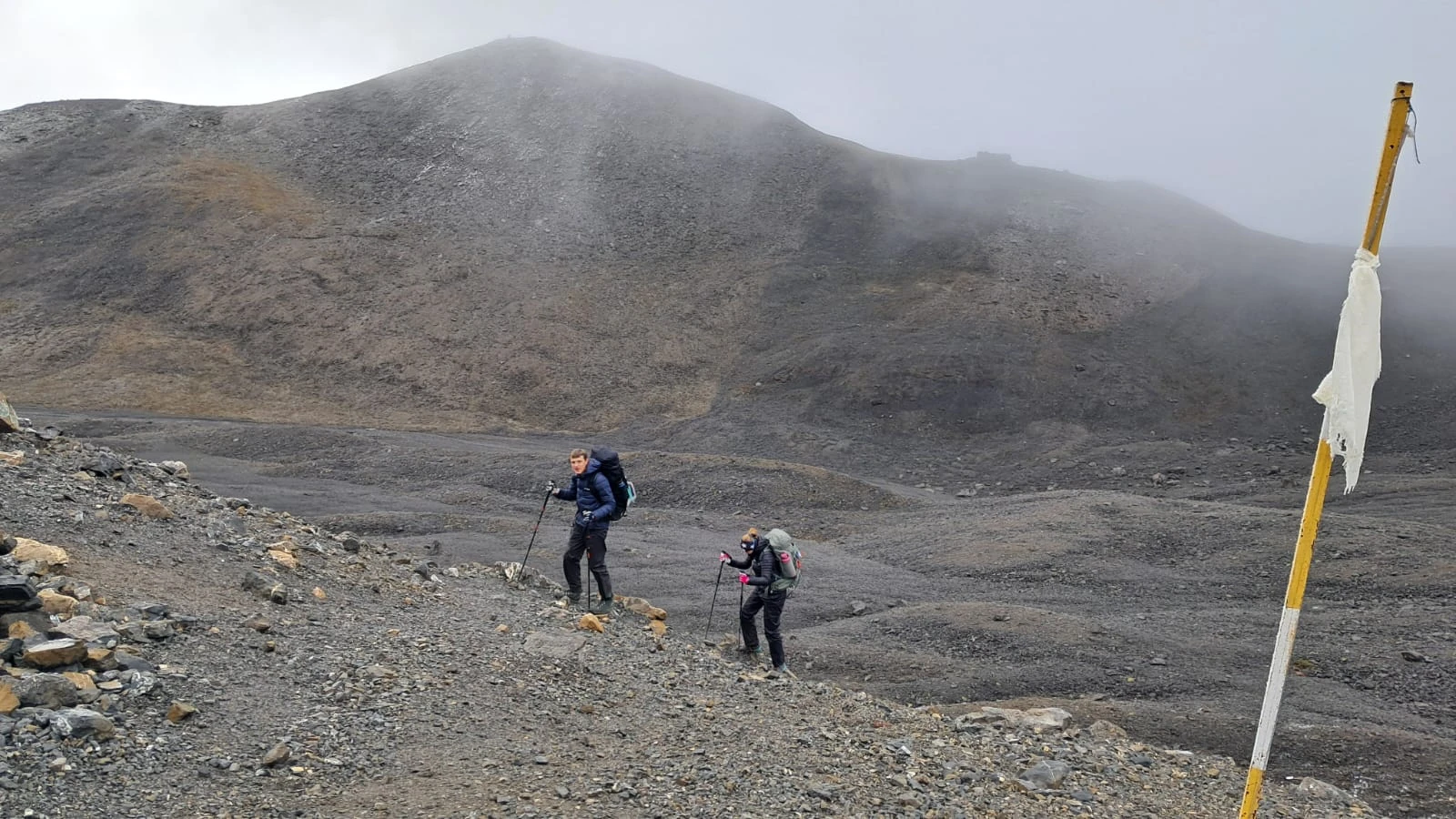
The trail passes through a wide range of landscapes, from subtropical forests and riverside villages to the dry valleys of Manang and the high-altitude terrain around Thorong La Pass (5,416 m). The changing scenery, villages, and terrain make the long journey feel like a series of shorter stages rather than one continuous walk.
The exact distance can vary by itinerary, road conditions, transportation use, and the starting and ending points selected. If your itinerary includes more road sections, the total walking distance will be shorter than a full walking circuit.
The highest point of the Annapurna Circuit Trek is Thorong La Pass at 5,416 meters (17,769 feet) above sea level. The pass is the main high-altitude crossing of the trek and connects the Manang and Mustang sides of the Annapurna region. From Thorong La, trekkers can see several major Himalayan peaks, including Annapurna, Dhaulagiri, Manaslu, Tilicho Peak, Gangapurna, and Tukuche Peak.
The trek begins at a much lower elevation and gradually climbs through subtropical forests, terraced farmland, river valleys, traditional villages, and the dry landscapes of Manang and Mustang. As you gain altitude, the vegetation becomes thinner and the terrain more rugged, creating a noticeable change in climate and scenery.
Because Thorong La is above 5,000 meters, altitude is an important consideration. The itinerary should allow enough time for gradual ascent and acclimatization, particularly before crossing the pass. Staying hydrated, maintaining a steady walking pace, and avoiding unnecessary rapid altitude gains can help reduce the risk of altitude-related problems.
The altitude gain is not the same every day. Some sections involve substantial elevation changes, while other days are designed to provide a slower progression or acclimatization. Your trekking pace and itinerary should therefore be planned according to the route, altitude, weather, and individual fitness level rather than focusing only on daily distance.
| Day / Route | Distance (km) | Distance (miles) | Walking Time | Altitude |
| Day 1: Arrival in Nepal | — | — | — | 1,370m / 4,493ft |
| Day 2: Drive to Chyamje | ~130 km | ~80.8 mi | Drive: 7–8 hrs | 1,460m / 4,790ft |
| Day 3: Trek to Dharapani | ~12 km | ~7.5 mi | 5–6 hrs | 1,920m / 6,299ft |
| Day 4: Trek to Chame | ~11 km | ~6.8 mi | 5–6 hrs | 2,700m / 8,856ft |
| Day 5: Trek to Pisang | ~10 km | ~6.2 mi | 5–6 hrs | 3,230m / 10,597ft |
| Day 6: Trek to Manang | ~12 km | ~7.5 mi | 5–6 hrs | 3,450m / 11,318ft |
| Day 7: Acclimatization Day at Manang | ~4–6 km hike | ~2.5–3.7 mi | 4–5 hrs | 3,450m / 11,318ft |
| Day 8: Trek to Yak Kharka | ~10 km | ~6.2 mi | 4–5 hrs | 4,200m / 13,776ft |
| Day 9: Trek to Thorong High Camp | ~7 km | ~4.3 mi | 4–5 hrs | 4,880m / 16,006ft |
| Day 10: Thorong La Pass to Muktinath | ~10 km | ~6.2 mi | 7–8 hrs | 5,416m / 17,769ft → 3,800m / 12,467ft |
| Day 11: Trek to Jomsom | ~15 km | ~9.3 mi | 5–6 hrs | 2,715m / 8,905ft |
| Day 12: Fly to Pokhara & Explore Lakeside | — | — | Flight day | 860m / 2,821ft |
| Day 13: Drive or Flight to Kathmandu | — | — | Drive/flight day | 1,370m / 4,493ft |
| Day 14: Final Departure | — | — | — | — |
Most days on the Annapurna Circuit involve approximately 8–16 km of walking. The distance is not the only factor that determines the difficulty. Elevation gain, trail conditions, altitude, and the length of the walking day also affect how demanding each section feels.
Lower sections generally have a mixture of dirt roads, stone paths, suspension bridges, and village trails. As you approach Manang, the landscape becomes drier and the trail climbs gradually toward the high mountain passes.
The Thorong La Pass day is usually the most demanding day of the trek. Trekkers normally start early from Thorong Phedi or High Camp, climb to 5,416 m, cross the pass, and descend toward Muktinath. Although this section is not necessarily the longest in kilometers, the high altitude makes the walk considerably more demanding.
Yes, beginners can complete the Annapurna Circuit Trek with proper preparation, gradual training, and a well-planned itinerary. Previous high-altitude trekking experience is not essential, but you should be comfortable walking for several hours a day on uphill and downhill trails.
Start preparing 2–3 months before the trek with activities such as hiking, running, cycling, swimming, or brisk walking. Include longer walks on consecutive days to improve your stamina and prepare your body for the demands of the trek.
You should also be prepared for changing weather, basic teahouse accommodation, remote mountain areas, and increasing altitude. Doing a few multi-day hikes before the Annapurna Circuit can help you test your fitness, footwear, backpack, and clothing. With proper pacing, acclimatization, and preparation, the trek is achievable for many first-time trekkers.
You should prepare for the Annapurna Circuit distance by building endurance, leg strength, and the ability to walk for several hours on consecutive days. Start training at least 6–8 weeks before the trek with walking, hiking, running, cycling, or stair climbing.
Tips to Prepare for the Annapurna Circuit Distance
You do not need to walk the entire Annapurna Circuit distance during training. The main goal is to become comfortable with long walking days, elevation changes, uneven trails, and consecutive days of trekking.
| Feature | Annapurna Circuit Trek | Annapurna Base Camp Trek |
| Total Trek Distance | Approximately 160–230 km, depending on the route | Approximately 65–70 km |
| Typical Duration | 10–21 days, depending on the itinerary | 7–12 days, depending on the itinerary |
| Highest Elevation | 5,416 m at Thorong La Pass | 4,130 m at Annapurna Base Camp |
| Route Type | Long-distance circuit with changing landscapes, mountain passes, and diverse ethnic cultures | Out-and-back route through forests, villages, and the Annapurna Sanctuary |
| Difficulty Level | Moderate | Moderate |
| Road Access | Road sections are present, especially in the lower sections | Limited road access, with most of the trek following established mountain trails |

In conclusion, the length of the Annapurna Circuit Trek can vary depending on the route, road conditions, and the sections you choose to cover on foot. Regardless of the itinerary, the trek takes you through changing landscapes, mountain villages, forests, and high-altitude terrain, giving you a chance to experience the Annapurna region from different perspectives.
If you are looking for shorter or alternative trekking routes in the same region, you can also consider the Mardi Himal Trek, Ghorepani Poon Hill Trek, Annapurna Sanctuary Trek, or Annapurna Base Camp Trek. Each route has its own trail, scenery, and pace, so you can choose one that fits your time and trekking preferences.
When you are ready to plan your next journey in the Annapurna region, feel free to get in touch with us. We are happy to discuss your requirements and help you choose an itinerary that suits your travel plans.
The Annapurna Circuit Trek is approximately 160–230 km (100–145 miles) in total. The exact distance depends on your starting and ending points, road transportation, trekking route, and any side trips included in your itinerary.
Most trekkers walk around 100–160 km on a modern jeep-assisted itinerary. If you choose to walk more of the original trail instead of using road transportation, the total walking distance can be considerably higher.
A typical trekking day on the Annapurna Circuit involves around 8–16 km of walking. The distance varies depending on the day's route, altitude, terrain, and planned overnight stop.
The Thorong La Pass crossing day is generally one of the longest and most demanding days of the trek. Starting from Thorong Phedi or High Camp, you cross the 5,416 m Thorong La Pass and descend toward Muktinath, usually taking around 7–9 hours.
The distance from Besisahar toward Manang is approximately 90–110 km, depending on the route and road sections used. Since roads now reach several villages along the circuit, trekkers can choose to walk selected sections or use a jeep where available.
The distance from Manang to Thorong La Pass is approximately 20–25 km, depending on your exact route and overnight stops. Most trekkers divide this section over several days to allow the body to adjust gradually to the increasing altitude.
The route from Thorong Phedi or High Camp, across Thorong La Pass, and down to Muktinath is approximately 14–18 km. Although the distance is manageable, the high altitude and steep ascent to the pass make this one of the more demanding sections.
The distance from Muktinath to Jomsom is approximately 18–22 km, depending on whether you follow the available road or walking trail. Many trekkers choose transportation for this section, while others continue walking if they want to experience more of the trail.
Yes. Road construction has changed the walking distance of the Annapurna Circuit. Jeeps can now cover several road-accessible sections, allowing trekkers to skip some stretches and reduce both the total distance and number of trekking days.
Yes, you can walk most or all of the route if you prefer a longer trekking experience and the current trail conditions allow it. However, some sections now follow roads, so many trekkers combine walking with transportation to avoid long stretches of road walking.
Yes. Adding Tilicho Lake as a side trip increases the overall trekking distance. Depending on your route and overnight stops, the Tilicho Lake detour can add approximately 25–35 km to the Annapurna Circuit itinerary.
The distance is only one part of the trek's difficulty. Altitude, elevation gain, trail conditions, walking hours, weather, and the Thorong La Pass crossing all affect how demanding the journey feels. A well-planned itinerary can make the distance more manageable.
A modern jeep-assisted itinerary can take around 10–12 days, while a more complete walking itinerary may take 14–18 days or longer. The number of days depends on transportation, acclimatization, walking pace, starting point, ending point, and side trips such as Tilicho Lake.
Most trekking days on the Annapurna Circuit involve around 5–7 hours of walking. Some lower-altitude days may be shorter, while days involving longer climbs, higher elevations, or the Thorong La Pass crossing can require more time.
Yes, beginners with reasonable fitness can complete the Annapurna Circuit with proper preparation and a suitable itinerary. You do not need technical climbing experience, but regular walking, endurance training, and gradual acclimatization are important, especially before reaching the higher sections.
Depending on where you start and where you finish, the Thorong La Pass crossing day can involve approximately 14–18 km of walking. The distance is not the only challenge, as the route reaches 5,416 m and includes a long ascent followed by a steep descent.
Yes. At higher elevations, walking can feel more demanding even when the actual distance is not very long. The reduced oxygen level can affect your pace and energy, which is why taking a gradual approach and allowing enough time for acclimatization is important.
The classic Annapurna Circuit is commonly estimated at around 160–230 km. However, there is no single fixed distance because the route has changed with road development, and trekkers may start or finish at different locations or include additional side trips.
Yes. You can reduce the walking distance by using jeeps on road-accessible sections and choosing a shorter itinerary. The amount of walking you can skip depends on the current road and trail conditions, as well as your preferred trekking experience.
Start preparing several weeks before the trek with regular walking, hiking, stair climbing, and endurance exercises. Gradually increase your walking distance and include uphill and downhill training. Along with physical preparation, choose an itinerary that allows gradual acclimatization rather than trying to complete the route too quickly.