Annapurna Base Camp Helicopter Tour: A Breathtaking Aerial Adventure
3 Apr 2025

The Annapurna region is the most varied trekking ground in Nepal. On one side you have the wettest, greenest valleys; on the other, the driest, most Tibetan-influenced plateaus. That means the "best" Annapurna trek depends entirely on how many days you have, your fitness, your altitude tolerance, and what you want to see. This guide compares the 7 treks we run most often and recommends one for each type of trekker.
The numbers show why the choice matters. The Annapurna Conservation Area (ACA) recorded 299,831 foreign visitors in 2025, the highest annual figure since record-keeping began in 2001, according to the Annapurna Conservation Area Project (ACAP), with the region crossing roughly 2.6 million foreign visitors over that 25-year span. The ACA is Nepal's most-visited trekking destination by a wide margin, and it is not slowing down. Within a couple of hours of Pokhara you can walk through subtropical rhododendron forest, stand inside a glacial amphitheatre ringed by 8,000 m peaks, or cross a high pass into a desert plateau that looks more like Tibet than Nepal. Few places on Earth concentrate so many different mountain worlds so close together.
That variety is exactly why "best trek" is the wrong question to lead with. The right question is which trek fits you: how many days do you actually have, how fit are you, how well do you handle altitude, and what kind of scenery draws you in? The seven routes below answer that question differently, and reading the profiles will help you match your circumstances to the route that genuinely delights you rather than overwhelms or underwhelms you.
Key Takeaways
- ABC (13 days, US$735) = the classic 4,130 m amphitheatre view, moderate difficulty
- Annapurna Circuit (14 days, US$1,085) = the classic full loop over Thorong La (5,416 m), high altitude
- Poon Hill (8 days, US$480) = the easiest sunrise viewpoint, big views at only 3,210 m
- Mardi Himal (11 days, US$555) = the quiet up-and-comer with Machhapuchhre close up
- Upper vs Lower Mustang = wild Tibetan plateaus, restricted-area permits, 13-17 days
- Tilicho Lake (15-16 days, US$1,025-1,110) = Nepal's most dramatic high lake, an upgrade to the circuit
- Every route needs an ACAP permit (NPR 3,000) + TIMS card (NPR 2,000), and since April 2023 a licensed guide is mandatory for foreign trekkers
- Not sure which fits you? Message Adventure A One Treks on WhatsApp and we'll match you to the right trek by your time, fitness, and budget
Start planning with our Annapurna Region Trek hub to browse all of our Annapurna trips. For a quick visual sense of what the region holds, watch this short overview filmed by our own team:
| Trek | Days | Max alt. | Difficulty | 2026 price | Best for |
|---|---|---|---|---|---|
| Ghorepani Poon Hill | 8 | 3,210 m | Easy | US$480 | Limited time, big views, first-timers |
| Mardi Himal | 11 | 4,500 m | Easy-Moderate | US$555 | Quiet trails, Machhapuchhre views |
| Annapurna Base Camp | 13 | 4,130 m | Moderate | US$735 | The classic sanctuary experience |
| Lower Mustang | 13 | ~3,800 m | Easy-Moderate | US$890 | Tibetan culture without the high pass |
| Tilicho + Circuit | 16 | 4,919 m / 5,416 m | Challenging | US$1,025 | Highest lake + full circuit |
| Annapurna Circuit | 14 | 5,416 m | Challenging | US$1,085 | The complete loop, desert north |
| Upper Mustang | 17 | ~4,000 m | Moderate | US$2,235 | Remote, restricted, exotic |
Prices are per-person guided packages for the 2026-27 season and include permits, lodging, and meals on trail. They change with exchange rates, so treat the dollar figures as a planning guide.
Rather than jumping straight into the profiles, run your situation through the five questions that separate these routes most sharply. You do not need to nail every answer, but having rough answers in mind will make the profiles below far more useful.
1. How many days do you actually have?
This is usually the hard constraint. With a single week on the ground, Poon Hill is the honest and rewarding choice. With ten days to two weeks, Mardi Himal and ABC come into reach. Only with two weeks or more should you consider the circuit, Tilicho, or Mustang. Do not be tempted to compress a longer route into fewer days: altitude and distance cannot be rushed safely, and the risk of turning a good trip into a medical evacuation grows the moment you start skipping acclimatization days.
2. What is your real fitness level?
Be honest rather than aspirational. A fit first-timer can complete Mardi Himal comfortably, and a determined beginner can manage ABC, but the circuit demands prior high-altitude confidence and Tilicho needs genuine conditioning. Lower Mustang and Upper Mustang reward cultural depth over raw strength. Matching the route to your actual legs is what turns a trip into a triumph rather than a struggle.
3. How well do you handle altitude?
Altitude changes the calculus dramatically. If you are altitude-sensitive or have never been above 3,000 m, Poon Hill (3,210 m) and Lower Mustang (~3,800 m) keep you safer. Mardi Himal and ABC push to 4,130-4,500 m but are manageable with proper acclimatization. The circuit, Tilicho, and particularly the Thorong La crossing at 5,416 m are a different league, and the published science backs that up: roughly one in three trekkers above 5,000 m reports altitude sickness symptoms. When in doubt, choose the lower route and climb to the alternative next time.
4. What kind of scenery draws you in?
The Annapurna region is really several landscapes under one name. If you want to be inside a ring of 8,000 m peaks, choose ABC. If you want a face-on view of a sacred 7,000 m mountain with solitude, choose Mardi Himal. If you want the full transition from green valleys to high desert, choose the circuit. If you want Tibetan culture and eroded badlands, choose Mustang. Each of these is a genuinely different adventure dressed in the same regional name.
5. What is your budget, and what are you willing to pay for uniqueness?
Prices here range from US$480 to US$2,235, and the spread reflects real differences in duration, permits, and exclusivity. Poon Hill is the budget entry point, Mardi Himal is excellent value, and Upper Mustang is a premium, permit-capped rarity whose restricted-area permit alone now runs close to US$50 per day. Decide what "worth it" means to you before you fall in love with a route that stretches your wallet.
Best for: trekkers who want Nepal's most famous "sanctuary" experience and a genuine 8,000 m-peak amphitheatre, without doing a full loop. Altitude: up to 4,130 m. Difficulty: Moderate.
You walk up the Modi Khola valley, through Gurung villages and terraced slopes, and end inside the Annapurna Sanctuary, ringed by Annapurna I (8,091 m, the world's tenth-highest peak), Machhapuchhre, and Hiunchuli. Return the way you came. It is moderately hard, requires acclimatization, and rewards you with one of the most dramatic 360-degree mountain views in Nepal.
What makes ABC special
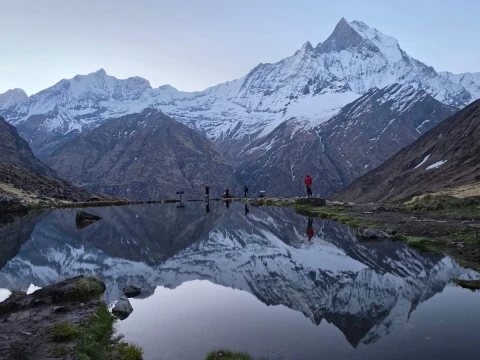
The defining moment of Annapurna Base Camp is arriving at the sanctuary floor. This high glacial bowl is enclosed on all sides by a near-continuous ring of peaks, including Annapurna I at 8,091 m, confirmed by surveyors as the tenth-highest mountain on Earth. Standing inside that amphitheatre with peaks towering over you is an experience that photographs never quite capture. Because you sleep inside the sanctuary at 4,130 m, you get dawn and dusk light raking across the surrounding walls, something a day-trip viewpoint cannot offer. The Tibetan placename fits the reality: a bowl you walk into, not a summit you reach.
Who it suits
ABC suits the classic first "real" Nepali trek: long enough to feel adventurous, high enough to feel epic, but not as punishing as the full circuit. The route passes through culturally rich Gurung villages, where many families trace histories of service in the British and Indian Gurkha regiments, so you mix mountain scenery with village life rather than spending every day in the wilderness. In Chhomrong, one of the main stops on the trail, every one of the village's 62 households now runs a guesthouse, which tells you how central trekking has become to the local economy. If you want one iconic Annapurna experience in roughly two weeks and are happy with the out-and-back format, ABC is the benchmark.
How it compares
ABC is shorter and lower than the circuit but more focused than Poon Hill, and it is busier than the quieter Mardi Himal. If you want to stand inside the peaks themselves, choose ABC; if you prefer watching the peaks from a ridge with far fewer people, Mardi Himal is the stronger pick. Read the full Annapurna Base Camp guide for the day-by-day itinerary, permits, and packing list, then message us on WhatsApp to check departure dates.
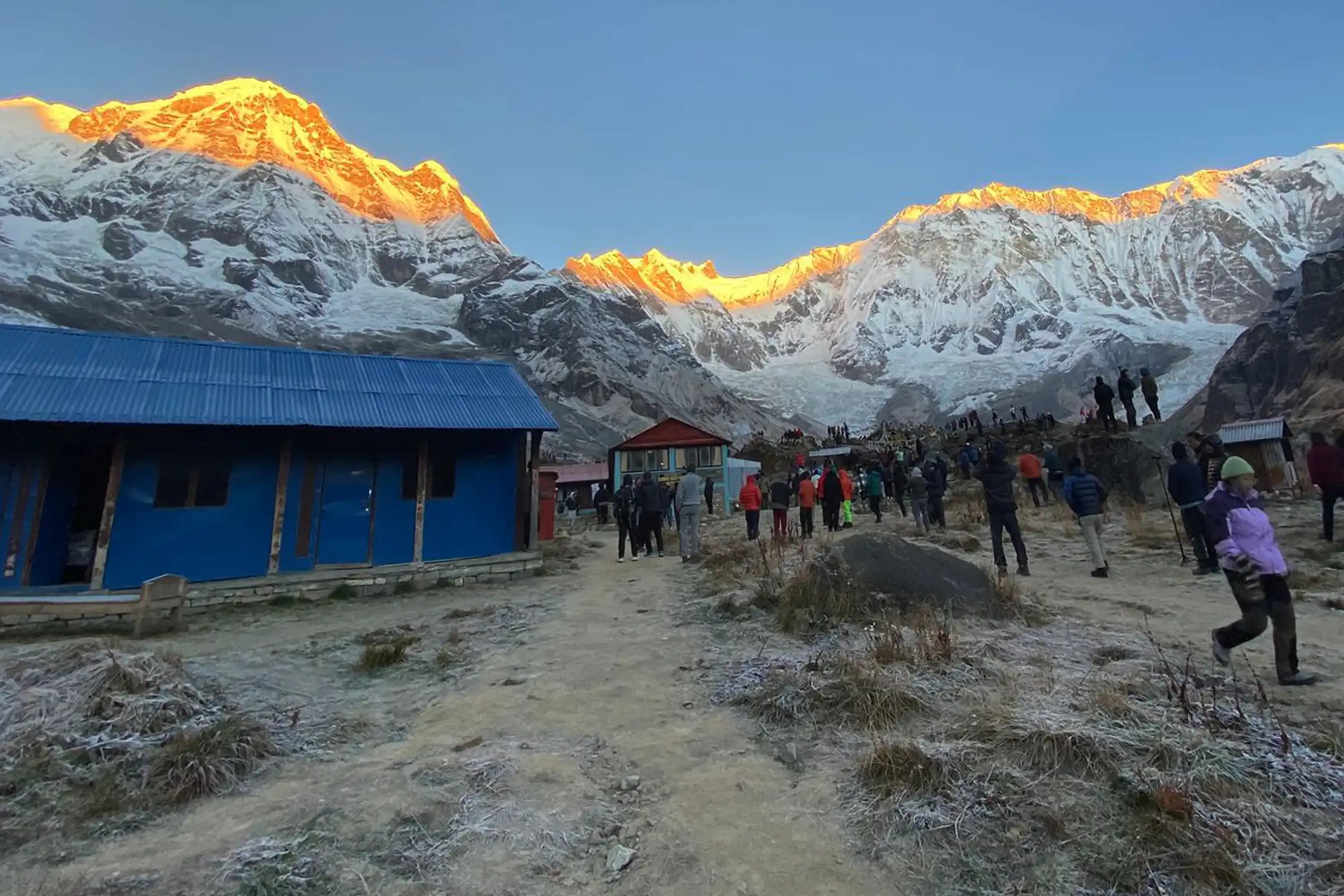
Best for: experienced trekkers who want the full journey from lush green valleys to the arid, windswept Trans-Himalaya and who are willing to cross a 5,416 m pass. Altitude: 5,416 m (Thorong La). Difficulty: Challenging.
The circuit goes counterclockwise from Beshisahar, around the Massif, and across Thorong La Pass into Mustang, before descending past Muktinath and Jomsom. It is longer and higher than ABC, with greater variety but also greater altitude risk and more walking days. It is consistently ranked among the best long-distance treks in the world, and the reason is the journey's range of climates rather than any single viewpoint.
A journey across two climates
The circuit is two journeys stapled together at Thorong La. The first half climbs through the lush, green, monsoon-washed southern valleys toward Manang, passing rice terraces, forest, and the dramatic Kali Gandaki approach. The second half, after the pass, drops into the arid, windswept northern plateau where stone villages, whitewashed chortens, and prayer flags recall a Tibetan landscape. That stark transition from green to desert is the circuit's signature, and it is why the route was long regarded as the most complete single trek in the Himalaya. It is also why the pass matters so much: nothing else in Nepal swaps two worlds over a single day of walking.
Crossing Thorong La
The crux is Thorong La Pass at 5,416 m, one of the highest trekking passes in the world and higher than Everest Base Camp. Reaching it means a very early start from Thorong Phedi or High Camp, a steady climb in cold, thin air, and then a long descent that drops roughly 1,600 m to Muktinath on the far side. It requires proper acclimatization over several days in Manang and a realistic respect for altitude. Do not rush it, and be ready to hold at high camp or turn back entirely if conditions or your own body say so. A free daily altitude-sickness briefing at the Himalayan Rescue Association's Manang clinic is one of the smartest pre-pass investments you can make.
Who it suits
The circuit is for trekkers with solid fitness, prior high-altitude experience (or excellent preparation), and roughly two weeks to spare. If you are confident at altitude and want maximum variety across a single journey, it is hard to beat. If you want the high pass but also Nepal's most dramatic high-altitude lake as a bonus, see the Tilicho Lake + Circuit option below. Message us on WhatsApp to plan the timing of the pass crossing.

Best for: trekkers short on time, families, and first-timers wanting panoramic sunrise views with minimal altitude. Altitude: 3,210 m (Poon Hill). Difficulty: Easy.
Short, gentle, and famous for the Poon Hill sunrise over Dhaulagiri and Annapurna. Low altitude keeps acute mountain sickness (AMS) risk minimal, which is exactly the point of this trek. It is the perfect "taste of Nepal" route.
The morning that sells the trek
Almost every Poon Hill trek is organized around one moment: the pre-dawn climb to the viewpoint at 3,210 m. Headlamps bobbing up the stone steps, you reach the top to watch the sun rise over an unbroken wall of snow spanning Dhaulagiri at 8,167 m to the west and Annapurna South with Machhapuchhre on the east. On a clear morning it is among the most photographable panoramas in Nepal. At 3,210 m the summit stays below the altitude band where the medical literature sees AMS take off: trekkers between 3,000 and 4,000 m report about a 10% AMS rate in trekking-population studies, versus more than half above 4,500 m. That low ceiling is a real safety feature, not just a selling point.
Who it suits
Poon Hill is the natural first trek in Nepal: short, gentle, cheap, and logistically simple, with teahouses all the way. It suits families, older trekkers, travelers on a tight schedule, and anyone who wants big Himalayan views without committing to high altitude or long distances. It is also an excellent, confidence-building warm-up before a higher trek like ABC or Mardi Himal, which is why its permit system and trailheads overlap with those routes.
How it compares
If you want the easiest route to a grand view, Poon Hill is the pick. If you are happy to walk a little more for notably greater solitude and even closer peaks, step up to Mardi Himal, still manageable but quieter. Message us on WhatsApp to fit it into your schedule.
Best for: trekkers who want close-up Machhapuchhre views with fewer crowds than ABC. Altitude: 4,500 m (Mardi Himal Base Camp). Difficulty: Easy-Moderate.
A rapidly popularizing route that rises quickly from the Modi valley toward Machhapuchhre and Mardi Himal. Quieter than ABC, slightly higher, and very photogenic. Ideal if you want solitude without a full circuit.
The view is the whole show
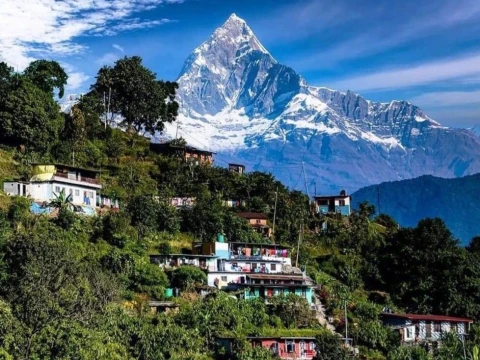
Mardi Himal's appeal is its angle on Machhapuchhre, the sacred 6,993 m peak that remains officially unclimbed. Nepal prohibited climbing on Machhapuchhre in 1957 after a British expedition reached near the summit, and the ban has held ever since, leaving the mountain in its natural state. Its south face rises almost directly in front of you, and from the Mardi Himal Base Camp viewpoint at 4,500 m you look nearly level at a 6,993 m peak, an intimacy that even ABC does not quite match. The route ascends through bamboo and rhododendron forest, then opens above the treeline to a dramatic high ridge at High Camp.
Who it suits
Mardi Himal is ideal for trekkers who want a real high-altitude viewpoint but dread the crowds of ABC, and for those with a tighter time window than a full circuit allows. It is low-cost, short, and non-technical, yet still delivers a genuine 4,500 m day, an excellent "up-and-comer" for trekkers who have already done Poon Hill and want a step up, or for returning visitors seeking a quieter route.
How it compares
Lower and shorter than ABC and the circuit, slightly higher than Poon Hill, and far quieter than all three. It is the stealth-value pick of the seven. Read the full Mardi Himal guide or message us on WhatsApp to secure dates before this route gets busier.
Best for: trekkers drawn to stone villages, the Kali Gandaki gorge, and Muktinath who want to avoid Thorong La. Altitude: ~3,800 m (Muktinath). Difficulty: Easy-Moderate.
Follows one of the planet's deepest river gorges into the arid, Tibetan-influenced south of Mustang. Dramatic geology, Thakali culture, the sacred Muktinath temple, and far less altitude stress than the circuit.
Into the Kali Gandaki gorge
Lower Mustang traces the Kali Gandaki river, which runs between the walls of Annapurna I and Dhaulagiri, both over 8,000 m and separated by a gap of only tens of kilometers at their bases. The resulting drop is widely described as the world's deepest gorge, with roughly 5,500 to 5,571 m of vertical relief, though some geographers reserve that title for the Yarlung Tsangpo in Tibet. Either way, walking the riverbed between the two giants is a humbling experience. As you travel north, the lush south gives way to a dry, high-altitude desert punctuated by stone Thakali villages, apple orchards at Marpha, and the architectural heritage of the region around Jomsom.
Muktinath and the sacred temple
The route culminates at Muktinath, a pilgrimage site sacred to both Hindus and Buddhists, where water spouts from 108 taps in the temple facade and a backdrop of snow peaks frames the setting. Reaching it without crossing Thorong La keeps Lower Mustang far more relaxed than the full circuit, making it a strong choice for trekkers who want that arid Tibetan flavor and cultural depth without the altitude risk of a 5,416 m pass.
Who it suits
Lower Mustang suits culturally curious trekkers, those who dislike very high altitude, and travelers who want a drier, sunnier, and less physically demanding alternative to the circuit while still enjoying an unmistakably "different" landscape. Message us on WhatsApp to check dates.
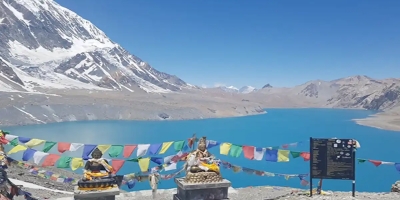
Best for: fit trekkers who want everything the circuit offers plus Nepal's most spectacular high-altitude lake. Altitude: 4,919 m (Tilicho Lake), 5,416 m (Thorong La). Difficulty: Challenging.
Branches off the circuit at Manang to climb to Tilicho Lake, one of the world's highest large lakes, then crosses Thorong La as part of the loop. Longer, higher, and more demanding than a plain circuit.
Nepal's highest large lake
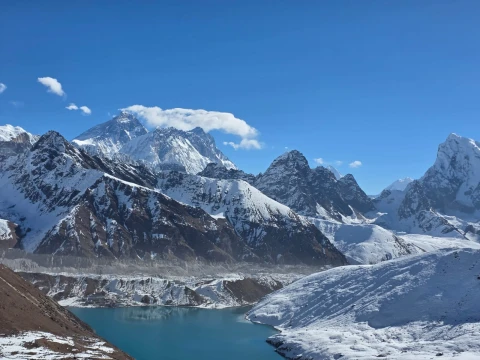
Tilicho Lake sits in a stark, dramatic bowl beneath the peaks of the Annapurna massif. Fed by glaciers and ringed by scree and snow, its turquoise water against a backdrop of 7,000 m mountains is one of the most striking sights in the Himalaya. The figure you will see most often is 4,919 m, though older maps and guides occasionally cite 4,949 m or 4,980 m; the differences come down to measurement methods, not the experience. Reaching it involves a demanding climb and a night at high altitude, which is why it suits fit, altitude-adapted trekkers rather than casual walkers.
Circuit plus a high bonus
You take the scenic approach to Tilicho from Manang, spend a night close to the lake, then rejoin the circuit to cross Thorong La into Mustang. You effectively upgrade a plain circuit into a fuller, more adventurous journey, at the cost of extra days, higher altitude exposure, and more demanding ground. There is also an adventurous Tilicho + Mesokanto Pass variant for those who want to link the lake with an additional crossing.
Who it suits
Choose Tilicho + Circuit if you are fit and have previous high-altitude experience, and if the idea of standing beside one of the highest large lakes on Earth excites you more than the circuit alone. Message us on WhatsApp to plan this tougher loop.
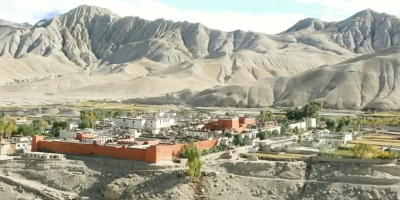
Best for: trekkers seeking remote, restricted Tibetan culture in the old capital of Lo Manthang, with a budget to match. Altitude: ~4,000 m. Difficulty: Moderate.
The restricted Upper Mustang region requires a special permit and a licensed guide. It rewards with the walled city of Lo Manthang, cliff-top caves, and a landscape like Tibet. The most expensive and most exotic trek on this list, and the least crowded.
The last of the forbidden kingdom
North of the Annapurna region, Upper Mustang was closed to all outsiders until 1992 and still requires a restricted-area permit that keeps the area remarkably unspoiled. Its landscape of red and ochre badlands, whitewashed monasteries, and wind-eroded canyon walls resembles Tibet more than anywhere else in Nepal, and the journey centers on the walled city of Lo Manthang, the old seat of a once-independent kingdom. Under the permit structure that took effect for the 2025-26 seasons, the restricted-area permit is billed at roughly US$50 per person per day instead of the old flat US$500 for ten days, with the ACAP permit on top, and licensed-guide rules apply throughout. For longer stays the daily rate makes Upper Mustang a noticeably bigger line item in your budget, one of the two reasons the trek stays quiet.
Cliff caves and ancient culture
Along the way you pass ancient cliff-side cave systems carved into the canyon walls centuries ago, their original purpose still debated. Combined with living Buddhist monasteries, prayer walls, and the region's distinctive language and dress, Upper Mustang offers a level of cultural immersion and sheer exoticism that the better-known Annapurna treks cannot match. Pilgrims, traders, and villagers have moved through these valleys for centuries, and the route still feels less like a trekking circuit and more like a journey across a small, high kingdom.
Who it suits
Upper Mustang is for travelers with a healthy budget, a fascination with remote Tibetan culture, and enough time for a 17-day journey. It is not the easiest or cheapest trek, but it is unmatched for atmosphere and uniqueness. Message us on WhatsApp to request a permit-capped date.
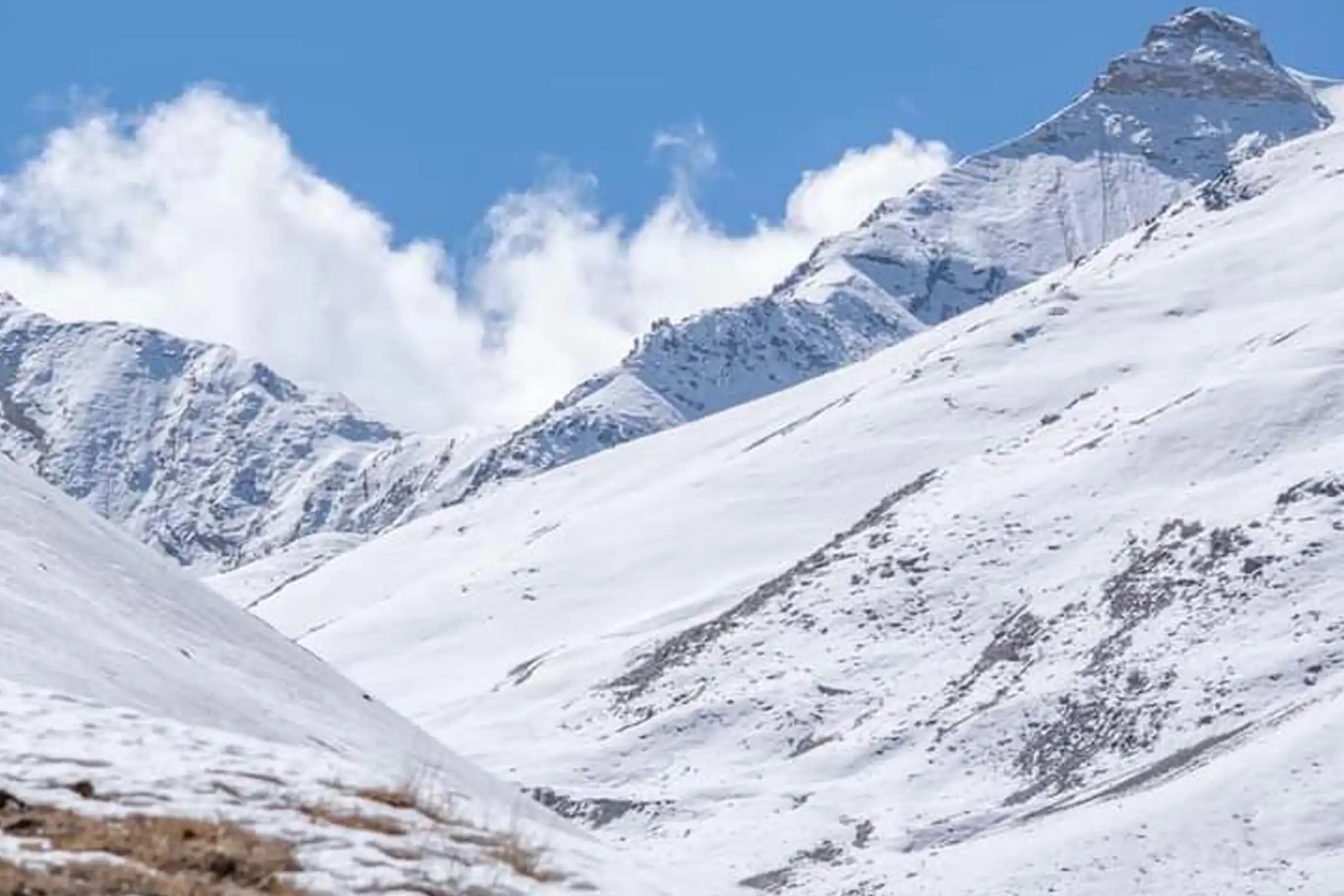
Altitude is the factor that most trekkers underestimate, so it deserves its own section rather than a footnote. Watch our short film of the Annapurna Himalaya to see the scale of the peaks these routes pass beneath, then dig into the numbers below.
The chart below plots the maximum altitude of each route against a shared scale, with the 2,500 m mark flagged because that is where acclimatization rules begin to bite.
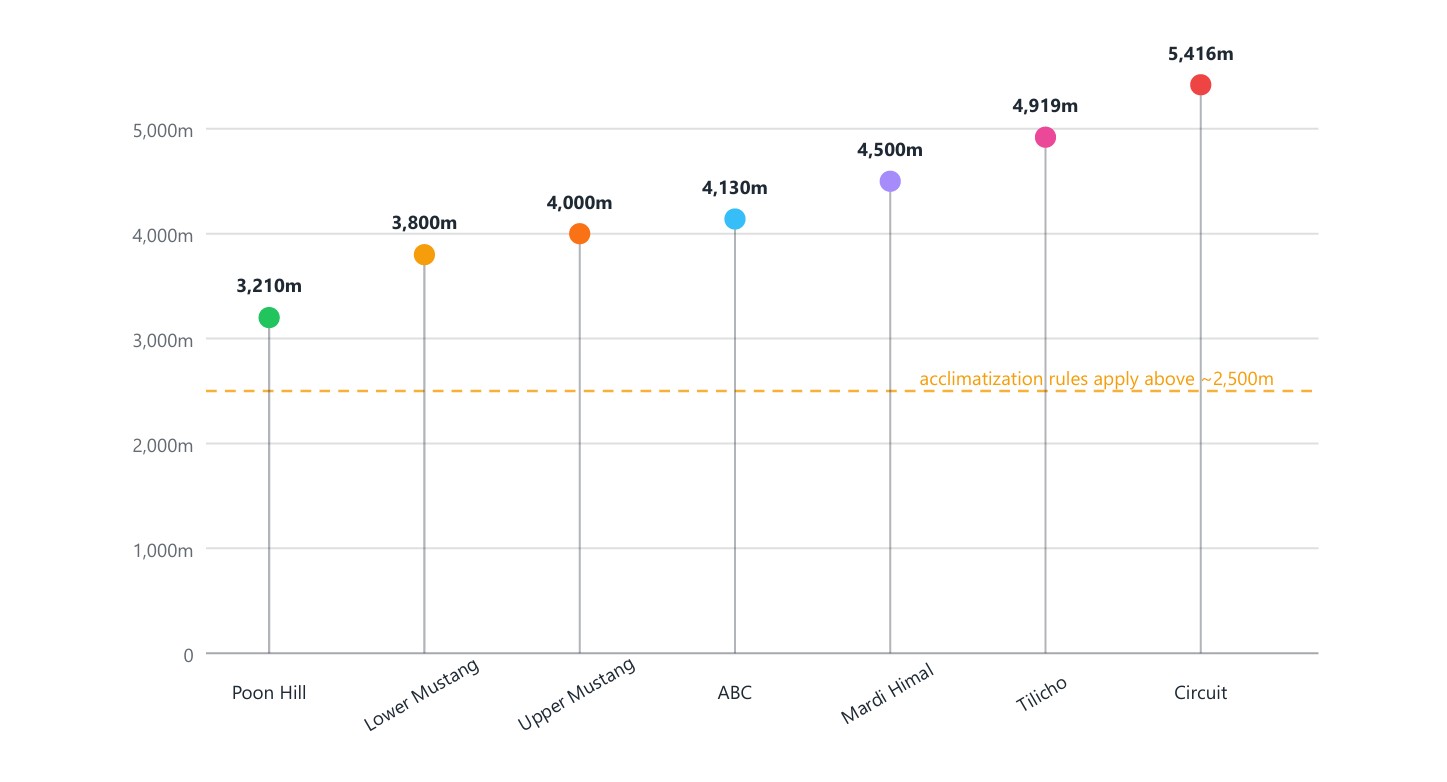
What the altitude research actually says
The medical data on altitude sickness is more precise than the folklore. In a widely cited 2006 clinical study of trekking populations, the proportion of trekkers reporting acute mountain sickness climbed sharply with elevation:
| Altitude band | Trekkers reporting AMS |
|---|---|
| 2,500-3,000 m | 0% |
| 3,000-4,000 m | ~10% |
| 4,000-4,500 m | ~15% |
| 4,500-5,000 m | ~51% |
| Above 5,000 m | ~34% |
Two patterns stand out. First, the jump between 4,000 m and 4,500 m is where most trekkers start to feel the altitude, which is exactly where Mardi Himal's summit and ABC sit. Second, the figures above 5,000 m come mostly from trekkers who have acclimatized for several days first; the unprotected newcomer arriving at 5,400 m on day two would fare far worse. The practical guidance that follows is the same in every textbook: above 2,500 m, do not gain more than roughly 300 m of sleeping altitude per day, build in an extra rest day every 1,000 m, and take one of them in Manang before Thorong La. Newer data from the Annapurna Circuit reinforces the point: a 2026 study drawing on Himalayan Rescue Association clinic records at the Manang aid post (3,500 m) reported acute mountain sickness in about 45% of trekkers at the standard diagnostic threshold (a Lake Louise Score of 3 or higher), while roughly one in five met the criteria for the cerebral form of the condition. Walking slowly, sleeping low, and hydrating well are not platitudes here; they are the difference between finishing the loop and turning back at a pass.
Permit rules in the Annapurna region have shifted more in the last three years than in the twenty before them, so treat older advice with suspicion. For the 2026-27 season, here is the current picture.
Two permits for every Annapurna trek
Every route in this guide requires the same base pair:
Together the two come to roughly NPR 5,000, or about US$38 at 2026 exchange rates. If you book a guided package through Adventure A One Treks, both permits are arranged for you as part of the itinerary, so you never have to navigate the counters yourself.
The licensed-guide rule changed everything
Since April 1, 2023, Nepal requires foreign trekkers in national parks and conservation areas, including every Annapurna route, to trek with a government-licensed guide from a registered agency. Fully independent solo trekking on these trails is no longer permitted, and permits are issued through the same agencies. This rule is not optional advice; it is checked at staffed permit posts on the ground. It is also why every package in this guide is guided by default, which has the side benefit of making rescue response, teahouse bookings, and pass decisions materially safer.
Restricted-area permits: Upper Mustang and beyond
Inside the Annapurna region, most treks are open routes inside the ACA. The exceptions are the restricted zones north of the high passes:
When mapping a budget, add the permit line to the price of whichever route you pick. For most treks it is a small number; for Upper Mustang it is a real line item.
What checkpoints actually check
Staffed posts sit at the gateways to the ACA and at the entrance to restricted zones. Rangers compare your permit and TIMS card against your passport, and your guide's license is verified at the same time. Carry the originals, keep a photocopy set somewhere safe, and never assume a checkpoint is optional. The consequences for being caught without the right paper are fines, refusal of entry, or being turned around mid-route.
How to Read the Prices and Decide
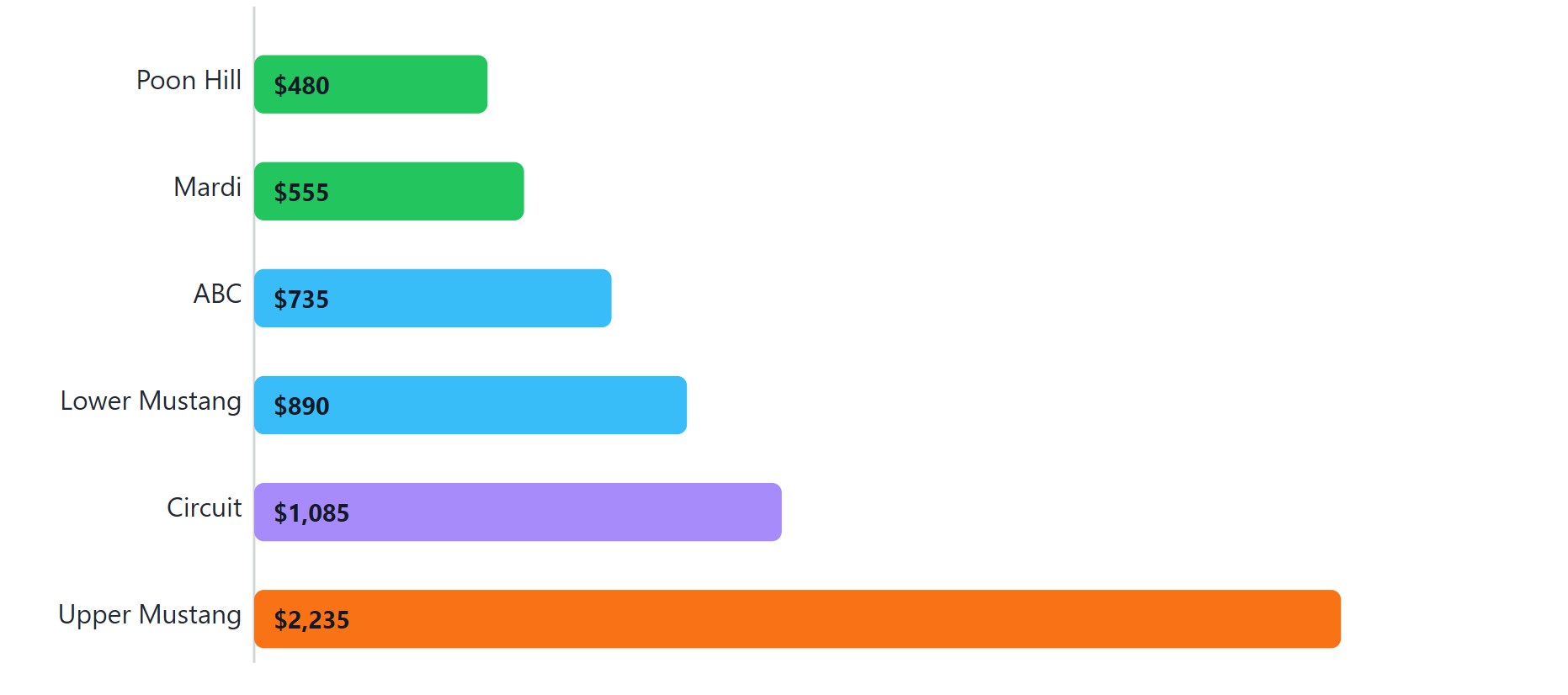
The bar chart above shows how the seven treks price out, but price is only one axis of the decision. The right way to choose is to weigh three things together: your available days, your fitness and altitude tolerance, and what scenery genuinely excites you. A trek that is a great deal on paper is a bad deal if it does not match your body or your appetite for a particular landscape.
Match the trek to your time and fitness
If you have a single week, Poon Hill is the realistic and rewarding choice. With two weeks and moderate fitness, ABC gives you the iconic sanctuary experience. With two weeks plus a tolerance for high altitude, the circuit (optionally with Tilicho) rewards you with the fullest journey. If you have time and budget for something genuinely rare, Upper Mustang is in a class of its own.
Choosing by season
Season heavily nudges the decision, and ACAP's published monthly arrival data for 2025 makes the pattern concrete: April was the busiest month of the year with 44,763 visitors, followed by October with 37,076 and March with 36,834, with the spring months combined contributing more than a third of annual arrivals. What that means on the trail is that the prime windows are also the crowded windows.
When in doubt, talk to a guide
The profiles, tables, and charts together cover the data, but a personalized recommendation is worth more than any single table. If you are torn between two routes, our guides can weigh your exact dates, fitness, altitude history, and budget and give you a definitive answer within minutes. That muscle memory of walking these trails weekly is the difference between a good guess and a confident choice.
| If you want... | Choose |
|---|---|
| Biggest views, least time or effort | Poon Hill |
| The famous amphitheatre sanctuary | Annapurna Base Camp |
| The complete full loop + pass crossing | Annapurna Circuit |
| Solitude with Machhapuchhre up close | Mardi Himal |
| Tibetan culture, moderate altitude | Lower Mustang (or Upper if budget allows) |
| Highest lake + the hardest route | Tilicho + Circuit |
| A remote, permit-capped rarity | Upper Mustang |
A Quick Word on Combining Routes
Many trekkers do not realize they can combine two of these routes into a single, longer adventure, and that is one of the smartest ways to get more from a Nepal trip. Poon Hill is the classic pairing piece: it is low and gentle, and because it shares the same region and permit, it works beautifully as a warm-up immediately before ABC or Mardi Himal. That sequence lets you ease your body into trekking with easy, confidence-building days before the higher, harder sections begin, and it adds only a few days to the itinerary.
Similarly, trekkers who want both the culture of Mustang and the sanctuary experience of ABC can, with enough days, stitch together a longer custom loop through the region. The main practical constraint is time, not logistics, because the region's shared trailheads and permit system make these combinations straightforward to arrange. If you want a two-in-one trip, tell us how many days you have and we will design the sequence that best fits your fitness and interests.
What is the easiest Annapurna trek? Ghorepani Poon Hill (8 days, max 3,210 m) is the easiest and most accessible Annapurna trek. It is also the lowest-risk at altitude, since serious AMS rates only climb sharply above roughly 4,000 m.
Which is better, ABC or the Annapurna Circuit? ABC is shorter, lower, and more scenic in a single spot; the circuit is longer, higher, and far more varied. Choose ABC if you have about two weeks and want the iconic sanctuary; choose the circuit if you want the complete loop and can handle 5,416 m at Thorong La.
How much does an Annapurna trek cost? From US$480 (Poon Hill) up to US$2,235 (Upper Mustang) as a guided package, depending on route, duration, and permit type. Upper Mustang's per-day restricted permit is a large part of its premium.
Which Annapurna trek should a beginner pick? Plan Poon Hill first for the confidence and views, then Mardi Himal or ABC as a step up. Each provides a natural progression in altitude and distance.
Do all Annapurna treks need the same permits? The base pair is the same everywhere: an ACAP permit (NPR 3,000) plus a TIMS card (NPR 2,000). Upper Mustang additionally requires a restricted-area permit priced at roughly US$50 per day under the current structure, and a licensed guide is mandatory on every route since April 2023.
Which Annapurna trek has the best views? If you want to be surrounded by peaks, ABC; if you want a face-on 7,000 m mountain, Mardi Himal; if you want a broad panoramic sunrise with minimal effort, Poon Hill. There is no single winner because the views are spectacular in different ways.
Can I combine two Annapurna treks in one trip? Yes. Poon Hill is commonly bundled with ABC or Mardi Himal as a warm-up, since they share the same region and permit. Message us and we can build a combined itinerary to fit your dates.
Is a guide really mandatory? Yes, for foreign trekkers. Since April 2023 Nepal requires a licensed guide from a registered agency on conservation-area routes, and permits are issued through those agencies. All packages here include guides, porters, and permits as standard.
How many days should I allow for acclimatization? Above 2,500 m, plan to gain no more than roughly 300 m of sleeping altitude per day and take a rest day every 1,000 m. On the circuit, that means an acclimatization day in Manang before Thorong La, and the Himalayan Rescue Association clinic there runs a free daily briefing worth attending.
What is the best month for the Annapurna region? October offers the clearest and most stable weather and remains the busiest month after April. Late September, November, and the early spring shoulder months give near-identical clarity with smaller crowds.
How long does the Annapurna Circuit take in 2026? Most of our groups complete the loop in 14 days from Kathmandu, including the Thorong La crossing and a rest day at Manang. Fit trekkers can compress it with jeep transfers on the roaded lower sections, but we do not recommend skipping the acclimatization day.
We're a Tripadvisor Travellers' Choice Award-winning (2025) Kathmandu-based agency and specialists in every route in this guide. Whatever you pick, your package includes:
Ready to match you to the right trek:
Every trek in this guide can be tailored to your schedule. Start planning on WhatsApp and one of our guides will confirm availability and pricing for you.