Manaslu Circuit Trek Route, Culture and Geography
29 Sep 2022
Manaslu Circuit Trek Route, Culture, and Geography information will be provided by our company A one Trek. It is a very interesting and wonderful thing around the Manaslu region.

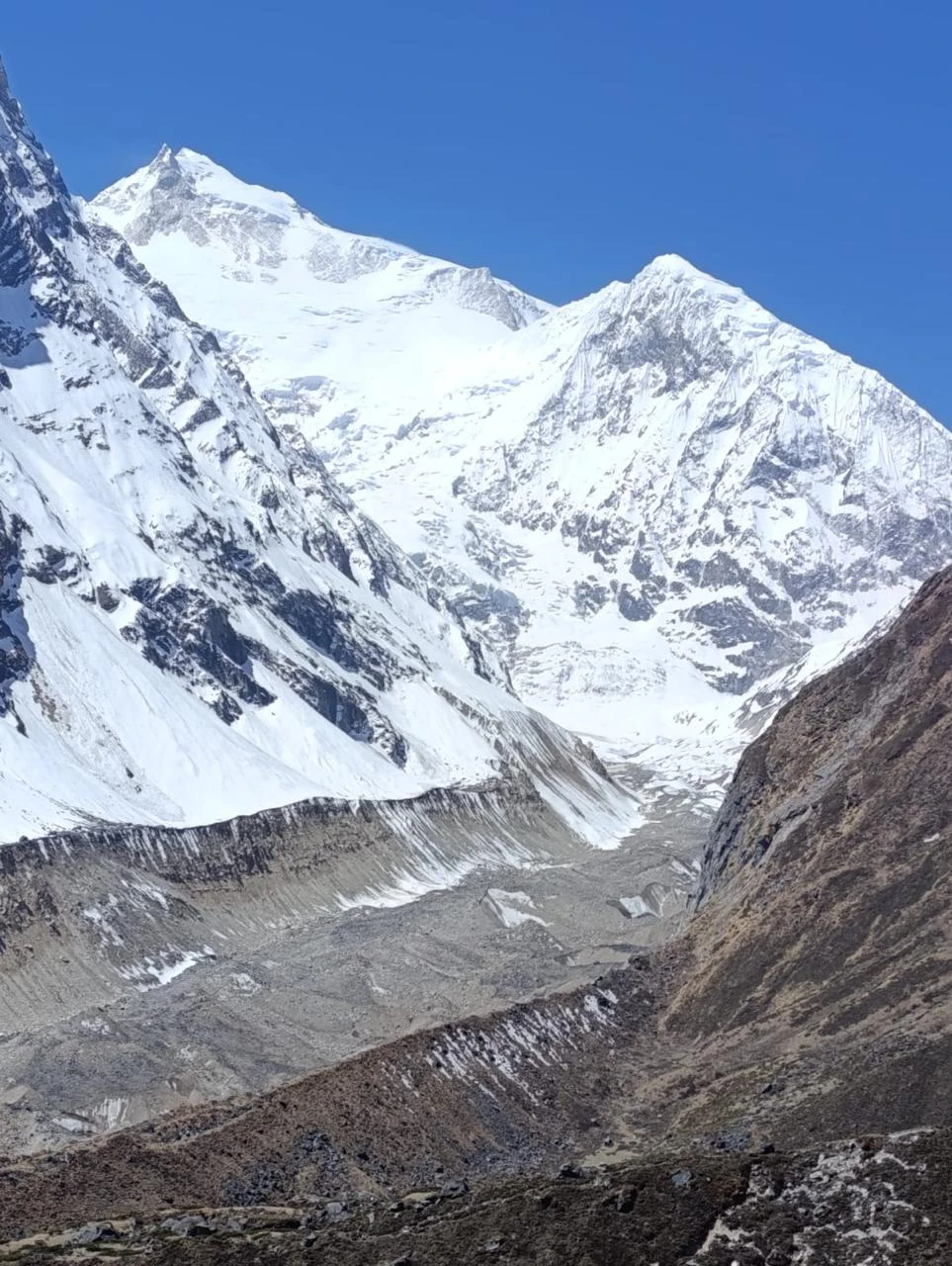
The Manaslu Circuit Trek cost and itinerary are the two things every trekker needs to understand before planning a journey around Mount Manaslu, the world's eighth-highest mountain at 8,163 meters. The route runs from the lower hills of Nepal into remote Himalayan valleys and traditional Gurung and Tibetan-influenced villages, crossing the spectacular Larkya La Pass at 5,160 meters along the way.
So how much does the Manaslu Circuit Trek cost in 2026, and how many days do you actually need? In short: a standard guided trek takes 14–18 days and costs roughly USD 1,200–1,800 per person, though the final number depends on group size, permits, accommodation, transportation, and how much you customize the route.
This guide breaks down the full Manaslu Circuit Trek cost and itinerary for 2026 — permits, accommodation, food, transportation, a day-by-day route, the best time to go, how difficult the trek really is, and what you should realistically budget.
The Manaslu Circuit Trek cost in 2026 generally ranges from USD 1,200 to USD 1,800 per person for a standard guided trek. Because much of the route lies inside a restricted trekking area, Manaslu requires additional permits and organized logistics — which makes it somewhat more expensive than unrestricted routes where independent trekking is possible.
| Trek Type | Approx. Cost per Person | Suitable For |
|---|---|---|
| Budget Group Trek | USD 1,100–1,300 | Cost-conscious trekkers |
| Standard Group Trek | USD 1,300–1,600 | Most trekkers |
| Private Trek | USD 1,500–2,000+ | Couples, families & friends |
| Customized / Premium Trek | USD 2,000+ | More comfort & flexibility |
These figures are planning estimates, not fixed prices. Permit fees, transportation, accommodation availability, group size, and itinerary changes can all affect the final quotation.
Understanding the total cost is easier once you see what it's actually made of. The table below shows an approximate planning budget for a 14-day standard guided trek.
| Cost Component | Avg. Cost per Person | Usually in Package? |
|---|---|---|
| Manaslu Restricted Area Permit | USD 75–100+ | Yes |
| MCAP & ACAP combined | USD 40–45 | Yes |
| Kathmandu – Machha Khola transport | USD 20–50 | Yes |
| Dharapani – Besisahar transport | USD 15–30 | Yes |
| Besisahar – Kathmandu transport | USD 15–30 | Yes |
| Teahouse accommodation | USD 100–180 | Yes |
| Breakfast, lunch & dinner | USD 250–350 | Yes |
| Licensed trekking guide | USD 250–400 | Yes |
| Porter service | USD 180–300 | Package dependent |
| Agency service & government taxes | Varies | Yes |
| Personal expenses | USD 100–250 | No |
| Travel insurance | Varies | No |
Typical total package cost: USD 1,200–1,800 per person.
• Permits: the Restricted Area Permit fee changes with season and the number of days spent inside the restricted zone — see the permit section below.
• Transportation: a shared local vehicle keeps costs down; a private jeep costs more but adds comfort on the rough roads to the trailhead.
• Group size: guide and transport costs are shared among the group, so larger groups usually mean a lower per-person price. Private treks cost more but give you full control over the itinerary.
• Itinerary length: extra acclimatization days, side trips, or shorter walking days add cost — but rushing the high-altitude section to save money is not a trade-off worth making.
It's also worth separating your trek package cost from your overall Nepal travel budget. International flights, your Nepal visa, travel insurance, and extra days in Kathmandu are normally additional. Look through Things to Do and Places to Visit in Kathmandu for more detail.
Tip: when comparing packages, compare total inclusions — not just the headline price. A slightly higher quote can be better value if permits, transport, meals, and guide services are already covered.
Two packages can carry very different prices while covering very different services, so always check inclusions and exclusions before booking.
• Permits: Restricted Area Permit, MCAP, and ACAP, arranged by your agency.
• Licensed guide: route navigation, teahouse logistics, altitude monitoring, and emergency coordination.
• Accommodation: teahouse rooms throughout the route, usually twin-sharing.
• Meals: breakfast, lunch, and dinner at teahouses along the trail.
• Ground transportation: Kathmandu ↔ trailhead, by bus, shared jeep, or private jeep depending on the package.
• Porter service: where included, covers the porter's salary, food, accommodation, and insurance.
• Government taxes and agency charges.
• Extras: often includes basic first aid, a duffel bag, trekking map, certificate, airport transfers, and a pre-trek briefing, depending on the operator.
• International flights and Nepal tourist visa.
• Travel insurance (must cover high-altitude trekking and helicopter evacuation) — see ou r complete overview of travel insurance for trips to Nepal before you book..
• Personal trekking gear — boots, down jacket, sleeping bag, poles, and similar items.
• Personal expenses: Wi-Fi, hot showers, charging, snacks, drinks, laundry, souvenirs.
• Tips for your guide and porter.
• Emergency helicopter evacuation — this is exactly why proper travel insurance matters.
• Are all required permits included?
• Is transportation included from Kathmandu to the trailhead and back?
• Are accommodation and three daily meals included?
• Is a licensed guide included throughout the trek?
• What additional expenses should I expect to pay personally?
If a company can answer all five clearly, you're in a much better position to compare packages on value rather than price alone.
Permit requirements are one of the biggest reasons the Manaslu Circuit Trek cost differs from other Nepal routes. Because the trail passes through a restricted area, international trekkers need three permits: the Manaslu Restricted Area Permit (RAP), the Manaslu Conservation Area Permit (MCAP), and the Annapurna Conservation Area Permit (ACAP).
Covers the section between Jagat and Samagaun. The fee depends on season and the number of days spent inside the restricted area, and must be arranged through an authorized trekking agency rather than independently.
| Season | First 7 Days | Each Additional Day |
|---|---|---|
| September – November | USD 100 | USD 15 |
| December – August | USD 75 | USD 10 |
Required once you enter the Manaslu Conservation Area. Standard fee for foreign nationals: NPR 3,000 per person.
The classic circuit continues past Larkya La toward Dharapani, entering the Annapurna Conservation Area, so an ACAP is generally required too. Standard fee for foreign nationals: NPR 3,000 per person.
Do you need to arrange these yourself? Not if you're trekking with an agency — your operator handles the permit process and paperwork ahead of the restricted section, so you can focus on the trek itself rather than the bureaucracy.
These aren't just administrative fees: the restricted-area system regulates tourism in an environmentally and culturally sensitive part of Nepal, which is also why Manaslu remains considerably less commercialized than better-known routes like Everest Base Camp or the Annapurna Circuit.
A well-paced Manaslu itinerary usually runs 14–18 days depending on transportation and acclimatization needs. The classic route follows this progression:
Kathmandu → Machha Khola → Jagat → Deng → Namrung → Lho → Samagaun → Samdo → Dharamsala → Larkya La Pass → Bimthang → Dharapani → Besisahar → Kathmandu
| Day | Route | Duration | Overnight |
|---|---|---|---|
| 1 | Kathmandu → Machha Khola | 7–9 hrs drive | Machha Khola |
| 2 | Machha Khola → Jagat | 6–7 hrs | Jagat |
| 3 | Jagat → Deng | 6–7 hrs | Deng |
| 4 | Deng → Namrung | 6–7 hrs | Namrung |
| 5 | Namrung → Lho | 4–5 hrs | Lho |
| 6 | Lho → Samagaun | 5–6 hrs | Samagaun |
| 7 | Acclimatization at Samagaun | Short hike | Samagaun |
| 8 | Samagaun → Samdo | 3–4 hrs | Samdo |
| 9 | Samdo → Dharamsala | 4–5 hrs | Dharamsala |
| 10 | Dharamsala → Larkya La → Bimthang | 8–10 hrs | Bimthang |
| 11 | Bimthang → Dharapani | 6–7 hrs | Dharapani |
| 12 | Dharapani → Besisahar | 4–6 hrs drive | Besisahar |
| 13 | Besisahar → Kathmandu | 6–8 hrs drive | Kathmandu |
| 14 | Departure | — | — |
The exact walking hours vary with trail conditions, weather, and pace — treat this as a framework, not a rigid schedule.
• Days 1–6 (Kathmandu to Samagaun): the trail follows the Budhi Gandaki River, with landscape shifting from terraced hills to alpine forest and Tibetan Buddhist villages like Namrung and Lho. Walking days shorten as altitude rises — that's intentional pacing, not a lack of ambition. For more on the region's route, culture, and geography, see our detailed guide.
• Day 7 (Acclimatization at Samagaun): one of the most important days of the trip. A short hike — to Birendra Lake, Pungyen Gompa, or a Manaslu Base Camp viewpoint — while sleeping at the same elevation gives your body time to adapt.
• Days 8–9 (Samagaun to Dharamsala): the landscape turns barren above the tree line as you move through Samdo toward Dharamsala (also called Larkya Phedi), the final stop before the pass.
• Day 10 (Larkya La crossing): the defining day of the trek. An early start, a long ascent to 5,160 meters, and a substantial descent to Bimthang — pacing matters far more than speed here.
• Days 11–14 (Descent and return): the trail turns green again toward Dharapani, then road transport carries you back through Besisahar to Kathmandu.
Fourteen days works well for experienced trekkers or those on a tighter schedule, but shorter isn't automatically better at high altitude. If you'd prefer shorter walking days, extra acclimatization, or more buffer for weather and road conditions, a 16–18 day itinerary is often the better fit. If you have extra time, pairing the circuit with the Tsum Valley extension adds a culturally rich detour that few trekkers ever see. Adventure A One Treks can adjust the pace, overnight stops, and transportation around your available time rather than treating 14 days as the only option.
Because the route reaches 5,160 meters at Larkya La, timing affects more than mountain views — it affects trail conditions, temperatures, and whether the pass is safely passable at all. Spring and autumn are the best seasons overall — for a full month-by-month breakdown, see our complete seasonal guide to the Manaslu Circuit.
| Season | Months | Conditions | Recommendation |
|---|---|---|---|
| Spring | March – May | Mild, clear, rhododendrons in bloom | Excellent |
| Summer / Monsoon | June – August | Rain, landslides, poor visibility | Less suitable |
| Autumn | September – November | Clear and stable | Best |
| Winter | December – February | Cold, possible snow at the pass | Experienced trekkers only |
Autumn (Sept–Nov): generally the best overall season — clear skies, stable weather, and comfortable daytime temperatures, though it's also the busiest period on the trail.
Spring (Mar–May): pleasant conditions and blooming rhododendrons, with March and April especially attractive; May tends to warm up and cloud over as monsoon approaches.
Winter (Dec–Feb): possible but significantly harder — sharp cold, snow risk at Larkya La, and more limited accommodation at higher settlements.
Monsoon (Jun–Aug): muddy trails, landslide risk, and unpredictable transportation make this the least practical window for most travelers.
If you want the simplest answer: October and November are the strongest overall choices, with April as the top spring pick. Your own priorities — photography, fewer crowds, cooler temperatures — should still shape the final decision.
The Manaslu Circuit is a challenging high-altitude trek. It doesn't require technical mountaineering skills, but it does demand good fitness, preparation, and the ability to handle several consecutive days of walking in remote terrain. The difficulty comes less from any single steep climb and more from the combination of long days, changing terrain, rising altitude, and the Larkya La crossing itself.
• High altitude: the trek climbs from low elevation past 3,000 meters to the high settlements of Samdo and Dharamsala. A built-in acclimatization day at Samagaun helps your body adjust — recognizing altitude sickness symptoms early and telling your guide is essential.
• Larkya La Pass: at roughly 5,160 meters, this 8–10 hour day is the physical and mental highlight of the trek — a long ascent followed by a substantial descent to Bimthang. Curious how it compares to other high Himalayan crossings? Read The Valley of Peace vs. The Gateway of Ice: Tsum and Larkya La.
• Long walking days: most days run 5–7 hours; the difficulty is doing that repeatedly for nearly two weeks, not any single day.
• Remote trail conditions: rocky trails, suspension bridges, stone staircases, and terrain that can shift quickly after rain or snow.
• Basic accommodation: simple rooms, shared bathrooms, and limited hot water and electricity, especially at higher elevations.
| Trek | Difficulty | Main Challenge |
|---|---|---|
| Ghorepani Poon Hill | Moderate | Uphill sections |
| Langtang Valley | Moderate | Altitude and long days |
| Everest Base Camp | Challenging | Altitude and duration |
| Annapurna Circuit | Challenging | Altitude and Thorong La |
| Manaslu Circuit | Challenging | Altitude, remoteness, and Larkya La |
Some beginners complete the Manaslu Circuit successfully, but it isn't a trek to approach casually. A first-time high-altitude trekker should prepare properly, choose a sensible itinerary, and trek with an experienced guide. Before you go, focus on cardiovascular endurance, leg and core strength, and comfort walking with a loaded backpack. For more detail, read our full Manaslu Circuit Trek for Beginners guide.
• Train beforehand: combine long walks, stair climbing, hiking, and cardio for several weeks — build up gradually rather than cramming in the final week.
• Don't rush the altitude: a slower itinerary is a better investment than an aggressive schedule.
• Carry only what you need: let your porter handle the main luggage and keep only daily essentials in your daypack.
• Listen to your guide: communicate early if you're feeling unwell — don't push through a problem to avoid slowing the group.
Most nights are spent in local teahouses and mountain lodges — see what to expect from Nepal's teahouses for more detail. Lower elevations offer more choice and somewhat better facilities; options narrow as you climb toward Samagaun, Samdo, and Dharamsala. A typical room includes two single beds, a mattress, pillow, blanket, and basic furniture, usually with a shared bathroom — especially at higher altitude. Private rooms are available at many lower teahouses but aren't guaranteed during busy seasons, which is why having accommodation coordinated in advance helps.
Most teahouses offer a surprisingly broad menu at lower elevations, narrowing as supply logistics get harder higher up. Common dishes include dal bhat, momos, noodles, fried rice, pasta, thukpa, Tibetan bread, and eggs.
Dal bhat — rice, lentil soup, vegetables, and sides — is the trekker's classic: filling, widely available, and reliable throughout the route.
Prices rise with altitude because supplies have to be carried in, so it's worth packing a few lightweight snacks (energy bars, nuts, dried fruit, electrolyte sachets) for the higher days.
Use a reliable purification method — tablets, a portable filter, or a UV device — rather than relying on untreated natural water. Tea (black, milk, ginger, lemon) and coffee are available throughout, though prices climb and availability narrows at higher elevations.
A simple daily rhythm: eggs, Tibetan bread, or porridge for breakfast; dal bhat, noodles, or pasta for lunch; tea and snacks in the afternoon; dal bhat, soup, or momos for dinner. Appetite often changes at altitude, so smaller, more frequent meals can be easier than forcing down a large one.
The trailhead isn't directly accessible from Kathmandu, so transportation is built into the itinerary on both ends. The trek begins with a 7–9 hour road journey from Kathmandu to Machha Khola by local bus, shared jeep, or private jeep. After crossing Larkya La, the trekking section ends around Dharapani, from where you travel by road to Besisahar and back to Kathmandu. For a full breakdown of options and costs, see our transportation guide to the Manaslu region.
Shared jeeps keep costs down; private jeeps add comfort and flexibility, particularly for families and private groups. Mountain road conditions can shift, especially in monsoon, so travel times should always be treated as approximate rather than fixed.
The route crosses several climate zones, from warm lower valleys to the cold, high-altitude terrain around Larkya La. Pack in layers, and avoid carrying things you won't actually use — your porter can take the main load, but your daypack should stay light.
• Comfortable, broken-in trekking boots
• Moisture-wicking base layers and a fleece or insulating mid-layer
• Warm down jacket and waterproof jacket/trousers
• Warm gloves, hat, and socks
• Cold-weather sleeping bag and trekking poles
• Sunglasses, sunscreen, headlamp with spare batteries
• Reusable water bottle or hydration system
• Personal medication, basic first-aid supplies, and a power bank
Some gear can be rented or bought in Kathmandu, which is useful if you're traveling internationally with limited luggage.
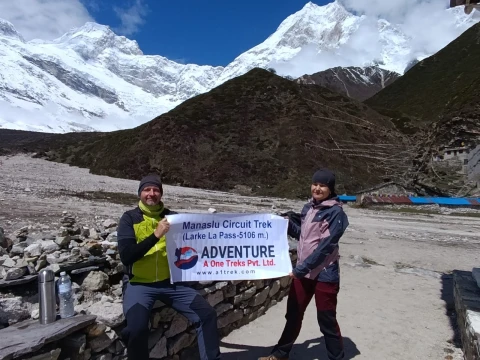
Booking the Manaslu Circuit isn't just a matter of landing in Kathmandu and starting to walk — permits need arranging, transportation has to be coordinated, and the itinerary needs sensible acclimatization built in. Adventure A One Treks is a Nepal-based operator that builds each itinerary around your available time, trekking experience, group size, preferred pace, and budget rather than defaulting to a fixed schedule.
• Trek planning built around you: extra acclimatization days, private transportation, or family-friendly pacing can all be discussed before you book.
• Support beyond the booking: permit preparation, transportation coordination, and guide support throughout the trek, with a single team to turn to if plans change.
• Transparent quotes: clear information on what's included and excluded, so you can compare options and know exactly what you're paying for.
If you're still deciding, you don't need to commit to a fixed package right away — share your preferred dates, group size, and expectations, and the team can help you work out what itinerary fits. If Manaslu isn't the only route you're weighing, our roundup of the best treks in Nepal for 2026 is a good place to compare it against other options.
Ready to start planning? Explore the full Manaslu Circuit Trek itinerary, inclusions, and departure dates, or if you already know this is the trek for you, book your Manaslu Circuit Trek with Adventure A One Treks directly and the team will take it from there — permits, transportation, and guide arrangements included.
It's helpful but not mandatory. What matters more is physical preparation, comfort with several consecutive days of walking, and following a sensible acclimatization schedule.
No. The restricted-area regulations require foreign trekkers to be accompanied by a licensed guide, which is one reason booking through a registered agency matters.
Most days involve about 4–7 hours of walking; the Larkya La crossing is longer, typically 8–10 hours depending on conditions and pace.
Coverage exists in parts of the route but is limited and unreliable in remote and higher sections. Wi-Fi is available at some teahouses but can be slow — don't plan around continuous connectivity.
Not reliably. Carry enough Nepali cash before entering the remote sections, since card payments and ATM access are limited.
Yes, at many teahouses, though availability narrows at higher elevations and there's often a small fee — a power bank is a smart backup.
Yes, though restricted-area rules mean your arrangements must comply with required guide and group regulations. Solo travelers commonly join a group or arrange a private guided trek through a registered agency.
Age alone isn't the determining factor — fitness, trekking experience, and acclimatization matter more. A comfortable, unhurried itinerary is a smarter choice than rushing the route.
It's generally quieter than Everest Base Camp or the Annapurna Circuit, though the trail does get busier during peak spring and autumn seasons.
Larkya La Pass, at approximately 5,160 meters (16,930 feet).
Several weeks to a few months ahead is sensible for peak-season travel, especially for private groups or fixed dates — earlier booking also gives your agency more time to arrange permits and guides.
Yes. Adventure A One Treks can adjust the number of days, pace, transportation, and overnight stops around your available time, trekking experience, and preferred comfort level.
Planning your Manaslu Circuit Trek? Share your travel dates, group size, and expectations with Adventure A One Treks, and the team can help you build an itinerary and cost estimate that actually fits your trip.